• About
  • Photographs
    • In Praise of Agiofili Beach
    • Corfu’s Most Beautiful Village?
    • Making a splash in Vassiliki

Andy James

~ A Writers Journey

Andy James

Author Archives: andyjameswriter

Trek day 6: over the Jungben La to Nulungsumda Kharka

02 Friday Dec 2016

Posted by andyjameswriter in Dolpo trek

≈ Leave a comment

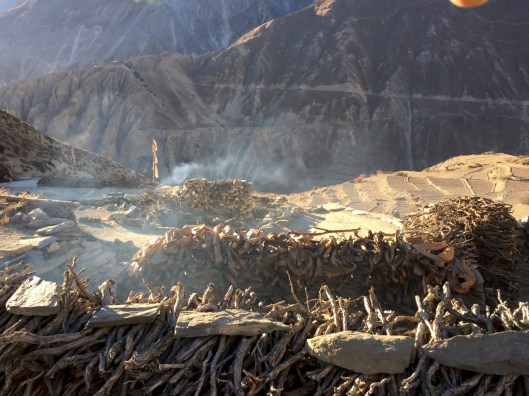
Today we needed an early start. Nobody really knew how they would perform at over 5,500m (18,044ft) and it was important to leave plenty of time in which to cross the pass and still make the night stop before dark. To that end Gyalbu and Sangye were especially vigilant and brought bed tea at 5:30 and we were up and eating our favourite tsampa porridge (ahem) by 6 am. It was barely light. By 7:30 we and the horses were packed and we set off into the morning sunshine. It was still cold at this hour and the smoke from several villagers’ chimneys was curling and snaking around the stone walls and prayer flags.IMG_2659.jpg

Our hostess was out on her roof to see us off and there was much Namaste-ing and steepling of hands by way of farewell. As we left the village we found most of the children all there, waving and saying either ‘Namaste!’ or a simple ‘bye-bye’. It was really quite emotional.

Then it was down into the small gorge, over the river which was the scene of yesterday’s yak crossing drama, and up the other side. Forty minutes later we had reached Blue Shack campsite, aka Ghalden Ghulden Khola camp, and the others were agreeing with me that we really didn’t miss camping here among other people’s detritus.

The slopes of the Gharchowk Chuska Danda ridge were now ahead of us, dusty dark green and reddish-brown low scrub giving way with height to bare sandy and grey rock, boulders, grit and dust. Spindly sandy and stony paths diappeared into the distance making the Jungben La look every centimetre of the 1300 metres height difference from here to the pass. Head down. One step at a time. Keep drinking. Find a rythym like Gyalbu. OM! MANI PADME HUM, OM! step step step. The monotony of the toil was broken several times by sightings of Himalayan snowcocks, a large grey partridge-like bird of the pheasant family found across the Himalayas.

I found myself going well and as I had a camelback rather than bottled water I could drink on the go and didn’t need to stop for water breaks. I also found it easier to gain height and distance steadily. So I kept going: step, step, step, step and soon found myself well ahead. At about 11 am I stopped for a while to let Sangye, the temporary hoseman and the pack overtake and to take in the views. The horseman knew the way after all, although there really weren’t any route choices. Just upwards ever upwards.

As we had gained height through the morning while the view ahead remained hidden behind the ridge and its pass the vista behind grew from significant, through astounding to its present full-blown magnificence. Looking back I could trace our route over the past 3 days and took this photograph. Through the centre of the picture from foreground to middle ground the Kyalunpa Khola gorge cut like a jagged saw, its northern bank mostly in shadow and its southern bank in sunshine. At the far end of the gorge was the milder-looking Kali Gandaki valley where we had started from Kagbeni 3 days ago and before there, Jomsom 5 days ago. The mountains beyond were crowned with snow with the inviting cup of the Thorung La to the right. Returning to the foreground, at the bottom centre-left in an area of scrub I could just make out the Blue Shack which we had passed nearly 3 hours previously. Above it was the scrub-traversing track that led to the little gorge and beyond it perched Ghok on the next plateau. On the opposite (dark) side of the major gorge I could see the precipitous mountain-hugging track the we and the yaks had taken to reach Ghok from Pilling 2 days ago. Beyond that track, shown at the left-centre of the photograph on a plateau on the right-hand bank of the gorge was Pilling itself, identifiable from the extensive terracing and the gritty track sneaking over the escarpment into the distance. Utterly magnificent and likely to be the last time I would see it.IMG_2683.jpg

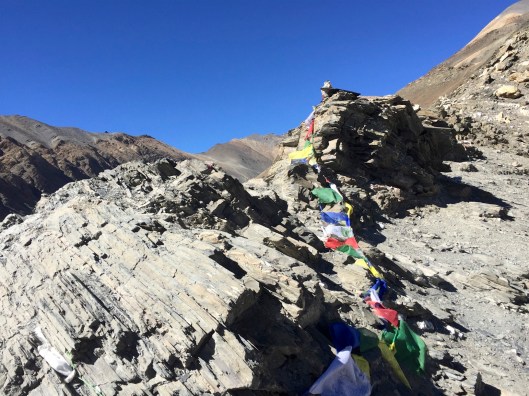
Looking back to the front I could see the last few metres to be climbed before reaching the pass. Sangye and the ponies were already over while Gyalbu and my mates were not yet in sight below. I had this extraordinary place to myself and with joy I strode to the top where the Jungben La was adorned with prayer flags and across into Dolpo.IMG_2706.jpg

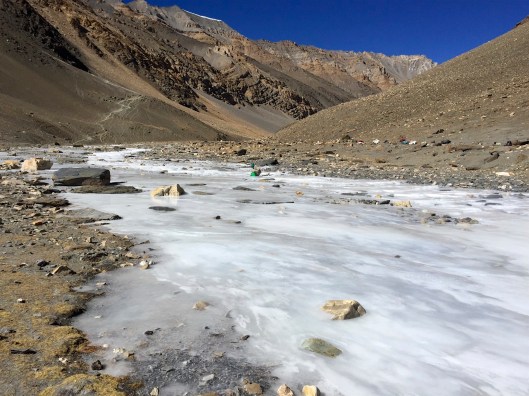
Thirty minutes and a couple of miles later I caught up with Sangye and the pony team, but only because they had stopped to prepare lunch beside the Bheri Khola which was mostly frozen. While Sangye prepared the food our temporary horseman was on the ice trying to fill our green bucket with water, which he did eventually. It was distinctly muddy and not ideal for consumption. I was glad I still had some of my own from Ghok. The track back to the Jungben La was distinct being a light sand colour against the darker rock of the mountain and that made it easy to spot the other trekkers when they appeared not long after.IMG_2720.jpg

After our lunch of Wei Wei noodles at around 1 pm, hurriedly consumed as time was moving on and it was bitterly cold, we continued smartly west. Mark had been sick at lunchtime although he maintained it was due to bolting his food which was today particularly heavily laced with whole garlic cloves rather than any illness, and so it proved as there was no repeat.

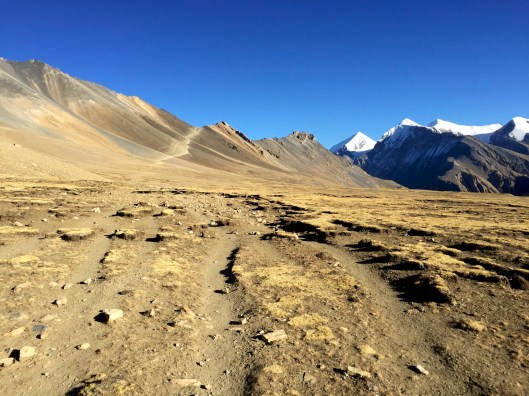
Crossing our second high pass of the day, the 5120m (16,798ft) Niwas La at around 3:15 we instantly noticed a difference of vegetation. Gone now was the grey stone and grit of Mustang and in its place we found pasture, or at least what would be pasture if it was at a lower altitude in a warmer clime. The photograph below taken at around 4 pm shows that while the sky remained azure blue with not a cloud in sight, looking back the snow-capped mountains to the east were in sharp contrast to the gentler region in which we now found ourselves.IMG_2735.jpg

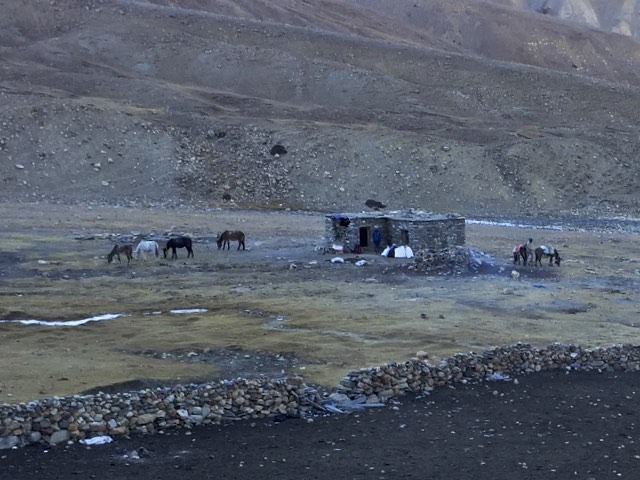
An hour later on this long hard day I once more found myself in the company of Sangye and the horseman with his string at Nulungsumda Kharka. This was the camp for the night marked only by a drafty but functional stone shelter on the desolate south-west bank of the Thasan Khola. At least we could prepare food inside, out of the biting wind. The pony and mules were unloaded and they were soon eating what little vegetation survived at this height while Sangye fetched water from the river.IMG_2739 - Version 2.jpg

I quickly put up my tent and once the water was on to boil Sangye erected Lizzie’s. While together we set-up Jovi’s tent we mused that it was odd that we had seen no other trekkers or local people since leaving Ghok. It wasn’t that unusual not to see people going our way but not to see anyone at all going from west to east towards Kagbeni for a whole day was a first and we wondered why. During this speculation Tim arrived and between us we completed the remaining tents while the horseman fed his string. Shortly after dark Jovi, Mark and Lizzie came into camp with Gyalbu, unsurprisingly tired but delighted to find their tents ready.

Once kit was stowed we piled into the stone shelter and huddled together on the floor at one end for warmth, head-torches acting as a weak floodlight for Gyalbu and Sangye while they made tea. The main topic of conversation was food; more particularly food fantasy. Particlar items mentioned were a big meat pie and mushy peas (Lizzie), Jamie Oliver’s roast chicken breast stuffed with Roule cheese (Mark), a plate of Momos – Asian meat filled dumplings (Jovi) and (from me) a smoked salmon and cream cheese brown bread and butter sandwich. I think all of us were missing meat without bone and gristle – and we were still only in week 1! Then Tim proposed Dal Bhat, a Nepalese lentil curry, and amidst a howl of good natured derision he made Chinese chicken with rice from our ‘Look What We Found’ supplies that I had couriered to Jovi in advance of the trek. There was plenty of it and there were no bones. Delicious!

Following a (small) mug of Raksi which the amazing Gyalbu had brought from Ghok a tough day was brought to an end. Everyone was in their sleeping bag by 7:15. Under normal circumstances such an early night would be unthinkable but these circumstances weren’t normal. We were tired and it was very cold outside.

Tomorrow, with any luck, we shall be at Chharka Bhot, a village 600m lower but well over 20 miles away. Looks like another early start!

Trek day 5: Resting in Ghok

01 Thursday Dec 2016

Posted by andyjameswriter in Dolpo trek

≈ Leave a comment

As the last 2 days have been fairly tough and while we continue to acclimatise ready for the push over Jungben La tomorrow, today, Monday 7th November, is a rest day. Despite that, following another chilly night Gyalbu and Sangye brought us bed tea at 6:30 and several refills thereafter. Once the sun hit our tents at 7:30 there was no further excuse for laziness and we were up and ready for breakfast. Today I managed the amount of tsampa added to my tea, finding that 2 spoonfulls is plenty to get a drinkable consistency. Mmm yummy tsampa porridge. Cue another bout of food fantasy.

The night hadn’t only been chilly but noisy too with one of the village Nepalese mastiffs barking ferociously most of the night. It is usual for nomads’ camps and remote villages to be guarded by big black or brindle mastiffs. I understand that these are so fierce that travellers carry a charm portraying a savage dog in chains. During the day these dogs are chained but at night they roam free as sentinals and guards. What we had heard all night was a dog at work. Sometimes close and sometimes at some distance, first in one direction then another. It was particularly frantic just after midnight when it sounded to be some way up the hill directly behind our tent compound, after which its ire subsided a little. In the morning we learned from a villager that a yak had been killed up there during the night by a snow leopard. That would certainly explain the dog’s excitement!

After an hour or so of taking photographs of the village in early sun, generally messing about with the solar charger and trying to figure out why my satphone posts hadn’t been getting through to the blog I finally had success with the latter. The penny dropped that there was a limit on how many characters could be sent before the satphone re-inserted the email address; an action that caused the post to fail. This didn’t happen normally and impacted only the satphone. Thus I had to limit each satphone email post to a single block of text comprising less than 100 characters. I was pleased at last to be able to send an update on where we were and let folks know we were fine. It was very basic, saying ‘Hi all, we are in the village of Ghok near Santa and all is well. More to follow if this post is successful’. I knew by then that there was no village called Santa but that is where my earlier posts had said we would be so I figured I would refer to it to avoid any concern at home about us being off route. We were after all still in the Santa area which comprised Pilling and Ghok. If I could have posted photographs of Ghok these 2, both taken at about 9 am, would have been my selection.

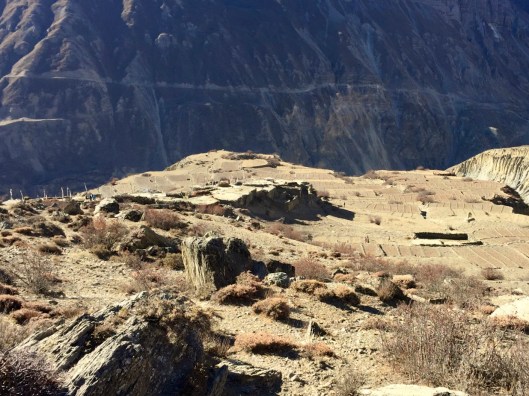
First the view of the village from further up the mountain when I went to the spring for water. Children are playing in the dry and dusty terraced fields centre right and the escarpment we crossed testerday is beyond. At centre left (although very small) may be seen some of our group on the roof where our tents are pitched.IMG_2591.jpg

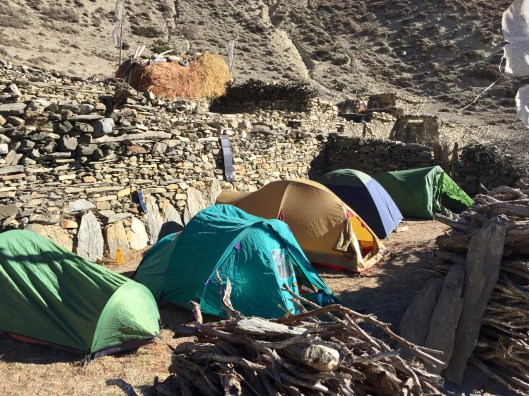
Second our tents (L to R) Mark’s, Lizzie’s, mine, Jovi’s and Tim’s next to piles of juniper firewood with solar chargers hanging on the wall to catch the best sun.IMG_2603.jpg

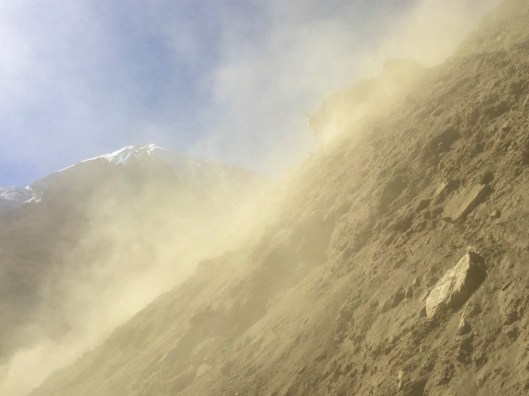
At mid-morning with the hot sun high in the sky Lizzie and I took the opportunity to rinse some of the thick dust out of our clothes and maybe give the wet wipes a break from cleansing duty. Tim was going to join us but in the end asked us to rinse some of his stuff too, which we did. We headed down the steep path to the bottom of the little gorge we had crossed just outside the village for a wash. There being nobody else in sight we found our own spaces down by the side of the river and, separated by 20 feet or so and each facing in opposite directions, removed enough to be able to make the most of clean running ice cold water. Much of the river was frozen but there remained enough of a flow to rinse the clothes removed and drape them over a warm rock to dry out a little then splash ourselves and towel dry before putting on glorious, warm, clean and fresh underwear, socks and t-shirts. It was quite an operation but the opportunity to get some of the dust off ourselves and feel clean again (even if we weren’t really) was very welcome. After 20 mins or so boots went back on and our still wet washing was put into a plastic carrier bag and we headed back to the crossing. As we were negotiating the best route we heard a loud and urgent cry from above. Looking up we could see nothing but a cloud of dust – then the cry came again with more urgency and we realised something serious was afoot. Then, not more than 30 feet above us, a pair of yak horns appeared, followed by a head and the body moving at speed in our direction. Recognition of the situation was instant – a herd of yaks were being driven down the hill above us and we were directly in their path through the little gorge and up the other side to Ghok! Lizzie and I dashed upstream as far as we could go just as the lead animals careered down the last few feet of the hillside and barreled across the river. There was dust and mayhem everywhere and we were so lucky that the herders had seen us in time to raise the alarm. In the event we had a ringside seat at an amazing spectacle that could hardly be seen due to the dust. After it was over we had a huge laugh about the diligence we had exercised in getting clean only to be covered in grime again not 5 minutes later. At least the washed clothes were in a bag and had remained clean even if we hadn’t.IMG_2624 - Version 2.jpg

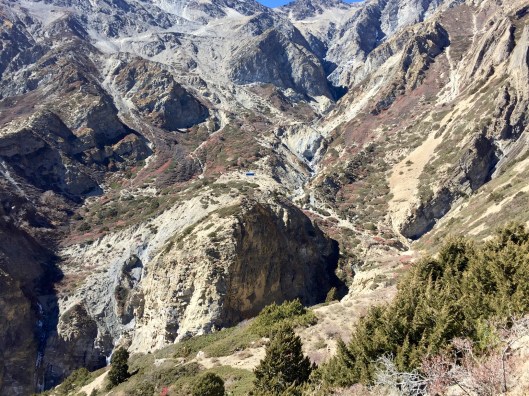
After returning to the village and enjoyjng a customarily early lunch of buckwheat bread, yak and potato soup and tea my restlessness got the better of me and I went for a walk. Our route tomorrow would take us past what the trekking map referred to as Ghalden Ghulden Khola camp but which we now knew as the blue shack. As this was only a couple of miles away it was only a pleasant stroll in the sunshine away. This is the view of the blue shack from the westard side of the little gorge where Lizzie and I encountered the yaks earlier. The shack may be seen in the centre of the picture. The approach is from lower right and the onward route to Jungben La may be seen above.IMG_2633.jpg

Once I reached the shack I was delighted that we hadn’t stayed there as had been the original plan. It was a tip. Quite why fellow trekkers would come all this way, paying considerable money for the priveledge and committing significant time to do so, and then strew litter is beyond me.

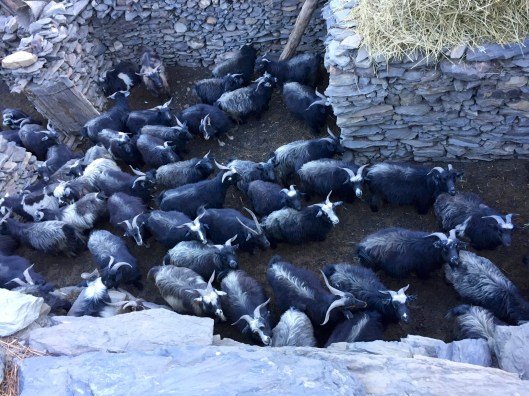
From the campsite, rather than start up the trail to the pass I went towards the gorge and up a hill on top of which I could see a small chorten. Once there I was checking directions and distances on the GPS when I became aware of a herdsman calling to a sizeable flock of goats coming down the mountainside towards me. After a few mnutes he left the flock and came over to my vantage point and sat down. There followed several minutes of conversation, or attempted conversation given he had no English and I have no Nepali beyond ‘Namas-te!’ and ‘Tashi Delay’. Namaste is an ancient Sanskrit greeting still in everyday use in India and especially on the trail in the Nepalese Himalaya. Translated roughly it means “I bow to the God within you”, or “the Spirit within me salutes the Spirit witin you”. Tashi delay is a Tibetan greeting that means ‘I honour the greatness in you’. So we exchanged greetings and names, me introducing myself as memi tsamba, then struggled thereafter. However we were able to establish that we were both going to Ghok and would sleep there tonight. We then smiled and nodded and bade each other Namaste (which serves for hello and goodbye) and I headed back to Ghok leaving the herder with his flock. Sure enough, later that day a flock was driven into the compound below our tents and I recieved a cheery wave and call from the herder as he arrived. Regrettably he declined a photo but I will treasure the cameo of our faltering discussion on that remote hillside in the sunshine. It really doesn’t matter that we couldn’t actually converse as there was a level of understanding between us that was beyond words.IMG_2653.jpg

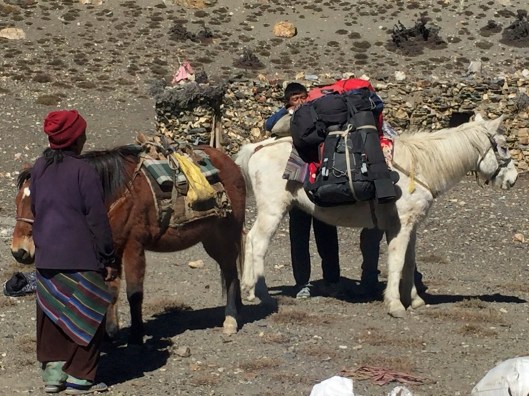
In the afternoon sun I put my sleeping bag on the roof of my test to air in the warmth and solar charged all my tech: iPhone, GPS, satphone and iPod. Remarkably, not long afterwards our replacement pony and mules arrived a day earlier than expected and with a different horseman to the one with whom Tim and Jovi had negotiated. How he had managed it we don’t know but the horseman they spoke to had managed to split his string of animals so that 6 were made available to us immediately with a deputy horseman while the leader continued to Kagbeni with a reduced string supporting the Aussies. He would then return to support us while the deputy took the spare nags back to Juphal. This was remarkable planning and we were delighted. The owner of our original 3 ponies was also delighted that he wasn’t going to have to go over (and return over) the Jungben La. Everyone was happy. The original horseman was paid and released, the replacement string of 6 nags would enable our Sherpas not to be over-burdened, and we trekkers could continue with relatively light day sacks. Result!

While all this was going on Sangye was entertaining a group of village children with card tricks until Lizzie’s Go-Pro proved more of a draw. I sneaked this picture while she was filming and Sangye reluctantly put the cards away.IMG_2647 - Version 3.jpg

During the afternoon, in the margins of the excitement over horses, there were also frequent trips up the hill to pee. The acclimatisation process, and more importantly protection against the effects of altitude, requires the consumption of 3 to 4 litres of water a day all of which needs to be sterilised prior to drinking. That much water together with frequent cups of diuretic tea has a predictable result but going to the loo in rural Nepal is never a problem, at least not for chaps. There are no toilets, not even in peoples houses in places like Ghok. You just find somewhere outside the village and ‘go’. Commonsense is required and discretion is appreciated. For a pee you don’t go in or close to a river and the girls go a little further away in search of privacy than the boys, but in a barren landscape distance and mutual discretion may be the only privacy available. Where solids are involved then the distance needs to be greater and subsequent burial of all materials under a rock or mound of earth is expected not least as it serves to show where the best places to go are. In a land where toilets, even the long-drop variety, are few and far between, animals are everywhere, and their dried dung is the best almost smokeless fuel around, one soon gets used to the absence of Western mod-cons. But thank goodness for wet-wipes. The rural Nepalese don’t have those either and appear generally indifferent to their and their childrens’ cleanliness, but when shrouded in dust within moments of each wash, hands are forever grimy and icy river water doesn’t appeal, wet-wipes are an essential item in every trekkers pack.

Moving to more savoury matters, in late afternoon we once again ate with the family living beneath us. We had another delicious yak and potato soup but this time served with spicy rice; and there was plenty of it. As yesterday the lady did all the work while the men, mostly ‘old grandfather’, talked with Tim and Gyalbu. As tomorrow was to be a long and tough day we didn’t tarry after dinner although we did stay for some Raksi of course. Once dinner was over we departed at a time that enabled the family to eat before it got too late. Remarkably by 7pm we were all in our tents; probably in sleeping bags too as the temperature drops sharply once the sun goes down. Some people were reading. I was listening to music on my iPod and making pencil notes from the day in my notebook. Others went straight to sleep in preparation for early morning bed-tea.

This would be our last night in Mustang. Once over the Jungben La we shall at last be in Dolpo!


Memi tsamba: Trek day 4 to Ghok

30 Wednesday Nov 2016

Posted by andyjameswriter in Dolpo trek

≈ 6 Comments

After a chilly night I think everyone was very glad when light appeared in the sky over Pilling and the sun peeked its warming face over the mountains to our east. Even then, tucked as we were into the animal compound with its 5 to 6 feet high walls, it was nearly 8 am before we felt any warmth and could air our sleeping bags on the roofs of our tents. Not that it had rained during the night – far from it – we had a dry night with a completely clear sky and a breathtaking number of stars twinkling above. The Milky Way was so abundant in these conditions of zero light pollution it appeared to be a hazy cloud above our heads rather than the distant outer reaches of our own galaxy. Nonetheless damp sleeping bags resulted from condensation in our tents due to the coldness of the air.

At around 7:30 Gyalbu and Sangye brought us ‘bed tea’ to encourage mobility among those who hadn’t already been forced by other pressures to rise. Their strong black tea and jovial exhortations to action did the trick and by 8 am we were enjoying tsampa porridge. This gloopy breakfast, Nepalese internal central heating, comprised several tablespoons of tsampa mixed into a bowl of hot tea.

Tsampa is roasted maize or barley meal ground to powder. In a relatively thin mixture it is just about drinkable and can be downed quickly. Any thicker and it needs to be spooned. Thicker still and it refuses to mix and is taken in lumps. Tsampa porridge at its thickest is an acquired taste that has eluded me and many of the team, although Tim swears by it as the perfect start to the day and takes it thicker than most. Either way that is what we have for breakfast and we each made of it what we could in the absence of a ‘full English’. Our food fantasies started at about this time, just 24 hours out of Kagbeni, and with these we filled many an hour on the trek.

Rucksacks were packed and any still-damp sleeping bags were stowed by 9 am and by shortly after the ponies were loaded and they, and we, were heading west in the sunshine. Our target for the day was the village of Ghok. Not formally on the Great Himalayan Trail, Ghok was to be a stepping stone as it was still a little soon in our acclimatisation program to head directly over the 5550m (18,209ft) Jungben La around 1800m (5,905ft) higher than Pilling. The Jungben La can be clearly seen in the photograph below, indicated by the narrow sandy track heading into the pass to the right of the apparent ‘rhino horn’ in the top centre of the photo. You will appreciate its height and size when I tell you that the Jungben La is around 7 miles as the crow flies from Pilling where the photo below was taken. It shows Tim and Lizzie striding out first thing, with Gyalbu ahead passing the chorten to its left.IMG_2424.jpg
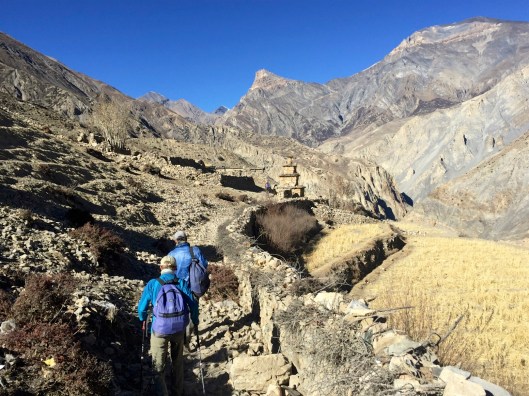
Chortens are Buddhist commemorative monuments seen all over Asia, from huge and rich chortens in important city temples to small, typically battered, structures alongside remote mountain trails. Also known as stupas these are typically mound-like or hemispherial structures containing relics used for meditation. Sometimes they are decorated by mani stones which are flat stones or boulders upon which the Buddhist chant OM MANI PADME HUM has been incribed in Tibetan as below. The script is frequently less embellished and may also be found on prayer flags and prayer wheels.
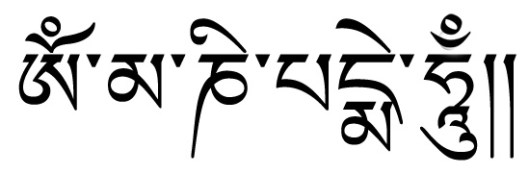
OmManiPadmeHung.jpg

OM MANI PADME HUM, pronounced and intoned Aum – ma-ni – pay-may – hung with the leading Aum being deeply resonated means Om! The jewel in the heart of the lotus! Hum! and has a deeply religious implication to Buddhists.

Devout Buddhists are likely to chant OM MANI PADME HUM every day and, on our trek so far, I have spent considerable time following in Gyalbu’s footsteps. I have heard but never discussed with him his intoning of the chant, in particular the deeply resonant OM! rhythmically in time with his pace. Gyalbu was almost certainly chanting ahead of Tim, Lizzie and I as he passed the chorten on the left as is customary.

Soon after leaving Pilling our path indented into a valley to the left and lost height to cross a minor tributary of the Kyalunpa Khola, the Dhundok Khola. We were somewhat surprised to find the river completely frozen and this confirmed that our overnight coldness wasn’t solely due to our lack of acclimatisation. It appeared that winter was coming sooner than we hoped. If confirmed this would have a significant impact on our approach to the trek, not because we were incapable of progressing on ice but because the ponies would struggle and the availability of food sourced locally may be reduced.

In the case of this relatively small river, for example, while we trekkers crossed the ice without difficulty our ponies could not cross laden. More precisely, while they might have been able to cross the bed of the river they were unable to regain the far bank due to the icy despite steps having been cut for them by their handler. Instead each pony had to be unloaded on the home bank and led across and then up onto the far bank unladen. Only then would they allow their burdens to be replaced.IMG_2438.jpg
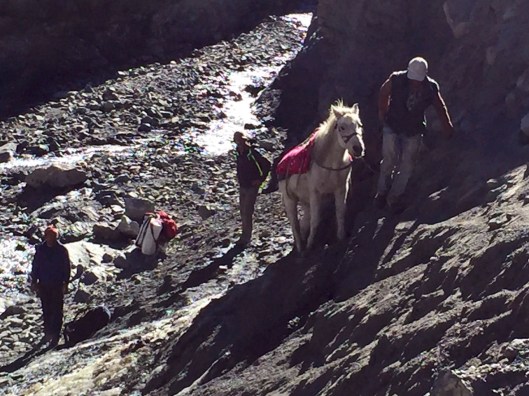
From this time the horseman began reminding us that he was not engaged beyond the first 5 days out of Kagbeni and he was clearly concerned about getting back home safely. Five days out of Kagbeni would see us safely over Jungben La but not far thereafter and might result in us carrying our own bags from the high pass all the way to the next village where new ponies might be found. This was expencted to be Tinje – 3 days trek from the pass.

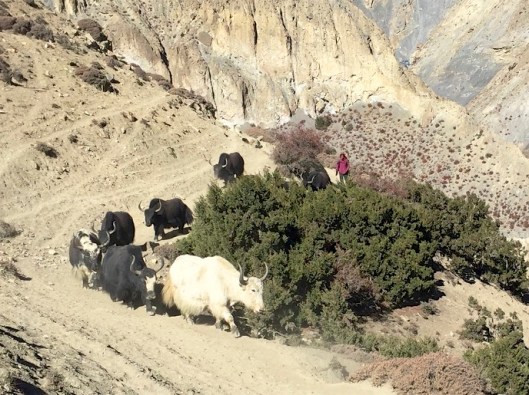
As we continued along the south side of the Kyalunpa Khola gorge we began to meet several groups coming the other way. First there was a herd of yaks bustling and snuffling eastward. Their herder confirmed he was heading for Kagbeni although this was no surprise given the only other village between here and there was the deserted Pilling. We moved smartly to the uphill side of the track to let these docile but wide and clumsy beasts, whose leader was a relatively rare pure white yak, pass. Being knocked down the mountain by a yak would be an ignominious end for a careless trekker. Second there was a herd of goats and after them more yaks. Was everyone leaving?IMG_2451.jpg
We then met our first trekking group of 9 Australians on a commercial trek from Juphal to Jomsom. Lizzie and I stopped for a chat about how things were going and they were quite chatty and clearly looking forward to completing their trek in 3 or 4 days time. After they passed we saw porter after porter carrying all manner of home goodies including tables, chairs and even a portable toilet. These Aussies had clearly been on the comfort trek. We counted a total support team of 20 porters and 13 ponies which rather put in perspective our frugality using 4 porters and 3 ponies and caused a degree of mirth. Nonetheless Lizzie and I bade them a hearty g’day, acknowledged to ourselves that any fool can be uncomfortable, and moved off. Unbeknown to us when they in turn met the Aussies Tim and Jovi had a brainwave. While the rest of us didn’t learn of this until later, Tim and Jovi realised that the horseman supporting the Aussies from Juphal to Jomsom would need to return to Juphal or thereabouts and would be keen not to do so ’empty’. While Juphal wasn’t our objective our planned route to Jumla went via Saldang and Bhijer, both of which are on the way to Juphal. Who knows, maybe the Aussie’s horseman woiuld be prepared to go to Jumla once he realised we were a good team? This wasn’t mentioned at the time; instead Tim, and Jovi our ace negotiator, agreed a very good price for the horseman to return immediately from Jomsom once he had completed his current contract and support us to Juphal in replacement for our current team of 3 ponies who we would lose in 3 days time. Furthermore Jovi negaotiated a team of 6, that being 1 pony and 5 mules, which meant that at Ghok we could release the 2-man porter support team who continued to disappoint and agaite to be released. We would then progress over the Jungben La with just 2 porters (the hugely strong and determined Gyalbu and Sangye) and 3 ponies until those nags were replaced by a team of 6. In light of the extra effort that would take, Tim and Jovi prepared to let the rest of know that there would be a rest day in Ghok tomorrow. What a result and well done Tim and Jovi! Ok, we got lucky meeting the Aussies but what inspired negotiating eh?

In the meantime, and oblivious to what was transpiring behind us, Lizzie and I together with Mark at this stage, continued west along some very precipitous cliff-clinging tracks. By around 11 am we had successfully negotiated another frozen river crossing, the Jharche Khola, and were glad to see the ponies had no difficulty this time as the river, though frozen, was largely dry.

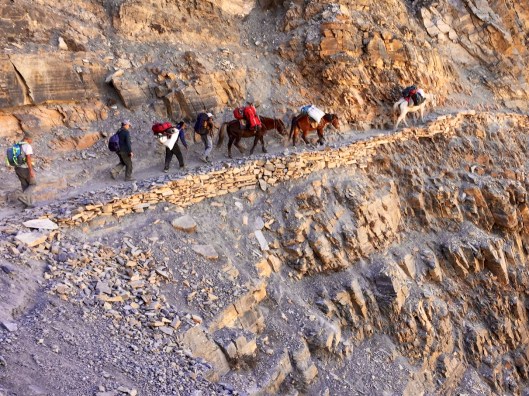
Thereafter the track became even more ‘airy’ as we neared the point at which we would need to descend into the gorge and cross the Kyalunpe Khola onto the northern side in order to reach Ghok. Tim and Jovi had joined us again by now although hadn’t at this time shared their news. I think everyone was totally focussed on not slipping off the treacherous path. I sure was!IMG_2506.jpg
By 12:45 we were descending into the valley and were enjoying the spectacle of a herd of yaks being driven towards the same crossing point from the other side. Animal after animal was slipping and sliding down the path we were to climb. They all survived and the clouds of dust they produced was spectacular. Once they had passed us we moved down to the river. Following a short break during which I rinsed and re-donned my t-shirt, we crossed a small rustic stone bridge and headed up the yak track. Once we had gained some height we were able to look back across the gorge and see the yaks which had passed us negotiating the airy path recently survived by us. Seen from a distance the extraordinaty nature of our route was emphasised by the current occupants despite the poor photography. Look for the little black dots clinging to the mountainside to the left of centre and on the right. Don’t look down big guys!IMG_2543 - Version 2.jpg

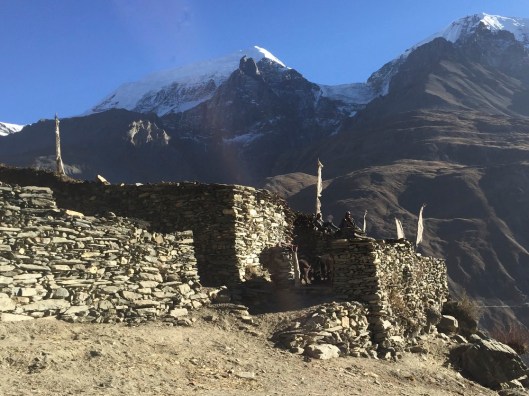
Shortly after the magnificent sight of the yaks on the pathway we approached the village of Ghok. This involved yet another river crossing although it was only minor. The key issue was that the track down into the little gorge was too broken for laden horses. They were unladen and we carried our own main bags in addition to our day sacks down through the cut and up the steep eastern bank to the village which we reached by about 3:30. We were relieved to see this village had occupants however they apeared less that pleased to see us. Instead of the tentative welcome we hoped for they seemed to man the ramparts of the village, just watching us, massive Tibetan mastiff guard dogs growling.IMG_2563 - Version 2.jpg
Tim, Gyalbu and our horseman approached the villagers and a conversation developed unheard by the rest of us. Meanwhile we watched cafefully and noticed that the construction of this village was similar to that of Pilling. That could have been coincidence or simply a local style, but on returning to us Tim said that the people here were the residents of Pilling who had recently moved from their summer village to Ghok. Their winter village was better placed to make the most of winter sun and the reason thay had been wary of our arrival was that they had seen our lights last night in Pilling some miles away but clearly visible across the gorge at night and wondered who on earth we were. Our presence in Pilling would not have been notable if visitors were common but that wasn’t the case. While the horseman knew the people from a previous visit we were the first Westerners ever to visit Ghok. That took a while to sink in. Afterwards we were invited into the village and shown to a place where we could pitch our tents. This was an animal compound similar to that used last night which turned out to be on the roof of one of the villager’s houses as it had a chimney, i.e. a hole, in the middle of it.

In the setting sun we pitched our tents. While we were doing this Gyalbu was dismissing the 2-man porter support team. They were paid well for their work and were delighted to have been let off the hook. They had really bitten off more than they could chew and our style of trek was well beyond their expectation. They left without saying goodbye. We would now rely on Gyalbu and Sangye and the stregth of our ponies and ourselves to get over the Jungben La the day after tomorrow and then trust to the honesty of the Aussies’ horseman to return.

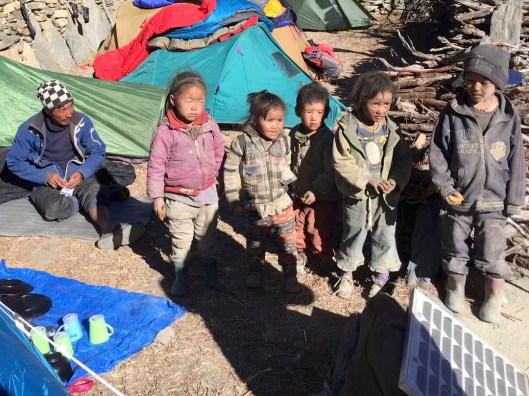
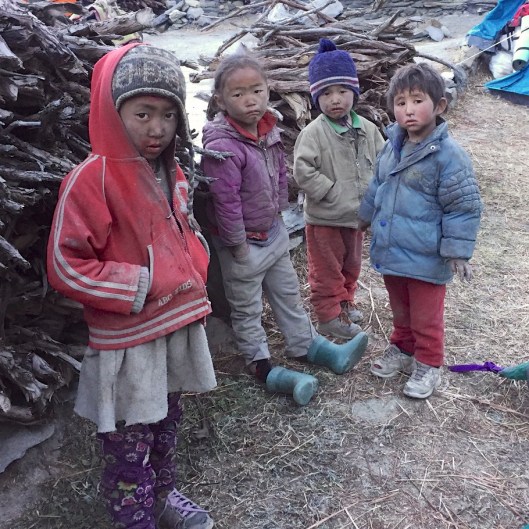
Meanwhile a number of inquisitive village children arrived to see the strange visitors. I showed them my ThermaRest and Neo-Air mattresses being inflated and made a fuss pretending my sleeping bag was alive by fighting with it. There was much laughter but I could see they were more astounded than amused. They had probably seen none of these things before and their faces spoke volumes. They were all agog when I showed them their photograph and photographs of my grandchildren on my iPhone which I was using as a camera.IMG_2586 - Version 2.jpg
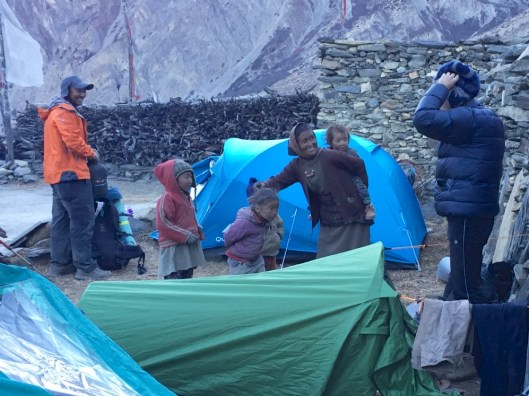
Then a mother arrived, presumably on the pretext of making sure the kids weren’t being a nuisance or in any danger from the visitors. At this point Mark took over the show messing about with his large furry hat much to their and Gyalbu’s amusement.IMG_2582 - Version 2.jpg
Then something even more amazing happened.While we sat or repacked by our tents enjoying the last rays of the day an old Nepalese woman appeared in our midst. She had brought us some hot black tea which she poured from a flask and invited us to go down into her ‘house’ for dinner. Of course she would be paid and I’m sure the money would be very welcome but to be shown such hospitatilty when we were practically aliens to her was an extraordinary gesture.IMG_2577.jpg
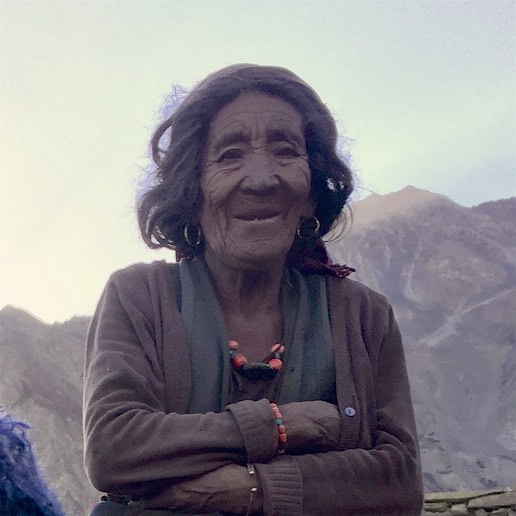
In her 60’s she was dressed traditionally with dark robe and an apron striped in bands of red, blue and green but these garments and her brown cardigan were heavily sooted as were her face and hands. Her hair was jet black and wild. She wore heavy metal earrings and a metal amulet on her left wrist, and a necklace and right bangle of coral and turquoise. Most striking was her broad toothy grin and smiling eyes. We were as welcome in her house as we were permitted to pitch our tents on her roof.

The woman whose name, with regret, I never learned, led us to her main room beneath where we were camped. Access was down a ladder hewn from a single log and through a tiny ante-room filled with farming paraphernalia. Then through a low doorway on which we almost all bumped our heads we entered the room which functioned as kitchen, dining room, sitting room and bedroom. The room was low ceilinged and around 14 feet wide by 18 feet long, lit by a single small low-wattage lightbulb powered by a solar panel next to our tents on the roof. In the middle of the room was a squat rusty metal stove measuring around 4 feet long by 2 feet wide set in a stone hearth. At one end of the stove was a hatch through which fuel, either juniper branches or dried yak poo, was fed. At the other end a simple chimney pipe led smoke towards but not actually through a hole in the roof. Thus the room was very smoky. The top of the stove had room for 3 pots. These either sat in a purpose cut circular hole with their base directly over the fire and hot embers inside the stove, or on a metal plate placed over the circular hole. Around the stone hearth were not chairs but rugs on the floor. On one side only between the hearth and the rugs was a narrow bench of about 6 inches high and wide. This acted as a table and we visitors were invited to sit on the rugs on the other side of the table with our backs against the wall. Opposite us on the other side of the hearth or to one side of it 2 men were seated on rugs. The older of these was the husband of the lady we met earlier while the younger was their grandson, a tall handsome and grubby lad in his late twenties. Around the outside of the room on 3 sides were old wooden shelves at a variety of odd angles bearing pots, pans, glassware, cups and other assorted crockery and household bits and pieces. There were also spices, jars and cooking ingredients, and several thermos flasks. Nothing was in cupboards: everything was on show on narrow shelves. On the 4th side, the one at the end of the longer side of the room there was a partially screened alcove in which I believe the couple slept although no bed could be seen. I think that as we sat on the floor on rugs so the lady and her husband, and probably the grandson too, slept on the floor on rugs. Everything that could be seen in this dark sooty room, including the clothing that the family wore, was dark brown tending to black. Whether it started that colour or became it with age and long-term exposure to the smoke from the hearth, or just appeared it due to the low light I don’t know. But it was all brown tending to black now. There was no mains electricity, generator or gas. Water was collected in plastic containers either from a muddy spring further up the mountain or from the river we crossed on our way. But this rural Nepalese dwelling was homely and we were honoured to be the first Western people to see it.

The old lady prepared our dinner while we revelled in the warmth from the hearth and from the family’s invitation to join them. We were also warmed by the Raksi she heated in a kettle and served in small glasses. The ice was well and truly broken and Tim and Gyalbu were able to converse with them. They both commented however that it was not easy to follow a conversation as our hosts spoke a strange and unfamiliar dialect.

Dinner comprised Tibetan winter wheat pancake and a spicy soup of yak meat and potatoes. The mixture for each pancake was poured from a mixing vessel onto a flat metal pan on the stove. It was then periodically turned using a broad knife until done and then removed onto a pile on a hotplate. Then, using a corner of the rag used to insulate her hand from the heat of the pan handle, the lady scooped embers from the fire onto the flat metal pan and rubbed it until the pan was clean. She then used a different part of the rag to remove the debris before another measure of the winter wheat pancake mixture was poured into it and the process began again. This continued until 14 pancakes were piled on the hotplate; 2 for each of the 5 trekkers and 2 Sherpas. She and her family would eat later. By this time the soup was ready for serving into small bowls and these and the pancakes were put on the table for us together with a spoon each. Any peices of inedible yak bone or gristle were placed in a neat pile on the table until the first bowl was empty and not refilled at which time the inedible pieces were placed in it. Once everyone was finished and had refused another serving of the very tasty soup the bowls and spoons were removed. There was no dessert but the small Raksi glasses were refilled with the delicious warmed liquor, twice, among much smiling, nodding and appreciation of the family homebrew. Throughout the whole meal the woman did all the work. The men were convivial, especially the older man, but neither contributed in any way to preparing or serving the repast.

After dinner the polite Nepalese conversation continued for a while, some of which was translated for us by Tim. I was most intrigued when it became clear the family, in particular the older man, was talking about me. It transpired that he was 72 years old and was known univerally as ‘grandfather’. Apparently Tim had told him that I was a grandfather too and had 4 young grandchilderen back in the UK. The man immediately laughed and named me ‘Memi Tsamba’ which in the dialect of the area meant ‘new grandfather’. That proud name stuck for the rest of the trek among we trekkers, the Sherpas and anyone else we were speaking to. From that day on I was no longer Andy but Memi Tsamba. Others in our group were named too. Tim was ‘shaba’ meaning the one who likes meat. Mark was ‘memi ningma’ the old one – a little unfair as he wasn’t the oldest by some margin but maybe he’d had a bad day. Jovi was ‘changba lendhup’ the crazy one who drinks chang (in addition to Raksi). Most amusingly Lizzie, who was educated in a convent school and was partial to a glass or two of Raksi, was affectionately but not entirely accurately named ‘ani arakba’ – the drunken nun!

All the names were amusing and the conditions in which they came about in that dim, remote, smoky Nepalese room, will never be forgotten. But I was as pleased as punch and remain so to be for all time remembered by those kind and generous people as memi tsamba.


Now it gets serious: Trek day 3 – 20 miles to Pilling

29 Tuesday Nov 2016

Posted by andyjameswriter in Dolpo trek

≈ 6 Comments

Hi everyone – thanks for waiting. Now the story begins.

You may recall that before I left the world of mobile communications what now seems a long time ago on the 4th November I had recounted our first 2 days of trekking. On day 1 (Wed 3 Nov) we had flown into Jomsom. Following some last minute foraging for a second sleeping bag for Lizzie and my trekking lifesavers (half a dozen Snickers bars) we trekked north to Kagbeni. This stretch was a fairly modest 12 miles or so but we were getting used to the altitude and each other and this takes time.

The others? Ah yes, maybe this is a good time to introduce the team. We numbered 5 trekkers and 4 Sherpa porters.

Our lead Sherpa and guide is Gyalbu Tamang. Gyalbu is a long-term associate of Tim’s and they have worked together many times. Gyalbu suffered very serious injury and family loss when his home in Langtang was destroyed by the Nepalese earthquake (the Gorkha earthquake) in April 2015 but his strength, fortitude and determination and the skill of a surgeon has shone through and he now works as a guide again in Nepal and Japan. Our second Sherpa is Gyalbu’s elder brother Sangye Tamang. The support pair are friends of Gyalbu about which more in due course.

Other than myself the trekkers comprise Tim Calder, Liz Roberts, Jovan Ilic and Mark Pearson. Tim is my friend and mountaineering buddy previously based in the Lake District but now living in Vancouver. We climbed on Cho Oyu together in 2013 and, but for the Good Friday avalanche in April 2014, we would have attempted to climb Everest together that season. This trek is Tim’s brainchild and without his planning and contacts it would not be possible. Liz (Lizzie) is a broadcast journalist from Chesterfield on a career break from her job as political reporter at BBC Radio Sheffield and BBC Sunday Politics on Yorkshire TV. Lizzie has trekked with Tim before. Jovan (Jovi) is a firend of Tim’s. He lives in Kathmandu and is the acting Country Director at the British Council Nepal. Mark Pearson is not known personally to the others but has worked with Jovi’s wife and comes highly recommended. He is a trekking nut who has walked in Cambodia, Vietnam and Burma, among other places. When not trekking Mark consults on health advisory matters and is based in the south of England.

So to the trek. The height gain from Jomsom to Kagbeni was a mere 100m and the walking was easy. But as we were already approaching 3000m (9843ft) above sea level we could already feel the effects of altitude in our breathing on even the most of gentle inclines. The walk east to Jharkot and back on Thu 4 Nov assisted our preparation. This meant that despite maybe enjoying 1 or 2 beers too many and some glasses of the local moonshine known a Arak (or Raksi – pronounced Roxy) in the evening we were broadly in good shape to get the real trekking business underway the following day.

Raksi is a traditional distilled Nepalese moonshine which is often made at home. It is usually made from kodo millet and different grains produce different flavours although it commonly resembles Japanese saki in appearance and flavour. As it is not licensed it can be very strong in aroma and taste. I love CNN’s description of Raksi: “It sends a burning sensation straight down your throat which resolves itself into a surprisingly smooth, velvety sensation. Nepalese drink this home brew to celebrate festivals, though some think that the prized drink itself is the reason to celebrate.” The most notable feature of Raksi in my (limited) experience is that the drinker experiences no gradual degradation of lucidity or function. All is well through the happy stage until sudden, complete and utter system failure. ‘Nuff said (for now anyway).

On day 3 of the trek, Friday 5th November, we left Yac Donalds at just before 8 am following a good breakfast of porridge, eggs, toast, jam and lots of tea. The sun was still low in the sky so the eastern-facing buildings were in brilliant sunshine while those facing west remained in deep shadow. The air was chill and most of the team had donned thick jackets but had already applied suncream in anticipation of the hot day to come. I alone was in short sleeves following the adage ‘be bold – start cold’. I seem to operate at a higher temperature than many and even in the morning chill I was fine in light beige trousers, a red/grey trekking t-shirt and an old faded red The North Face (TNF) baseball cap with ‘a foreign legion-style’ drape on the back and sides as sun protection, together with sunglasses. (I bought this hat in 2014 in Namche Bazaar on the way to Everest basecamp and it is well past its ‘use by date’ but its a favourite I can’t part with having left its predecessor on the summit of Aconcagua a few years previously). I would soon warm up despite my 35 litre Lowe Alpine rucksack weighing a mere 8kg or so and if not I had extra layers to hand.

Our loads were light as Tim and Gyalbu had secured 3 ponies and their horseman/handler to assist with the load carrying over the first few days. This meant that the Sherpa loads were relatively light, although probably still double ours, and the 3 ponies were doing all the heavy lifting. In this way we could focus on acclimatisation and keeping up a good pace on the trek. The time would come when we would need to carry heavier loads but the first few days were to be among the toughest so lighter loads was a sensible precaution against early strain injuries.

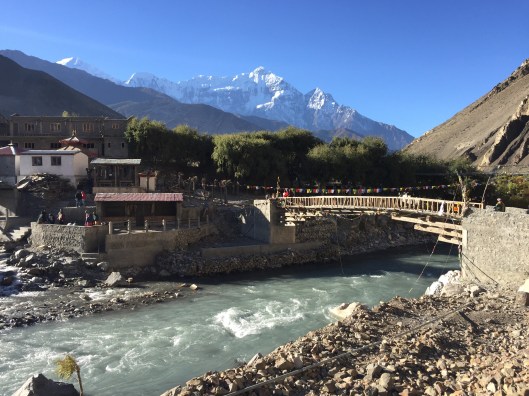
We made our way through the alleyways of Kagbeni, walking poles clicking on the rough paving, to the river. Having followed the Kali Gandaki to Kagbeni from Jomsom 2 days ago, today we were to cross it as we headed out of the Upper Mustang region towards Dolpo. The Kali Gandaki has its source in a Himalayan glacier on the Nepalese/Tibetan (Chinese) border. This mighty river, also known as the Narajani in southern Nepal and the Gandak in India, is one of the major rivers in Nepal and eventually flows into the Ganges. As we crossed the wooden bridge its prayer flags fluttered in a light breeze in the sunshine. Meanwhile the grey, frigid and fast-moving waters of the Kali Gandaki churned through its steep-sided gorge to bisect the distant Annapurna and Dhaulagiri mountain ranges to the south.IMG_2282.jpg

Gradually leaving Kagbeni behind we headed up the escarpment. It wasn’t long before the remaining duvet jackets were stowed as heads bowed to the uphill struggle. The path was steep and stony and although the path was clear it did not appear often used. Sandstone bluffs ahead were heavily eroded and our footfalls were softened by a thick covering of dusty sand. The sky was a beautiful cloudless deep blue throwing the crestline of the mountains into sharp relief while the bright sunshine picked out a flock of severfal dozen diminutive but impressivley horned black goats on the slopes below the crest.

Overhead Himalayan griffon vultures were circling. These vultures are found mainly in the higher regions of the Himalayas and is the largest and heaviest bird found in this region. While they may be seen perching on crags they are well camouflaged and as a result they are most often seen soaring in thermals. Due to their size and weight they are not capable of sustained flapping flight. Vultures typically follow grazers up the mountains in their search for dead anaimals as food so while we were admiring the flocks of goats from below the vultures had them in their sights from above.

After 3 hours of uphill toil under an increasingly searing sun we stopped for lunch. We had noticed that while Gyalbu and Sangye had made great progress uphill with the ponies the other 2 porters had been struggling. This didn’t cause concern at the time as this being our first day on the trek proper we were in no particlar hurry and we recognised that the junior Sherpas may need a day or two to shed cobwebs spun during lowland living. Despite their slowness we were pleased to find that when we reached Yak Kharka (which means yak resting place) and its tiny settlement just after 11 am the ponies had been unloaded, the support Shepas were there too, and lunch was being prepared. A woman who lived at the settlement had appeared. She was dressed traditionally in a dusty dark brown robe (over less traditional green slacks and decripit sandals), an apron striped with diagonal bands of red, black, blue, white, yellow and green, a dishevelled purple jacket and a red woollen hat. We saw a man too but he kept his distance. The woman was showing particular interest in our equipment and food and we learned later that she had attepted to gain payment for our use of ‘her’ water. Given that a gallon of water had been fetched from a nearby stream in a green bucket by Sangye her charges weren’t paid. We did however share some of our Chinese Wei Wei noodles with her and she left content.IMG_2327.jpg

We were to find that lunch at or before midday was the norm on the trek. Due to the shortage of power for lighting and heating rural Nepalese people tend to make best use of daylight and we followed their excample. This meant taking breakfast with the dawn at around 6:30, lunch at around midday and the evening meal at the British tea time between 5 and 6pm. There are variations of course and not everyone is the same, but this was the rythym we were to get used to not least as when camping we would ideally put up the tents and have our evening meal before we lost daylight. Furthermore it was very cold in the late afternoon as the sun went down. All heat was from the sun and there was no residual heat in the ground. Typically in the mountains, or more precisely in the deep mountain valleys and gorges in which we normally found ourselves, we lost the sun as early as 3pm despite sunset not formally being until 5pm. As a result when camping we were normally in our sleeping bags by 7pm or even earlier.

After lunch we continued our ascent. Following the increasingly broken and difficult track northwest we found the support Sherpas dropping back again. While some of the trekking group hung back too, and Gyalbu felt obliged to stay with the rear group, I decided to follow the ponies with the horseman and Sangye up ahead. So it was that we came to the landslide area first.

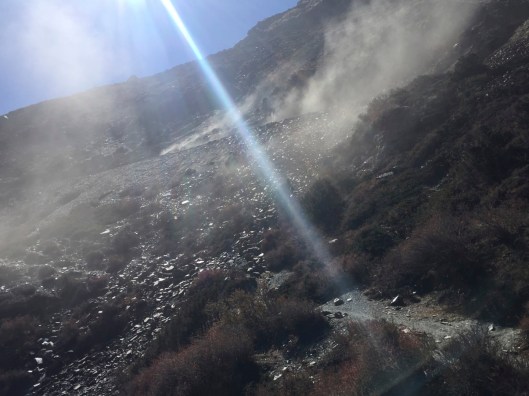
At about the 4000m (13,000ft) mark we were happily following a fairly well defined but loose path. The slope above and below us was at around 45 degrees and while there were a few spindly trees and the occasional low scrub it was effectively scree. After a while we came to a section of the slope that had recently slipped. This was obvious as there was no track across it yet we could see where it continued on the other side, around 20 metres away. However, it wasn’t moving at that time and as there was no alternative route we decided to cross; very gingerly. The horseman went first with the ponies and had no problem. Sangye followed and likewise had no drama. Then it was my turn. I started off very carefully but when I was around half-way over while my section of the hill wasn’t moving another landslide had started above me, to my left, and if that continued then pretty soon the whole slope would slip. RUN!! yelled the normally quiet and reserved Sangye. SAH RUN!! he yelled again. Needless to say run I did, but not before being clouted on the left side of my head by a sizeable rock. Thankfully it caught me above the ear and I still had my TNF hat on which softened the blow. No harm was done and I wasn’t knocked over or out, but I fairly sprinted over the last few metres to the safe zone before, as feared, the whole slope slid. Here is a photo of the aftermath, taken while I was on the satphone to Clare. I didn’t mention my lucky escape but figured it was time to check-in and let her know what a great time I was having and everything was fine.IMG_2346.jpg

Following that, a few hundred metres later we unexpectedly came upon a wide track built for a vehicle. Quite why it had been built and where it started in the east we had no idea, but it was going in the right direction west and eased navigation issues for a while and we were glad to be able to get a decent pace going along it. Gaining height all the time we crossed an unnamed pass at 4306m (14,127ft) on the Jeula Danda ridge before reaching the Bhima Lojun La at 4460m (14,633ft). At this point Sangye, and the horseman with the ponies, continued while I climbed to the summit of Bhima Lojun itself. While at 4465m (14,649ft) it was hardly a major Himalayan peak it was nonetheless a summit not much lower than Mont Blanc. The wind was blowing a very cold gale on the summit and my 2 layers of clothing (green Rab Alpine Lite added to Trespass t-shirt) weren’t really up to the job so I waited until I got down a little before taking this shameless ‘selfie’ with the summit of Bhima Lojan in the background.IMG_2364.jpg

As it happened Tim, Jovi and Lizzie arrived as I got back to the Bhima Lojun La just before 3pm and we shared some snacks. A favourite biscuit was already developing: coconut crunchees! Despite the welcome rest Tim was concerned that our 2 support Sherpas were some way behind and we would be losing light in a couple of hours. At this stage there was no alternative but to press on. We certainly couldn’t camp at this height due to the exposure and our target remained a village still several miles away. This is the village I had referred to in my introductory blog ‘the first 5 days’ as ‘Santa’. I had learned by now that the trekking map I had used as my source wasn’t especially accurate. More correctly, it didn’t reflect the range of names that different Nepalese peoples give to the same place. Thus Santa was not recognised as a specific location, rather an area, and our intended resting place for the night was not called Santa at all but Pilling.

Once Bhima Lojun La was left behind we had a very cold late afternoon as we tried to make speed along the stony track coutouring around the mountain between snow-covered Tashikang to the south, at 6385m (20,948ft) the highest peak in the area and the reason we lost the sun so early, and the Kyalunpa Khola (Kyalunpa river) gorge to the north. Quite a few lessons were learned that afternoon about the right clothing for the environment and the importance of making good progress early so as not to get caught out in the dark.

Just before 5pm in the gathering gloom and with the wind whistling around us a loud rumble to our left, in the direction of Tashikang, caused heads to spin. A huge avalanche was pouring down the escarpment around 1 km to the south. It was sufficiently far away for us to be in no danger but it sure quickened our step.

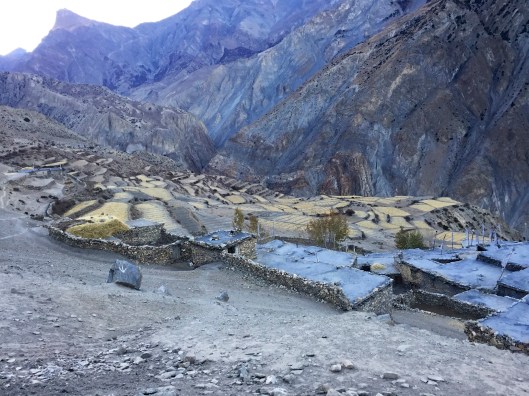
Twenty minutes later we emerged from the huge shadow of the Sandachhe Himal ridge of which Tashikang is a part to be confronted by the village of Pilling. Perched on a plateau several hundered feet above the Kyalunpa Khola, Pilling was a complex series of squat, single-story austere stone dwellings and livestock compounds situated above many acres of terraced arable land surrounded by seriously tough mountains. Looking left, to the west, I could see the precipitous Kyalunpa gorge continuing towards and beyond the Jungben La, the massive pass that we would traverse a few days hence. Looking right, to the east, I could see the Kali Gandaki gorge from where we climbed out of Kagbeni 9 hours earlier. In front of me was Pilling, beyond it the gorge with the river invisible in its depth and on the opposite side was a deserted village with terracing, apparently clinging by its cold fingernails to the unbelievable steep mountainside. In the failing light the terrain looked foreboding nonetheless we investigated the village hoping to find a welcoming hearth and food so as to preserve our stocks. If not we would find a camping space for our tents. Tim and Gyalbu approached the village first in order to save the inhabitants from concern or obligation. While from our garb we expected that our purpose in the land was obvious, but brigands are not unheard of in these parts and we needed to be cautious.

IMG_2397.jpg

They returned shortly having found the village deserted. Every part of the village was neat and as clean as is normal for people who live cheek-by-jowl with their animals. There was fresh hay on some roofs and fresh-looking footprints in the dusty walkways. White prayer flags fluttered in the cold wind and nothing was overgrown or in disrepair. But the village was empty. Not a single person or animal remained. They had all gone, and quite recently too, possibly within the past few days.

As it was approaching 5:30 we made the decision to set up camp in one of the empty animal compounds. Kicking fresh animal droppings to one side tents were hastily erected with the help of head-torches while Gyalbu and his team, now at full strength following the belated arrival of the final 2, very tired, porters, set about preparing dinner in a corner of the compound in the gloom.

We had trekked around 20 miles on our first full day. This was significantly more than would have been possible without the additional acclimatisation day at Kagbeni and the use of ponies from the start. Add to that a vertical height gain of 1650m (5,414ft) from Kagbeni at 2810m (9,219ft) to the Bhima Lojun La at 4460 (14,633ft) and we had reason to be pleased with ourselves. We wolfed our dinner of chilli con carne and rice with black tea prepared by the amazing Gyalbu and Sangye and mostly slept well although Lizzie was cold during the night despite adding thermal layers. Given the overnight temperature was around freezing and that even the contents of pee bottles were frozen in the morning anyone without a good 4-season sleeping bag and decent thermal insulation beneath was going to suffer. I think most suffering was felt by the 2 support porters who we understood may not have prepared well enough, neither physically nor in equipment and clothing, for their work and were already making noises about returning to Kagbeni. If that were to happen then we would be carrying heavier bags very soon.

And so day 3 of the trek came to a close. We’d arrived at Pilling in the nick of time after an amazing day and had enjoyed hot food. We had tired legs but no injuries, and soon the only sounds around the compound were the bells on the necks of our restless ponies and (mostly) contented snoring. Plus the inevitable zip, zip, zipping that accompanied those needing to vacate their tent and dash behind a wall to accomplish things not feasible in a bottle.

Life had returned to a pitch black and very cold animal compound in the deserted village of Pilling for just one more night this year. Tomorrow we would move on, forever westward for the next few days at least.

Back in the land of WiFi

24 Thursday Nov 2016

Posted by andyjameswriter in Dolpo trek

≈ Leave a comment

Hi everyone,

I have just returned to the land of WiFi and found that none of my recent posts actually made it to the blog despite me keeping them well below the 100 character limit imposed by using the satphone. So here is an update.

Following the rest day at Phoksundo Lake we continued south staying 1 night (last Sunday) at Chhepka before reaching the end of the trek at Juphal the following day (Monday). Our flights back to Kathmandu via Nepalgunj were booked for the Wednesday to give us some leeway in case of problems. In the event there were problems with the plane and all flights were cancelled. We tried to charter 2 other planes but despite being told each in turn was on its way neither actually turned up. Such is Nepal. 

Following another nail-biting night last night the plane did turn up this morning and we flew out at 7:45 this morning. We are now at Nepalgunj awaiting the onwards flight to Kathmandu just after 4pm local time, about 5 hours from now.

However, enough of the logistics. I have one heck of a story to tell you and I really can’t wait to tell it. I wanted to tell it ‘live’ but couldn’t as my plan to link the iPad to my Thuraya satphone was stymied by the iPad refusing to recognise the phone. Then, as you know, the satphone transmissions were limited to about 100 characters. As the count includes punctuation and spaces that allowed nothing more than brief positional updates. So I have been making written notes every day and have taken plenty of photographs. These will enable the story to be told in a few days time.

It will be called “The boy in the orange jacket – an epic tale of human migration in Upper Dolpo”.

For now I’ll just leave you with the assurance that we are all well and have had an amazing physical and cultural experience that will be shared.

Bye for now!

19 November, 2016 15:09

19 Saturday Nov 2016

Posted by andyjameswriter in Dolpo trek

≈ Leave a comment

Today is a rest day beside the outstandingly beautiful Lake Phoksundo.

17 November, 2016 12:12

17 Thursday Nov 2016

Posted by andyjameswriter in Dolpo trek

≈ Leave a comment

Another 5000+m pass cleared today. Now sitting at a campfire in the dark a few miles from Lake Phoksondo. All well.

16 November, 2016 10:32

16 Wednesday Nov 2016

Posted by andyjameswriter in Dolpo trek

≈ Leave a comment

Crossed Sela La 5095m in freezing gale. Later in valley saw fresh Snow Leopard tracks. Now at Shey Gompa. All awesome.

15 November, 2016 07:59

15 Tuesday Nov 2016

Posted by andyjameswriter in Dolpo trek

≈ Leave a comment

Arrived at Namgong. Glorious sunshine but wind bitter and rivers half frozen. Tonight we sleep in the monastery.

13 November, 2016 15:04

13 Sunday Nov 2016

Posted by andyjameswriter in Dolpo trek

≈ Leave a comment

Long day. Packed 2 days trekking into 1 and reached Saldang a day early to buy a rest day tomorrow. All looking good.

← Older posts
Newer posts →

Enter your email address to subscribe to this blog and receive notifications of new posts by email.

Join 49 other subscribers
Follow Andy James on WordPress.com

Blog Archive Categories

  • Dolpo trek (45)
  • Lefkas (3)
  • Mont Blanc June 2019 (9)
  • Picos de Europa (8)
  • The Great Glen Way (5)
  • The Haute Route (10)
  • The West Highland Way (6)
  • The Writing Journal (6)
  • Walking London – the Capital Ring (4)

Blog at WordPress.com.

  • Subscribe Subscribed
    • Andy James
    • Join 49 other subscribers
    • Already have a WordPress.com account? Log in now.
    • Andy James
    • Subscribe Subscribed
    • Sign up
    • Log in
    • Report this content
    • View site in Reader
    • Manage subscriptions
    • Collapse this bar
 

Loading Comments...