• About
  • Photographs
    • In Praise of Agiofili Beach
    • Corfu’s Most Beautiful Village?
    • Making a splash in Vassiliki

Andy James

~ A Writers Journey

Andy James

Author Archives: andyjameswriter

A circumnavigation of London – the Capital Ringz

05 Wednesday Jun 2019

Posted by andyjameswriter in Walking London - the Capital Ring

≈ 2 Comments

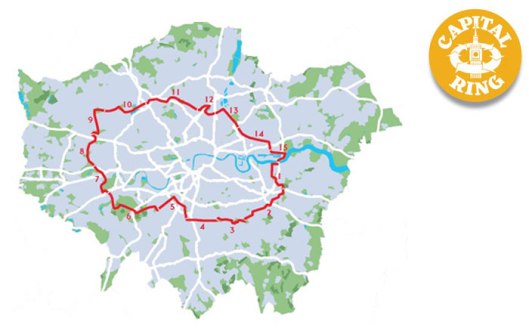
The Capital Ring is a signposted circular walk of 78 miles (126km) around London. Divided into 15 ‘easy-to-walk’ sections it traverses some of London’s finest scenery, including open spaces, fine scenery, nature reserves and Sites of Special Scientific Interest as well as urban areas. The graphic below, courtesy of Transport for London’s very helpful and informative website, gives the general idea.

capital-ring-and-logo.jpg

Over two and a half days commencing Monday 10th June I will walk the Capital Ring, counter clockwise, starting and finishing at The Dodo Micropub in Hanwell. The Dodo is close to Section 7 of the walk and while it won’t be open when I start, at 7:30 Monday morning, it will be open when I return around 13:30 Wednesday and I can’t think of a more fitting place to finish my walk. The Dodo’s fine ales and one of Mr Barrick’s legendary pork pies will encourage a timely return.

On Monday I will walk over 30 miles from The Dodo in Hanwell to The Rusty Bucket in Eltham. Why? Because many months ago I met Rachel, now co-proprietor of this wonderful micropub, in The Dodo when she popped in for a chat and left inspired. Those of us who met her said we would visit once the Rusty Bucket was up and running. And it’s time we did. I plan to be there at opening time at 4pm having left The Dodo at 7:30. This day will see me walk through or around Brentford, Richmond Park, Wimbledon Common, Wandsworth Common, Streatham Park, Norwood, Beckenham and Crystal Palace to Eltham.

On Tuesday I will walk from Eltham via Falconwood, the Woolwich Foot Tunnel, London City Airport, the Olympic Park, Hackney and the River Lea to Finsbury Park and on Wednesday I will start early, around 7am, in order to enjoy an ale and pork pie at the Dodo, all things being equal, by around 1:30. My route in the final day will be via Highgate, East Finchley, Hendon, Harrow and Greenford.

Should anyone want to join me for a section or two on my fairly sprightly trip around some of London’s finest scenery please let me know and I’ll share the section timings. Or maybe you fancy a visit to The Rusty Bucket? Otherwise I hope you will enjoy the blog which will aim to take you with me in words and pictures.

The 4th and final day: from Invergarry to Fort William

26 Sunday May 2019

Posted by andyjameswriter in The Great Glen Way

≈ 4 Comments

Breakfast of poached haddock seemed an appropriate start to a day by the waterside. Sounds good doesn’t it? No heights today and no high/low route options. Just 25 (or so) miles of canal/lochside stroll to Fort William.

The first 3 miles was a retracing of my steps from Invergarry down to the Laggan Swing Bridge at the southern end of Lock Oich. Thereafter I picked up the canal link down to Ceann Loch and then Loch Lochy.

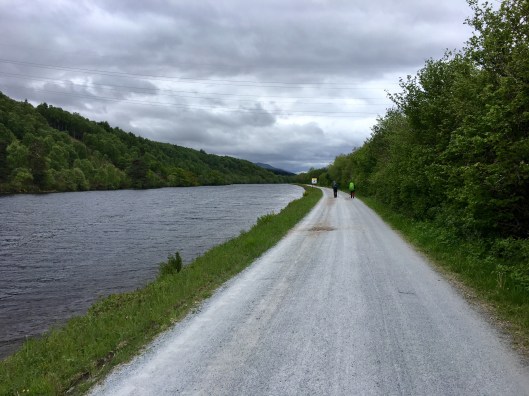
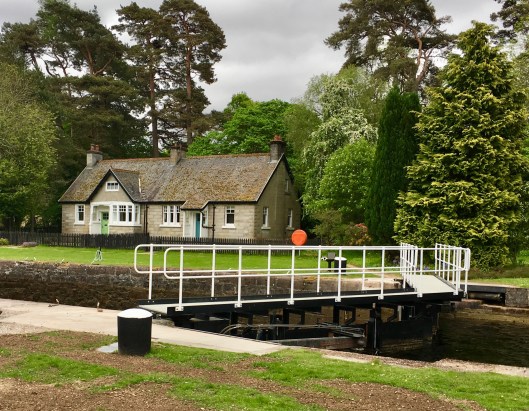
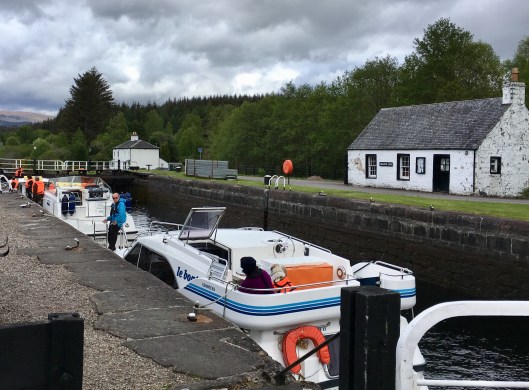
The canalside walk started well with a well-marked firm gravel track cutting through neatly trimmed grass and scattered broom bushes. On either side the hills rose steeply, blanketed with pine forests. From time to time the forests encroached upon the canal. As it was still early, only around 9am – I had started early in view of the distance to be covered – the waters were still and the bordering pines were reflected in the mirror-like stillness. Not a thing stirred on the water. In many ways it was quite idyllic and so it went on. And on. Mile after mile. I longed for some variation in outlook or elevation. Odd though it may seem, I wanted to be up in the mountains again looking down, not down in the valley looking up. The only respite was upon reaching Laggan Locks an hour and a half out of Invergarry. This delightful basin was busy with small leisure craft readying for movement up or down the Great Glen waterway.

IMG_4781.jpg

Apparently constructing this, the highest stretch of the canal at 32m (106ft) above sea level, was a major challenge. There were massive amounts of earth to be dug out. Up to 250 men worked here, using horse-drawn wagons on railways to take the earth away. By the 1870’s steamer trips along the canal were very popular. This would have been good for local hotels and shops but not for the lock-keepers’ wives. They were forbidden to hang-out washing when steamers were passing. I would have thought they would have been happy not to have their whites covered in smuts from the steamer boilers.

IMG_4783.jpg

Not far from the lock is Kilfinnan, indeed my route took me through it although it was hardly recognisable as a seat of historic foment. Kilfinnan was the burial place for the chiefs of the MacDonells of Glengarry. Apparently the 15th Chief, one Alasdair Ranaldson MacDonell of Glengarry, known as Wild Alasdair, stripped his estate of timber to finance a flamboyant lifestyle and evicted tenants to make room for sheep. He was a constant problem for the builders of the Caledonian Canal, demanding large amounts of compensation and chasing canal workmen off his land.

Today Kilfinnan is notable only for its view over Ceann Loch and the boulder-strewn bed of the river which empties Loch a’ Choire Ghlais up in the mountains to the west into the canal. And maybe the cuteness of its lambs of which there were plenty at this time.

IMG_4788.jpg

The next 6 miles or so were not especially noteworthy. The Great Glen Way followed a minor road variously through pine forest, deciduous woodland, or a mixture. Loch Lochy was ever-present on my left and devoid of craft seemingly kept at their moorings due to the increasingly strong wind raising white horses on the loch. My focus was on making progress south and even the occasional vista of bluebells did little to engage me. The tunnel vision wasn’t arrested until Bunarkaig, about 2 miles north of the end of the loch, at Gairlochy.

Bunarkaig was a gem of a lochside hamlet. As I passed, to my right were a series of houses of significant quality with well tended gardens and the Clan Cameron museum.

IMG_4813IMG_4816To my left was the loch, but with an interesting outlook and history. During the 2nd World War the Commandos had a training base at Bunarkaig. A small fleet of various craft were assembled to support commando training. These included whalers, cutters, rubber dinghies, bridge rafts and others. By all accounts the training was extremely realistic. No blank ammunition was used and the instructors were skilled in missing ‘but not by very much’ offering training as close to battle conditions as they could get without actually slaughtering half the trainees. This information came from one of 8 commemorative panels outlining the training undertaken in the area of which local people are rightly proud.

IMG_4823.jpg

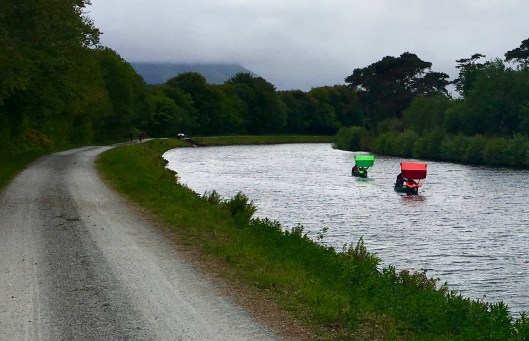
A further mile of so south I made it to Gairlochy after which there was nothing much to enjoy other that the flatness and straightness of the grey ribbon path, the quietude, and the fresh air being propelled at increasing speed in my face. I was probably lucky not to have had this sooner given the principal reason for walking the Great Glen Way west to eat is to avoid the headwind. No wonder the little craft heading towards me had makeshift sails.

IMG_4848.jpg

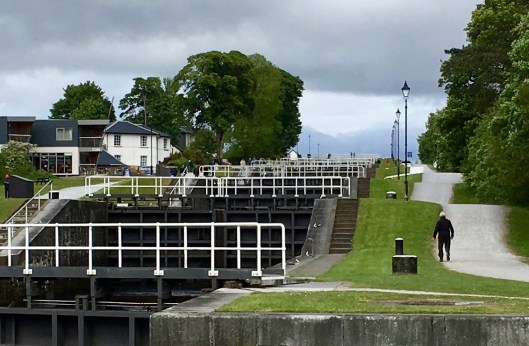
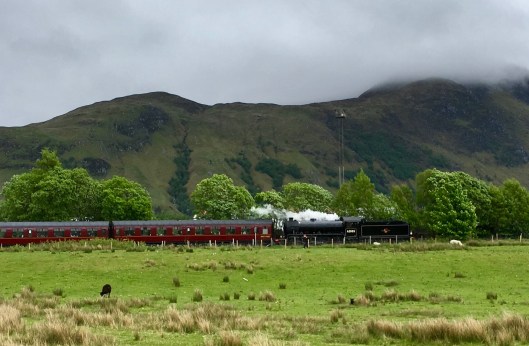
Eventually, after a further 6 miles of relatively uninteresting canalside slog, and with a degree of relief of which I was not proud given it was my choice to undertake this walk, I came to Neptune’s Staircase at Banavie. A short distance from Fort William, this is a staircase of eight locks built by Thomas Telford between 1803 and 1822. It is the longest staircase lock in Britain. The system was originally hand-powered but has been converted to hydraulic operation. The waterborne activity here and the number of visitors provided a most welcome respite and my spirits lifted. This was further helped when, unexpectedly, there was a whoosh of steam and the accompanying sound of a steam train getting underway. Each massively powerful and explosive piston stroke was just a little quicker than the last as it picked up speed departing Banavie station. I couldn’t see the train but I was to do so later.

IMG_4852.jpg

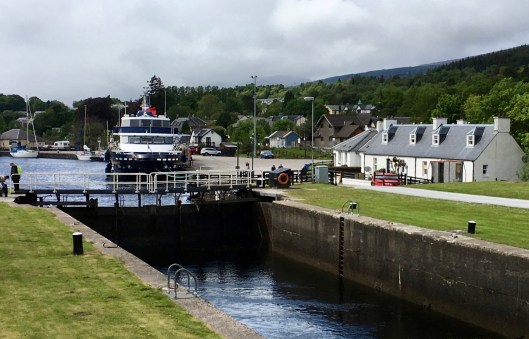
Once south of Banavie my spirits rose further at the prospect of being close to the end of this long distance trail, even though I still had nearly 5 miles to go to the final set of locks at Corpach which control access to the Caladonian Canal. It felt as though I should be able to smell sea air, but I couldn’t. Neither Corpach nor Fort William is on the sea which is, roughly, another 30 miles to the southwest, through Loch Linnie past Oban. It is however the end of the loch-controlled waterway.

IMG_4858.jpg

I walked on for a further hour and a half, past the Kilmalie shinty pitch at Caol, through Lochyside, clearly run-down but distinctly optimistic, and through Black Parks alongside the River Lochy into Inverlochy. Upon turning along the Black Parks riverside path I was treated to another whoosh of train steam as the locomotive went by, this time in full view. Hidden in the clouds somewhere beyond was Ben Nevis.

IMG_4862.jpg

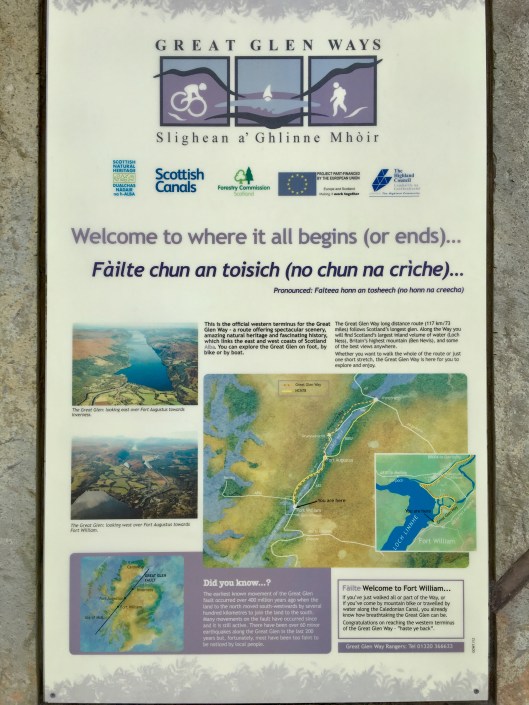
And then beside Loch Linnie, on the site of Fort William’s Old Fort, I arrived at the end (or the beginning) of the Great Glen Way.  After what should have been 78 miles but which, due to humans not walking in straight lines and thanks to the trail closure on the planned approach to Invergarry, turned out to be over 85 miles it was done. Over 4 very happy, healthy, exciting, surprising and enormously enjoyable days, it was complete. Today’s 25 miles had ended up being 28 but I could at last allow my feet to hurt as I shuffled to the best real ale pub in Fort William, the Grog and Gruel, for a beer, a sit down and a huge grin of pleasure.

IMG_4865.jpg

I love walking in Scotland. Thank you for being with me. Goodbye until the next time.

Day 3 – Invermoriston to Invergarry via Fort Augustus

24 Friday May 2019

Posted by andyjameswriter in The Great Glen Way

≈ 1 Comment

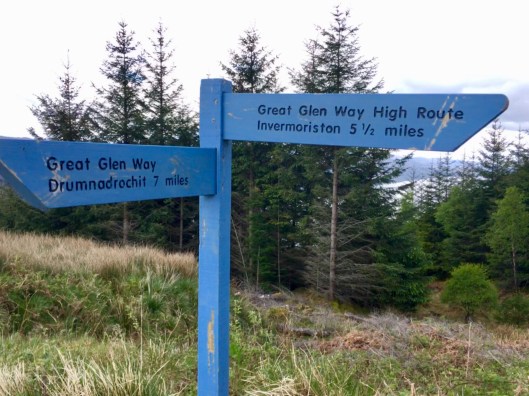
Today’s leg was supposed to be around 18 miles. As yesterday, there was a choice of routes. The low route skirted Loch Ness at a height of around 50ft for much of its 6 miles to Fort Augustus. The high route rose to 330ft and provided awesome views of the loch and the Monadhliath Mountains beyond although some of its 7 miles is in the forest. I chose the latter of course, not being a cyclist or a horse.

From Fort Augustus I was to follow the Caledonian Canal which links the southern end of Loch Ness with the northern end of Loch Oich. At the junction with Loch Oich I was to use the Invergarry link to get me to Invergarry for the night.

Once I had recovered from the wonderful surprise of Mark Horrell’s text early in the morning at the Darroch View B&B, and having consumed Mrs Morgan’s substantial breakfast my goosebumps and I headed off in glorious sunshine. The initial walking was easy along roads and good tracks, the River Moriston was in picture postcard form and my tread was light.

After a couple of miles of mixed deciduous and pine woodlands I reached the point at which the low and high routes separated. The latter took no prisoners and a well made track thrust upwards with some vigour. I didn’t see Mark and Edita at all on this day. I know they were heading all the way to Fort William. Unless they left Invermoriston earlier than me I suspect they took the low route. If so, that was a good call. The next half mile was relentlessly steep with no views. With dense pine all around the wildlife count was low and with rocks to my right even if there had been any life I wouldn’t have seen it. The purpose of this section was just to get up to where the views were.

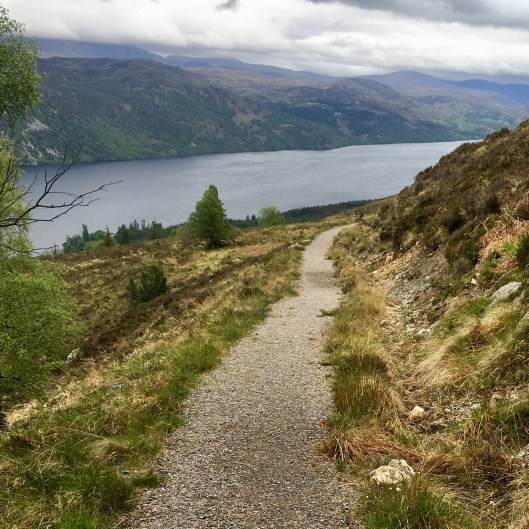
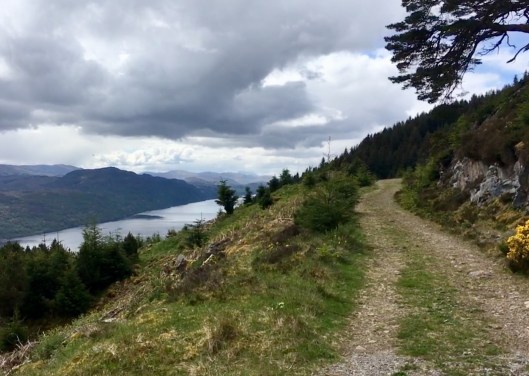
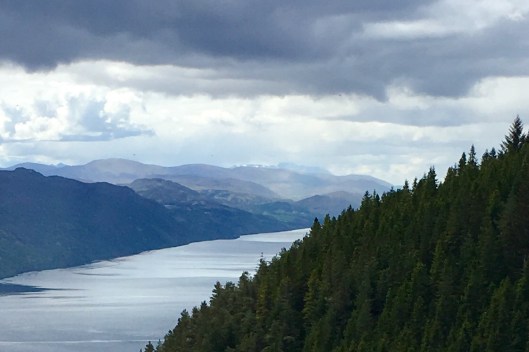
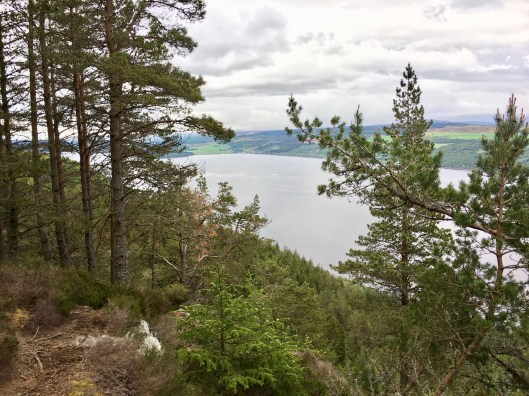
Then through sweat-streaked specs the view appeared right on cue. The pine forest fell away and I was presented with Loch Ness stretching away to the right, a big dramatic sky above and a sunlit path heading south. Every drop of perspiration had been worth it. I was breathless, literally and figuratively.

There was not a soul to be seen. The silence was broken only by the crunch of my boots on gravel and the skylarks above and it sounded as though I wasn’t the only one in their element. What joy! I fleetingly recalled that hidden far below but well within earshot of those on the low route, the A82 lurked. But that was of no matter to me. Not yet at least. My path snaked across open land well above the noise and fumes of real life.

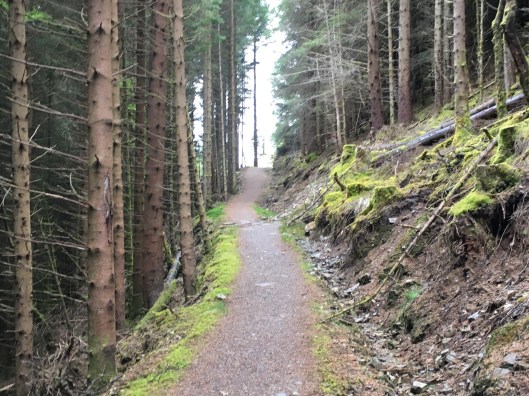
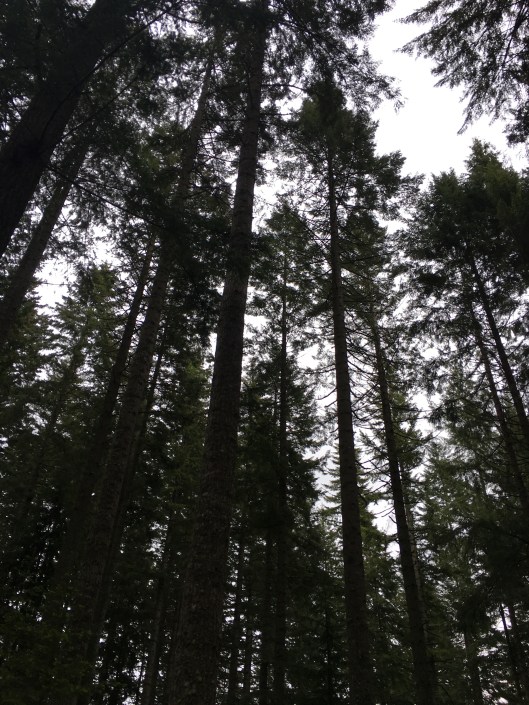
In due course the track wended it’s way lower and the open moorland gave way to pine trees of a dizzying height…

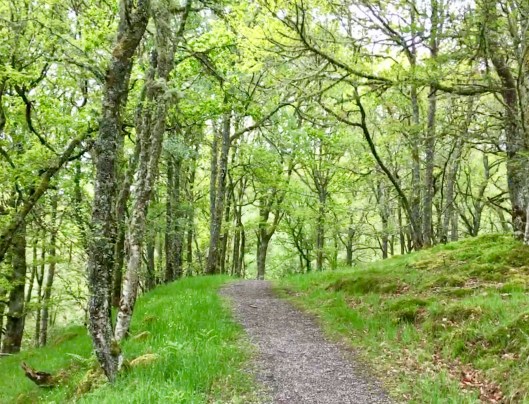
… and subsequently to deciduous bluebell-decorated woodland as we approached Fort Augustus.

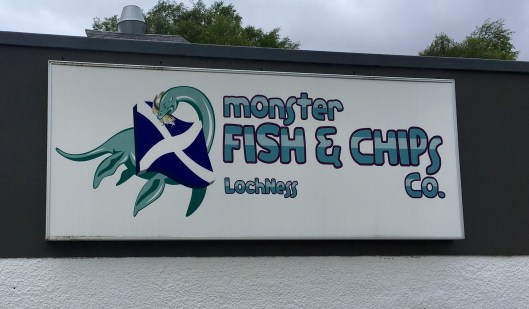
This small town relies heavily on tourism. All needs are catered for, from riders, cyclists, walkers, sailors, and canoeists to those arriving by cars and buses all with the ‘Nessie’ theme central. I was amused by the fish and chip shop. As with many if not all Fort Augustus businesses a link to ‘Nessie’ was, apparently, essential.

For me the high point of my transit, not being hungry, thirsty, in need of anything tartan or a cute Nessie fridge magnet, was the canal. While the ‘Lock Inn’ was a cleverly word-played temptation my interest was focused on the hive of activity on the locks of which a flight of 5 lower craft from the top of the canal down onto Loch Ness. There were many craft large and small all being marshalled either up or down the flight. I was very impressed by the efficiency and control of this operation and it’s management by the lock team. I can’t really capture all the activity in a single photo but hopefully you’ll get the gist.

This proved to be the last bit of waterside life for some time. Apart from the occasional, surprisingly occasional given the activity in the flight of locks, pleasure craft and a handful of walkers or cyclists there wasn’t a lot of movement on the path ahead. The couple in the distance in the photo below were Dutch. The size of their packs spoke of camping rather than using B&B, hostels or hotels. I spoke to them later, after they dubbed me ‘professional’ zipping by in T-shirt and shorts double-poling. They were loving Scotland and the fine weather although they were fully dressed for rain. Despite this they were in very good spirits.

After 3 miles or so of flat, level greyness I came upon Kytra Lock. This picturesque lock is one of 2 that manage the water level between Fort Augustus and Loch Oich.

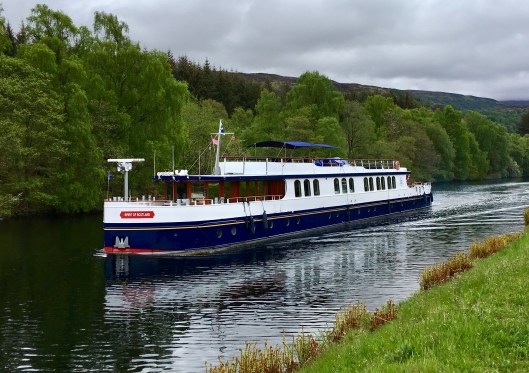
The next would be Cullochy Lock and after the previous hour’s quietude I expected more of the same. But it was not to be as the handsome ‘Spirit of Scotland’ chugged into view. Sadly it was empty but maybe it was just being brought into service and the Captain offered a cheery wave.

Then it was ‘head down’ and power pole to the next lock. Cullochy Loch was much busier than the first.

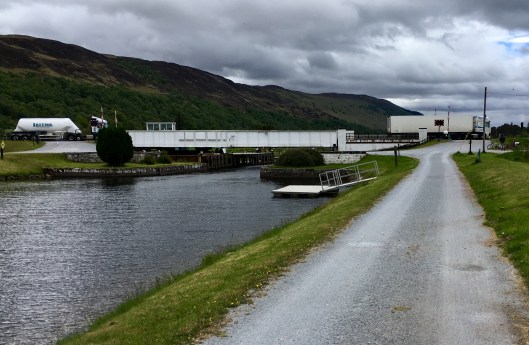
Not long afterwards the welcome sight of the Aberchalder swing bridge could be seen . The only regret was that I was still being ‘tractor-beamed’ to it by the same monotonous grey ribbon, i.e. the characterless path. Even from a distance I could see the A82 was busy but I was pleased to see it as from there I would be in woodlands again and in Invergarry, my target for the day anticipated in under an hour.

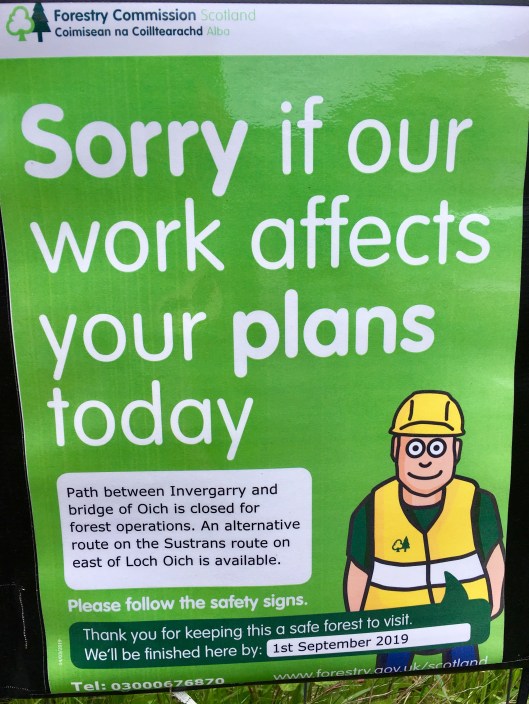
But it wasn’t to be. On reaching the woodlands I found this:

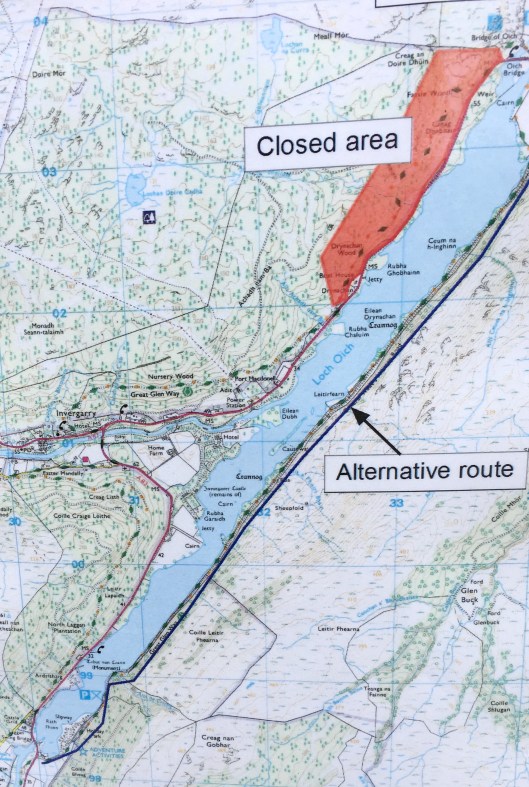
Drat! My route was blocked! As you may be able to see the footpath is within the red-shaded Closed Area.

I considered ignoring it and going anyway but was advised by the bridge master that the closure was patrolled and I would be turned back. I then walked along the A82 for 20m or so to see if it was viable to take the road, but it wasn’t. The A82 is very busy and not especially wide. When any combination of trucks and coaches pass they take up the full width of the road leaving no space at all for walkers and they whistle by at an alarming speed bearing in mind their proximity. Nope, I had no choice but to bite the bullet and use the alternative route. Instead of a short walk of around 3 miles down two-thirds of one side of Loch Oich I now had to walk the full length of the loch down the other side as far as the North Laggan Bridge and then back up to Invergarry. My walk had just increased by 5 miles. The 18 mile day was now 23. Hurrah! I like a good walk.

As if to rub salt in my wound I was unable to cross the bridge until it had opened to allow a craft to pass. No matter – it was interesting to watch the operation of the bridge while swallows performed in the nearby field.

IMG_4704.jpg

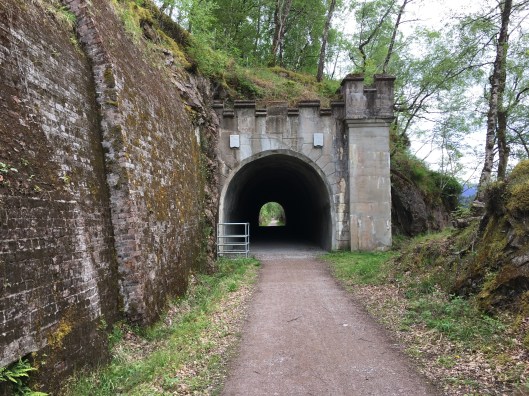
Once across, it was clear the route down the east side of loch was going to be something new. It was a disused railway line. A helpful nearby information board advised that this section of line was part of the Invergarry and Fort Augustus Railway, built between 1897 and 1903, which was intended to be the first stretch of an Inverness to Fort William railway following the Great Glen. Its tracks, bridges and tunnel were all built to mainline standards but the plan fell through. Competition between the various Highland railway companies meant that the second stretch of the line to Inverness was never completed. There was not enough local traffic to support this part of the line in isolation and it finally closed in 1946. While its tracks were sold for scrap the tunnel remains.

IMG_4716.jpg

Hereafter it wasn’t the most interesting of routes being dead straight with elevated damp woodlands on the left and mixed woodland and scrub to the right with the loch beyond. However increasing numbers of rhododendrons and occasional broom added colour and the A82 was too distant to disturb the peace and birdsong.

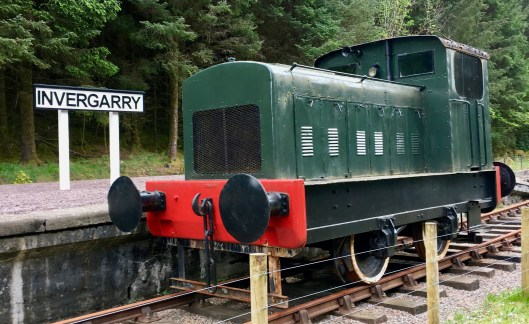
There was a bonus towards the end of the line: Invergarry station, or at least a platform with a sign and a loco under reconstruction. A nearby noticeboard advised that this was the work of the Invergarry Station Project.

IMG_4729.jpg

Not long afterwards my trek south was brought to a close by the North Laggan bridge which afforded dry passage to the Invergarry side of the loch and I was once more able to think of a shower, a beer and dinner.

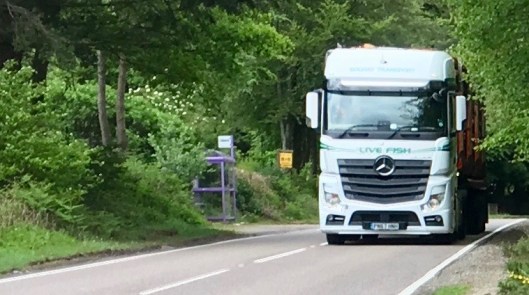
There was just a short section of the A82 to negotiate in order to reach the mountain track during which the prospect of being battered at speed by a consignment of live fish loomed large.

IMG_4740.jpg

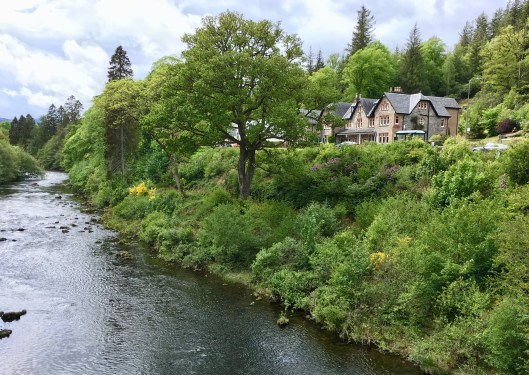
Eventually, after more miles than had been planned around the lock to be known as Ouch rather than Oich, the Invergarry Arms Hotel hove into view. Standing proudly by the side of the River Garry this venerable and award winning hotel has been welcoming guests since 1885. Today that’s where my head was to be rested. That is after a jolly fine dinner and a wee dram of Caol Ila, my favourite malt.

IMG_4759.jpg


The Big Reveal – who was that Masked Man?

23 Thursday May 2019

Posted by andyjameswriter in The Great Glen Way

≈ Leave a comment

I left you at the end of yesterday’s blog in a state of anticipation as to the identity of the mystery man. You remember, the chap in the Invermoriston Arms missing his cycle gloves. Some of you will know him while others will need some introduction and the context.

During the first couple of days of this week I and a cycling couple have been a ‘tag team’. Barely out of Inverness on day 1 we met early on and assisted each other navigate around a building site. Me being on foot with go-faster trekking poles I was more fleet than the cyclists as they were pushing laden bikes uphill. Of course they cheerily overtook me later but then I overtook them while they took lunch and I pressed on. Naturally they passed me again later. On each occasion pleasantries were exchanged but there was no recognition.

On day 2, I made an early start but in due course the tag-team couple overtook me. However they were tempted by a trackside coffee shop (curiously hidden) and the guy spent some time trying to find the vendor and his offerings, without success. Meanwhile the lady had pressed ahead, presumably concluding that a cup of cold coffee wouldn’t be her cup of tea. While his foraging was underway I caught up with the chap. He explained the situation and we both moved on.

It was he and his cycling partner who I saw in the Invermoriston Arms later that day, but with their backs to me and my focus on the most excellent Red MacGregor there was, again, no recognition. Even when he returned to look for the missing gloves there was none.

Then early on the morning of Day 3, I received a simple personal Twitter text saying: “Hey Andy, are you they guy who keeps overtaking these two people on mountain bikes?” (Accompanied with a photo of the couple in cycling gear). And it was indeed me.

The goosebumps started when I saw the Twitter handle: it was from Mark Horrell. Indie author, hugely influential mountaineering blogger and Everest summiter.

“So what”, you may say. Let me provide some context as to his place in my life.

Back in 2013, when I still harboured the belief that I could stand on the summit of an 8000m peak, I was preparing for an attempt at Cho Oyu, the 6th highest mountain in the world. In scouring the internet I found a great ebook called ‘The Wrath of the Turquoise Goddess’. I absolutely loved it and subsequently bought another by the same author: ‘The Chomolungma Diaries’ which was an account of the author’s attempt on Everest. In particular I loved the author’s written style. He presented things in a matter-of-fact, entertaining and informative manner which appeared to be based upon daily blogs. I was thus inspired to do likewise. I went on to blog extensively during my attempt on Cho Oyu and upon returning I self-published a book: ‘The Turquoise Goddess – not just about the summit’. Some of you were kind enough to buy it. (It’s still available on Amazon 🤣). This was achieved. entirely due to my reading of Mark Horrell’s work.

Then in April 2014 I was in Everest basecamp with Tim Calder and others to attempt to summit. In the event that attempt was stymied by the dreadful impact of the Good Friday avalanche, which resulted in the death of 19 Sherpas and, through political incompetence, closure of the south face for that season. Nonetheless I still blogged extensively and discovered a love of wild trekking. Upon returning to Kathmandu in early May I was lucky enough to meet Mark in a well-known bar and thanked him. That was the only time we met but the legacy lived on.

Within a few days I learned that I had been made redundant and with my wife Clare’s assistance I decided to try writing as a profession. Again due to Mark’s inspiration and Clare’s belief and encouragement, that summer I wrote, and was paid for, several pieces for the now defunct magazine ‘The Ionian’. I even had a cover photo published. I still fondly remember receiving my first acceptance email from the editor. We were on a beach in Corfu and spent more on celebratory wine than I grossed for the article.

Was I made as a writer? Er, no. In the event, while I loved writing, it was never going to provide a living wage. In October 2014 I returned to gainful employment with CLS, which I loved. Nonetheless I look back on the summer of 2014, which was not a great period for many people, with enormous pleasure and I place Mark Horrell’s influence right at the centre of it.

So, Mr Horrell. It was a real pleasure to meet, albeit in transit and fleetingly, you and your beautiful and talented wife. She being the lady I now know to be Edita, a humanitarian aid worker and the first Lithuanian woman to summit Everest.

That’s it. The big reveal is over. Thank you all for bearing with me. I appreciate this blog won’t have been hugely entertaining to some of you but I believe in telling it like it is, or was. This week has been fantastic fun for me and it has been brilliant to be blogging again. It, and your responses to date have shown me that enough people like my writing to continue. Thank you so much.

As a result I will continue to blog travels and will now complete the blog from my Upper Dolpo trek in late 2016. Moreover I will endeavour to write the related book I promised: ‘The boy in the orange jacket’ which will attempt to explain Dolpapan transhumance. It will take a while but I will do it.

Why? Due to Clare’s encouragement, your support and Mark’s inspiration.

Thank you for indulging me. The full Day 3 blog will follow tomorrow.

Broom and primroses, and an extraordinary encounter

22 Wednesday May 2019

Posted by andyjameswriter in The Great Glen Way

≈ 7 Comments

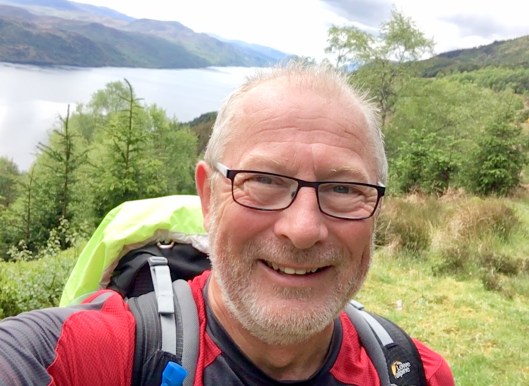
Wow. Just wow. Before I test your patience with a second Great Glen Way blog I just have say thank you for the comments, public and private, on yesterday’s missive. You give me confidence to try another. This is me grinning and feeling blessed, with the much more interesting Loch Ness in the background. Thank you. 😀

This is Day 2 and my route continues southwest, from Drumnadrochit to Invermoriston. For the statisticians out there this is slightly more than the middle third of Loch Ness. It was a relatively short day at around 14 miles with a choice of following a ‘high’ route or a ‘low’ route.

The low route skirts the loch and is ideal for cyclists and horses. The high route has some significant ‘ups and downs’ but the ‘ups’ are rewarded with magnificent views of Loch Ness and on a clear day Ben Nevis may be seen well to the south with the Cluanie Mountains visible to the west. There was no choice to be made.

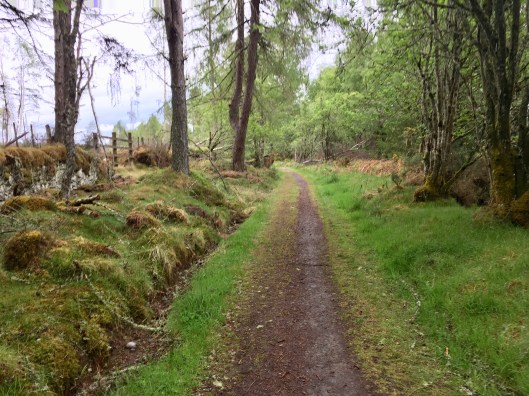
However let’s not jump ahead. They follow the same path for the first few miles then split. The route out of Drumnadrochit was a series of beautiful but uninspiring tree and scrub-lined minor roads significantly improved by being travelled following a wholesome scrambled egg and smoked salmon breakfast. As I gained height I noticed a resemblance between the flora and scrambled eggs. I wasn’t hallucinating. Rather the broom, previously merely present, was now more abundant. Never had I seen such coverage. We southern Englanders are familiar with the extensive show of rapeseed blooms in springtime but this broom was even more dramatic given the climate.

Despite its visual impact you had to be there and I know there is only so much fun I can generate for you through tales of broom-endowed minor roads.

Bye and bye I entered woodlands and, oh, the aroma of wet foliage and damp soil. Many birds were chirruping but with the massed chorus of chaffinches exultant.

This verdant environment was short lived and confined to the loch side and other low lying areas. In due course I headed towards higher terrain and the occasional glance of the loch was soon followed by the split of routes.

Upwards I trod on the ‘high route’, enjoying the breeze and freshness afforded by the more open ground and revelling in the views to my left and ahead. Despite the threatening skies the worst that happened were a few sprinklings of Scottish rain. Hardly rain at all but sufficient to reinvigorate the aromas of soil and vegetation.

Then my excitement level increased further. There, right down at the end of this loch, beyond even the second loch yet unseen and then on some, was Ben Nevis. It was hard to see, nestled as it was behind Carn Mor Dearg and it’s glorious arête (surely the best way to reach the summit of The Ben short of scaling one of several North Face routes with ropes and metalwork) and with its head in the clouds (sigh).

Then the primroses started to appear. First in ones and twos then in families. It was becoming primrose central. If anyone knows why, in this place alone (so far as I know) the primroses have found kinship with thistles please tell me.

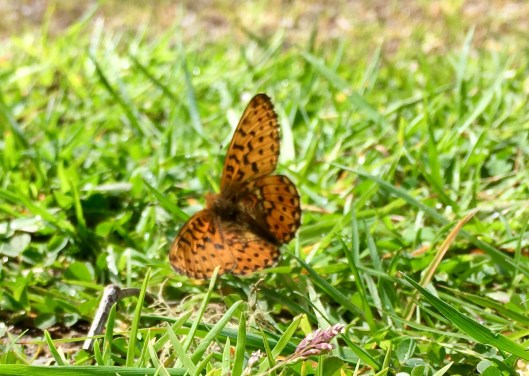
Then, joy of joys, a glorious winged beauty landed nearby. The Pearl-bordered Fritillary is orange with black spots on the upperside of its wing and has a wingspan of 38–46 mm (1.5 to 1.8 inches). It is a gem in the wilderness and it just sat there and let me photograph it.

Between areas of high ground a little treasure was stumbled upon; the Troll Bridge. This quirky but very practical bridge was opened in 2014 and features a notice board showcasing Tröll-related poetry, including some by local schoolchildren.

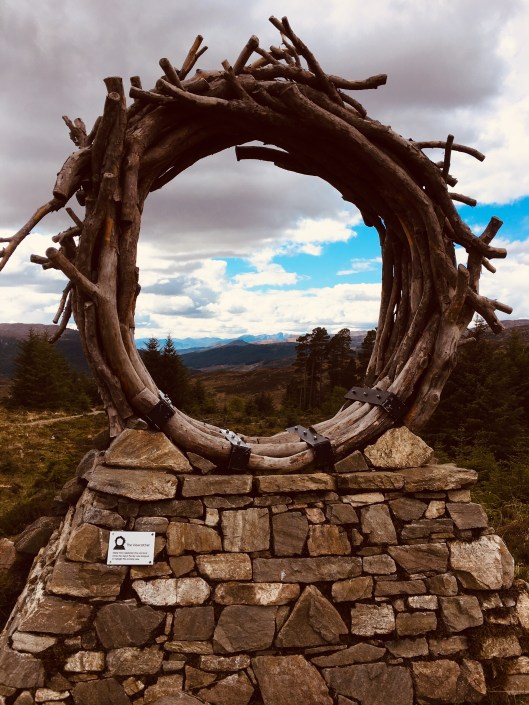
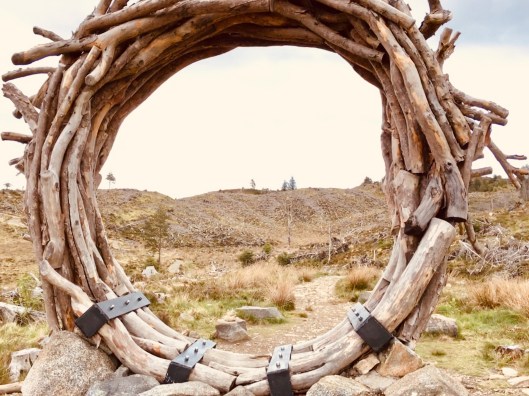
Moving on I headed into more open ground, much of it extensively logged. Out of the blue I came across the The Viewcatcher. A plaque says it was made from Caledonian Pine and local stone and was designed to highlight a stunning view. And it did so!

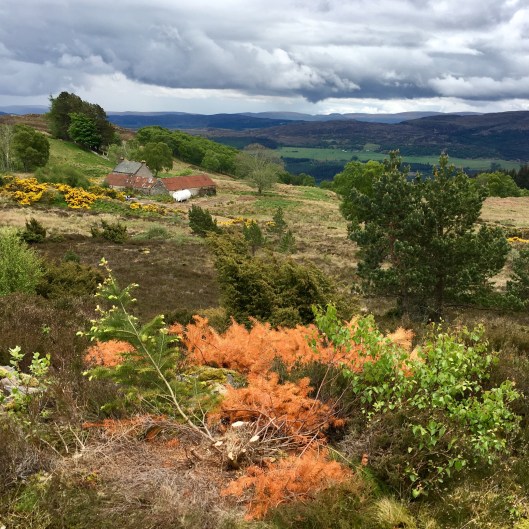
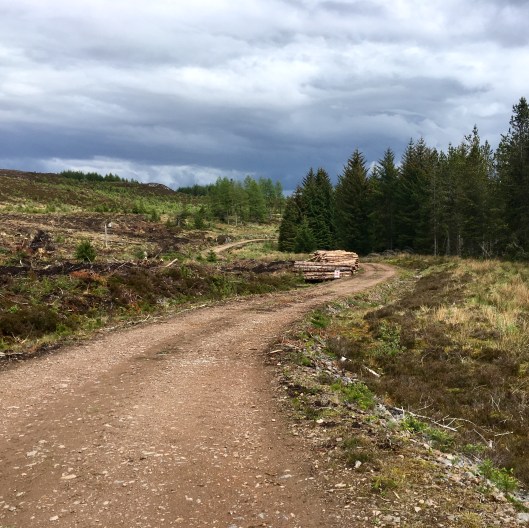
The view was that of the Cluanie Mountains to the west. But without in anyway decrying the value and necessity of sustainable logging, the reverse view was less easy on the eye. Not on mine anyway. I hadn’t troubled you with this before, but there is extensivelogging.

And that’s about it for Day 2, except for one quite remarkable encounter while enjoying a much anticipated pint of Scottish real ale in the Invermoriston Arms late in the afternoon. I was fortunate to find the Orkney Brewery’s Red MacGregor, a 4% ABV ruby ale which was the Champion Beer of Britain last year in the bitter category. But that wasn’t the remarkable encounter.

When I went into the bar there was a couple in a window seat. Dressed in cycle gear they had their backs to me while I was at the bar ordering the Red MacGregor, then they left. I hadn’t recognised them even though our paths had crossed a few times during Day 1. I then occupied their table and shortly after the man returned to see if he had left a pair of cycle gloves at the table. He hadn’t and that was the end of the encounter. Early the following morning I had a private Twitter message from him.

He had seen yesterday’s blog and he knew me, and me him. Stay tuned. I’ve been in goosebumps all day about this…

Are you out there Nessie?

21 Tuesday May 2019

Posted by andyjameswriter in The Great Glen Way

≈ 11 Comments

It’s an uncommonly fine day in the Highlands of Scotland.

Earlier today I arrived in a wet and grey Inverness having taken the first train there out of Glasgow’s Queen Street station. Why? Because Inverness is the start (or end) of the Great Glen Way; an iconic 78 mile long distance path. It links Inverness on the Scottish east coast and Fort William in the west via a series of waterways including Loch Ness. However, much of the Great Glen Way is along the glenside rather than the shoreline mostly for the magnificent views afforded by the elevation but not least as much of the shorelines are hogged by the A82, a quite busy main road.

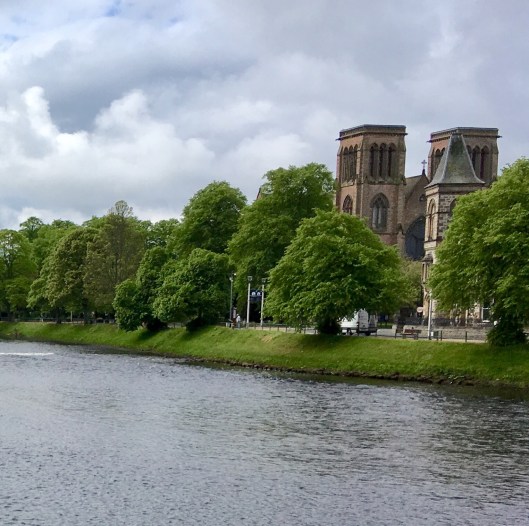
At just after 11am, and having bought a waterproof cover for my rucksack carelessly left at home, I set off along the River Ness. Passing Inverness castle to my left I approached Inverness cathedral over the river to my right. And the magic started. A piper was playing on the other bank of the river by the cathedral. He wasn’t performing or busking. He was just playing, seemingly for himself. And now unseen in this photograph, for me.

With joy in my boots, the rain having abated and with a shiver down my spine from the impromptu piped welcome, I continued to the official start (or end) of the Great Glen Way.

I should explain that the Great Glen Way can be walked in either direction. There is no ‘right’ way or ‘wrong’ way. However most people walk west to east, from Fort William to Inverness to benefit from having the prevailing wind at their back, rather than in their face. I’m doing it the other way for logistical reasons to tie in with train timings and so that, as I’m doing the walk over 4 days rather than the customary 5, I will have a 25 mile leg as my final day rather than my first day. Mercifully there is no significant wind forecast so the direction of travel makes no difference.

My journey southwest will be on the northern side of the Great Glen watercourses. These comprise not only the star of the show and her leading man, Loch Ness and Loch Lochy, but several other smaller waterways, including the Caledonian Canal which links Ness and Lochy.

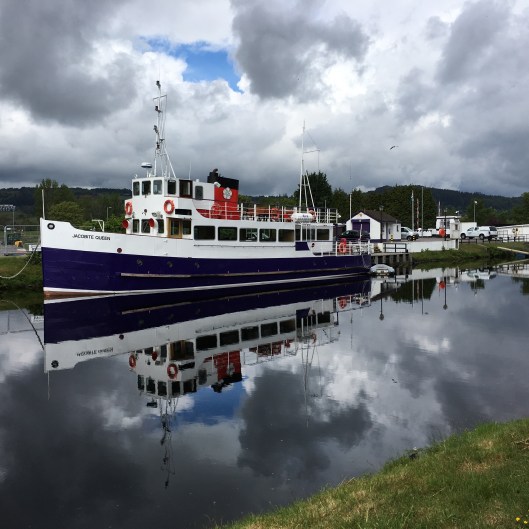
So first I had to cross to the northern side of the River Ness. This was achieved at the lower Tomnahurich Bridge a swing bridge alongside which was moored the Jacobite Queen, a pleasure cruiser offering waterborne tours of Loch Ness.

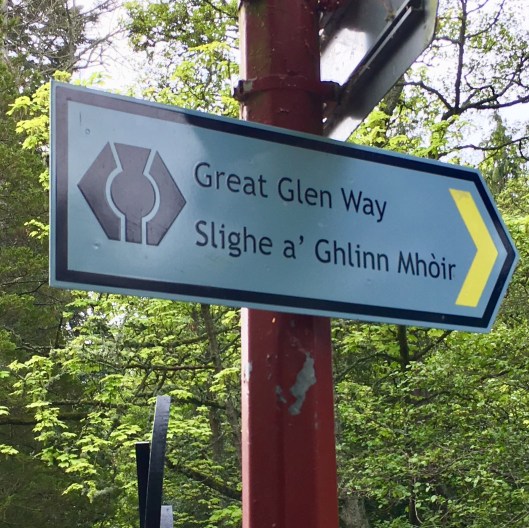
Then is was time to head for the hills, following the Great Glen Way (GGW) route markers between the Highlands Rugby Club and the Inverness Botanic Gardens. Thankfully the markers work in both directions. New builds and more traditional dwellings soon gave way to woodland tracks based upon ancient drove routes. These were flanked with silver birch, laurel and occasional pine with the air redolent with the heady aroma of damp undergrowth. The air was so damp it was impossible not to sweat although, in truth, it was not hard going.

Mile followed mile with many changes in outlook, from close woodlands through wider-tracked vehicle-supporting lands to open moorland. However the look of much of this was spoiled by logging.

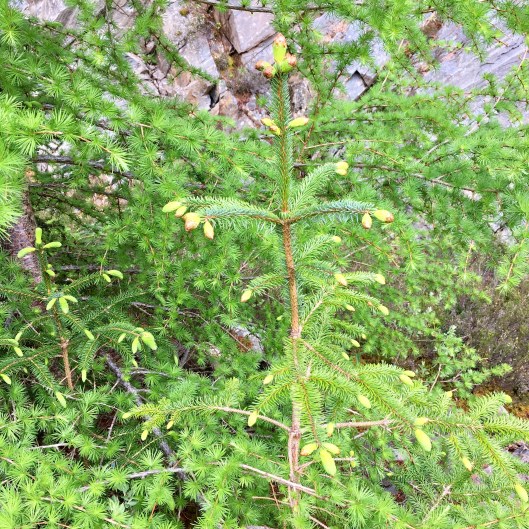
But even here in these more barren areas springtime fecundity was rife. There were many butterflies including the orange tip and small white. The new growth on pines was clear with almost all pine branches seeming to have been dipped in a lighter, fresher, hue of green.

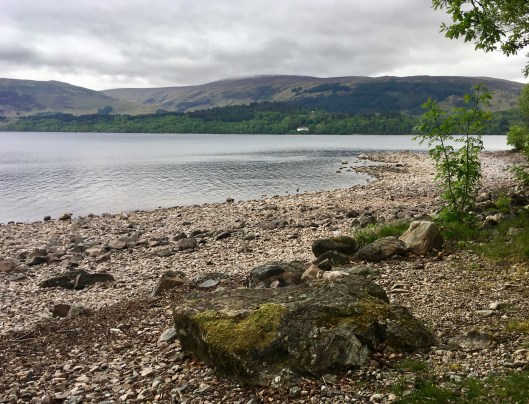
Then after, eventually, clearing the woodlands I was rewarded with my first glimpse of Loch Ness through the trees. And shortly after there was a clearing. Sadly no ‘nessie’ in sight but nonetheless a glorious vista over one of Scotland’s most iconic lochs.

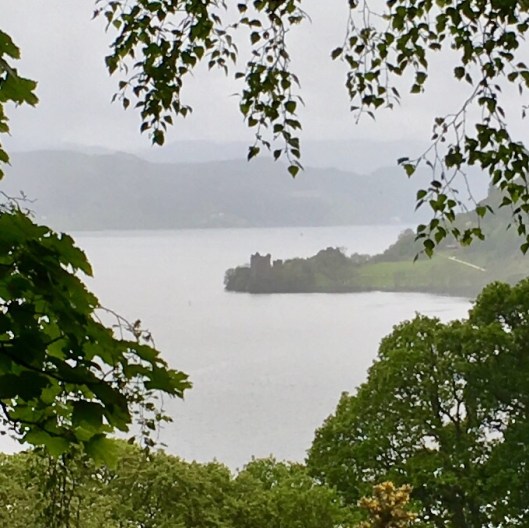
Unsurprisingly it was now raining. What was unusual was the lack of accompanying howling wind and drop in temperature. As a result while my newly purchased pack cover was called into service I didn’t bother with a waterproof on the grounds that it wasn’t cold and I was waterproof. In the event the rain was intermittent and I soon dried. More importantly I was rewarded with a glimpse of Urquhart Castle on a promontory, misty and distant to be sure but there it was. Urquhart Castle was fought over many times and was variously controlled by the English King Edward and the MacDonald Lord of the Isles in the Middle Ages. It was transferred to state ownership around 100 years ago and is now among the most visited of Scotland’s castles.

Shortly after, and having gone through several iterations of ‘rain/no rain’ I was in the outskirts of Drumnadrochit, where I was to spend the night. Having come over 20 miles from Inverness, seen almost nobody including ‘nessie’, but with all senses newly re-tuned to the beauty, quiet and richness of the Scottish Highlands I headed for the bar in the Benleva Hotel where I was to spend the night. The hotel that is, not the bar.

Trek Day 18 – to Chhepka

03 Sunday Sep 2017

Posted by andyjameswriter in Dolpo trek

≈ Leave a comment

After our day of rest in Ringmo it was time to move on. I was certainly keen to get back on the trail and I think others were too. The end of the trek in Juphal was still over 25 miles away over less rough but still demanding terrain. While we could have done that distance in a day if necessary we would have arrived very late in the day and would have had less time to enjoy the increasingly green and verdant surroundings. Instead we decided to head for Chhepka around 15 miles away, which would make the walk to Juphal as an easy final half-day or so. In light of this breakfast was at a leisurely 8 a.m. and we enjoyed the last of our sheep with tea and bread.IMG_3998 - Version 2.jpg

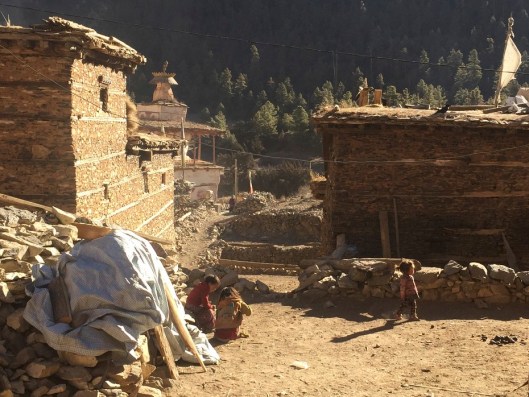
At an equally leisurely pace bags were packed and loaded. Then by around 9:15 we were on our way, warm-stoned dwellings reflected golden morning sunshine and the distant grey-brown mountain ridges cut a sharp and vivid contrast to the clear blue cloudless sky. As we prepared to leave the matronly lady had a few brightly-coloured hand woven scarfs for sale then we bade her farewell without ceremony. Children were already playing in the dusty courtyard as we headed for the track south and as we were by now a common sight about Ringmo our departure went unremarked.IMG_4003 - Version 2.jpg

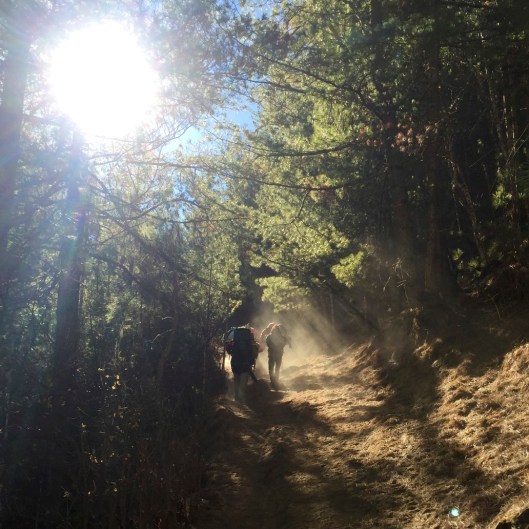
It was great to be walking again. The dusty animal dropping-laden streets of the village soon gave way to a stony track with low scrub on either side. Ahead was a pine forest backed by a mountain ridgeline in stark silhouette against blue. Striding past a huge ochre and cream chorten we soon caught up with a herder and his yaks and followed him along the pathway to the forest. Not being in any hurry we were content to wait but the herder soon waved us past and we had the forest path to ourselves, bright sunlight filtering through the green making subeams through the dust kicked up by passing feet.IMG_4029 - Version 2.jpg

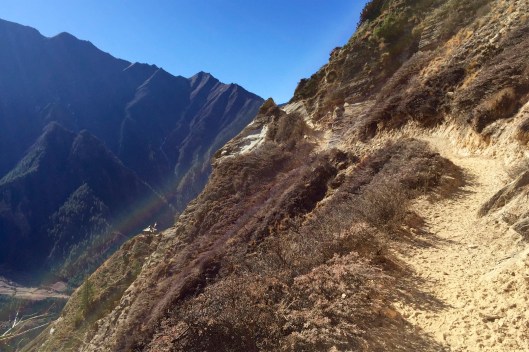
The trees soon gave way to the kind of terrain we were more used to; a narrow sandy track clinging to the side of a mountain. Ever since we lost height heading towards Lake Phoksundo the surroundings have been less stark and there has been more evidence of habitation. The track itself was indented with the footprints of many animals and their herders while from time to time prayer flags of red, blue, yellow, green and white drew our gaze upwards from the drabness underfoot to the glorious blue sky. From our perch high above the Phoksundo Khola, while our view south remained dominated by the jagged 5000m (16,000ft+) ridgeline to the south-east, deep down on the valley floor there were settlements and walled enclosures. Both looked barren in November but their presence showed that in spring life would return. Meanwhile on our side of the valley, in the vicinity of Nepal’s highest waterfall – on the Suli Khola, a tributary of the Phoksundo Khola itself and whose dimension proved impossible to photograph meaningfully without a wide-angle lens – a colourful shelter appeared seemingly balanced on a small pinnacle ahead.IMG_4041 - Version 2.jpg

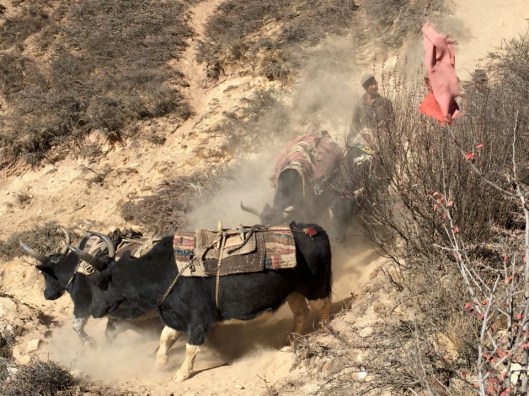
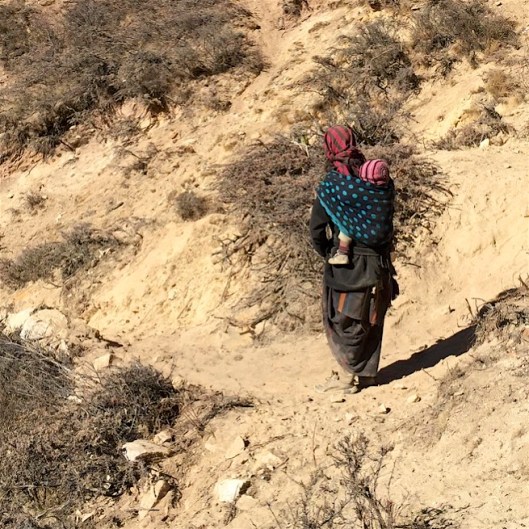
Taking the appearence of the shelter as an excuse to prolong today’s relatively short journey we stopped for a while to admire the stunning views. Although eyes were initially drawn to the waterfall to our left and the settlements of Rike and Maduwa in the Maduwa Khola valley snaking around the feet of the mountains to the east there were a succession of passers-by. While our laden ponies grazed the thin scrub nearby the herder we had passed earlier in the day hailed us as he drove his yaks past at some pace. A few minutes later 2 men passed us with 4 yaks adorned with load-carrying paraphernalia but no actual loads, followed a while later by the mens’ families; a lady in traditional dress carrying a youngster in a black and blue scarf papoose on her back and 2 young boys careering down the track without fear of the drop to their left.IMG_4061 - Version 2.jpgIMG_4070 - Version 2.jpg

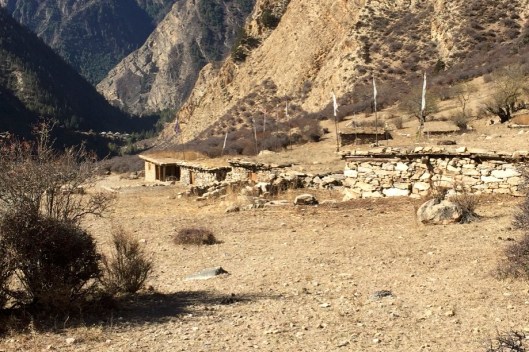
Thirty minutes down the track we came upon a small settlement that appeared only recently vacated and whose inhabitants we took to have left to head south, although from there less than a mile ahead, several colourful roofs could be seen.IMG_4079 - Version 2.jpg

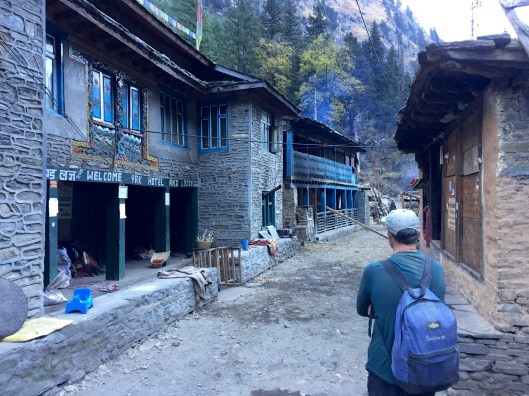
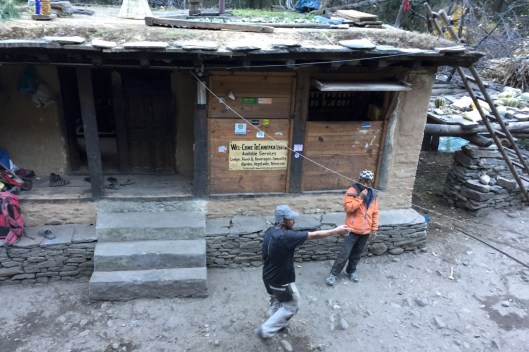
Just 15 minutes later we were alongside the Jharana Hotel and Lodge. This 4 room, 15 bed, 1 toilet establishment is basic and guests will need their sleeping bags in lieu of bedding, but it boasts 24 hour electricity, presumably due to the large array of solar panels in the garden, and running water. Next door the lodge sported a sign saying (curiously given that the colourful roofs we saw from the deserted settlement turned out to be nearby village of Sanduwa) “Wel-Come To Chunuwar (3134m)”. It went on to advertise: Lodge, Food & Beverages, Campsite, Garden, Vegetable, TeleCom.” It looked pleasant enough with sturdy walls, wooden-framed windows and doors with good padlocked bolts.

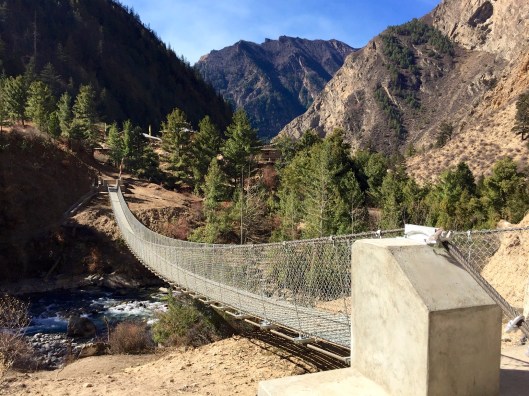
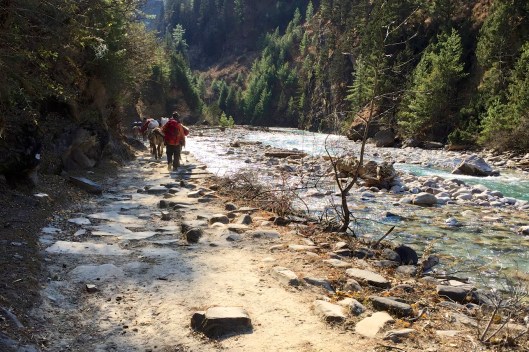
Next door was a suspension bridge across the river to Sanduwa. This splendid bridge, built in 2014, bore a sign saying “Donated by KADOORIE Agricultural Aid Association British Gurkhas Nepal.” The KAAA is the Kadoorie Charitable Foundation’s Nepal field team and has a close relationship with British Gurkhas Nepal. The KAAA is a long-term implementing partner of the Gurkha Welfare Trust and provides funding towards the trust’s community medical camps in remote areas. The KAAA has an extensive programme of community aid projects that develop the basic infrastructure of Nepal, improving village economies and quality of life, and this bridge was just one example. In 2015 and 2016 alone Kadoorie provided 5 micro hydro projects to support remote villages, built 20 bridges, built 20 remote medical camps and completely rebuilt 3 villages following the Nepal earthquakes. The KAAA was founded by the late Sir Horace Kadoorie CBE, a Hong Kong-based industialist, hotelier and philanthropist. Well done Sir!IMG_4086.jpg From Sanduwa there were many more river crossings as the path zig-zagged along the increasingly rapid and channelled Phoksundo Khola. With a Scandinavian appearance the terrain became more green with evergreen trees predominating. Conveniently, at around lunchtime we stumbled upon a small military base whose cooks were happy to sell us delicious Dal Bhat (Nepalese lentil curry) and some fairly cool San Miguel after which it was further criss-crossing of the river on normally, but not always, safe-looking wooden bridges.

It was after one of these crossings we saw a group of people and their pack animals ahead. We didn’t recognise these people as those who passed us earlier. They were in a small clearing to one side of the river and had makeshift campling equipment. A small group were higher up the mountainside to the rear of their camp and they were immediately recognised. To my delight it was the Boy in the Orange Jacket and his blue-scarved mother with a few others. They were gathering firewood and when they saw and recognised us little waves were excahnged and ‘Namaste’s’ called. Tim exchanged a few words with a girl wearing glasses. We had seen her before and she was notable as glasses are not common in Dolpo. How extraordinary that we were still in the footsteps of the transhumant family from Saldang. We were touched at the small recognition.

Moving on down the river there were periods when we were in a flat but still narrow part of the valley…IMG_4117.jpg

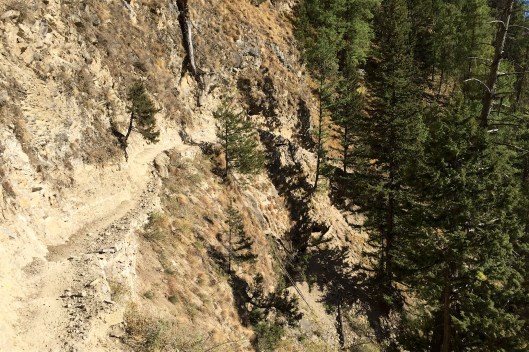
… and others when it was distinctly vertiginous and great care was needed to avoid a calamitous fall to the river far below.IMG_4138.jpg

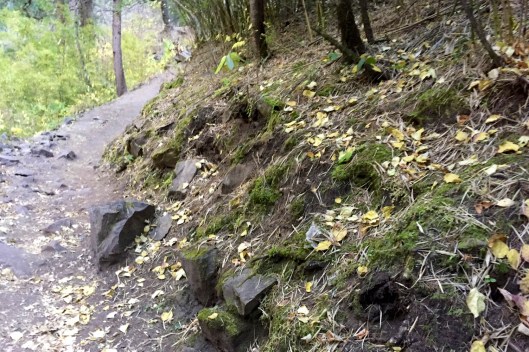
Mercifully those narrow sections became less common as the surrounds, in the space of an hour or two, went from looking Scandinavian to looking more British. Deciduous tress became more prevalent and the terrain underfoot went from rocky/sandy to rocky/earthen. Were it not for the obvious lack of British species we could have easily been in familiar woodland.IMG_4146.jpg

The cross-river hop-scotch and occasional revertions to steep-sided and thickly evergreen-wooded narrow gorges continued for another hour or so until we reached Chhepka at late afternoon. Chhepka is a single-street settlement of half a dozen dwellings and in the photo below Tim appears to be surveying it with a degree of scepticism despite the sign welcoming travellers to the Yak Hotel and Lodge.IMG_4184.jpg

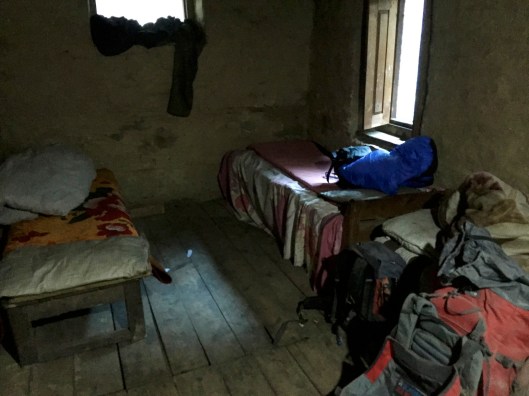
While it lacked the running water promised at the Jharana Hotel back up-river, and it certain lacked the other’ sunny disposition, it did have electricity and we were welcomed, found rooms, and fed. I shared with Tim in the best room. I didn’t dare enquire after the rooms which Lizzy, Mark and Jovi had, but they survived.IMG_4190.jpg

The hotel dining room was across the street, outside of which Gyalbu is showing Sangye where the toilets are – in a shed to one side of a field 50 yards away. The sign on the side of the dining room, on the wooden wall next to the shop (yes, that’s the settlement shop), was in exactly the same style and bore the same text as that which advertised the Lodge next to the Jharana Hotel. Except this one said “Wel-Come to Chhepka”.IMG_4193.jpg

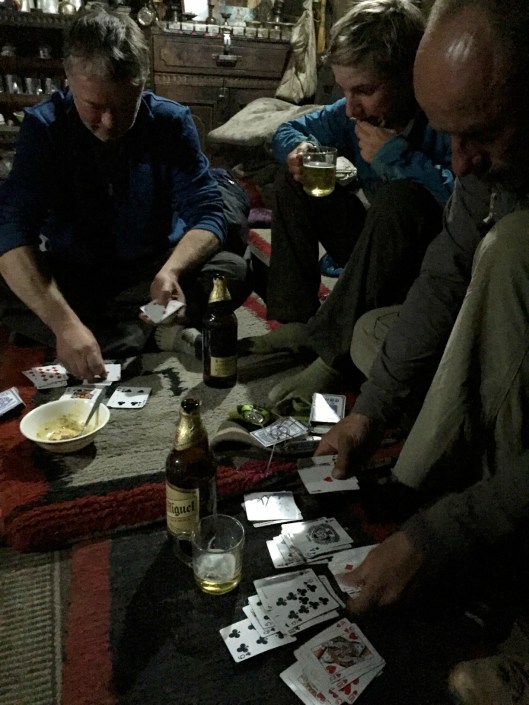
And welcome we were. The style of the dining room was what we had come to expect with a central stove and low benches to act a tables while diners sat on mats on the floor. We enjoyed black tea while waiting for the horses to arrive with our gear and once they had, and our gear was in our rooms, we ate. Meat and potatoes in a tasty rich sauce was washed down with more San Miguel and we played cards in the gloom…IMG_4203.jpg …while our horseman, Sangye and Gyalbu looked on in amusement beneath a sign unexpectedly saying ‘HAPPY NEW YEAR’.IMG_4206.jpg

The day, a day which saw us lose another 1000m (over 3000ft) in elevation while experiencing a range of different terrains in less than 20 miles, ended with a final unexpected pleasure. The lady owner open a cupboard in the corner of the room to reveal a small television. She explained that as it had been a sunny day she had plently of solar electricity and we could watch football on TV. So we did. San Miguel in hand, no sound and with a picture that was scratchy at best, we sat and watched football, while the lady owner spun yarn by the fire. IMG_4208.jpg

Trek Day 17 – at ‘rest’ at Ringmo

26 Saturday Aug 2017

Posted by andyjameswriter in Dolpo trek

≈ 2 Comments

Today, Saturday 19th November, was a rest day.

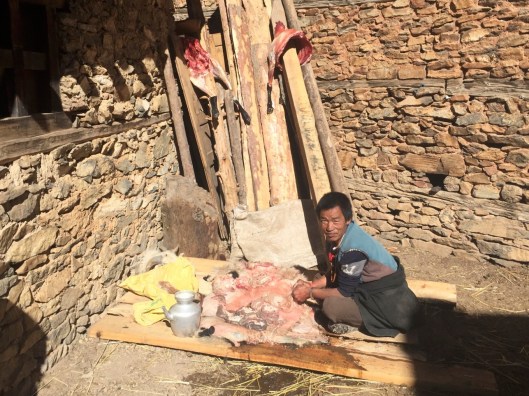
It began quietly enough with delicious egg banjos being served with tea. The banjos were omelettes rather than fried eggs between 2 slices of Nepali bread and they were going down very well. Until, that is, there was a bit a commotion outside. Further investigation revealed it was a sheep making a fuss in the courtyard; and not just any sheep but our sheep. Sure enough the sheep of which we had bought half the previous evening had just been swiftly despatched, skinned, butchered and halved. Each half was now drying on the end of a plank of wood in the corner of the enclosure where yesterday the yaks had been snuffling. Meanwhile the butcher, the owner of our guesthouse-cum-hotel, was cleaning the entrails and the fleece on a wooden platform close by where he could attempt to keep the flies off of the meat.

IMG_3932 - Version 2.jpg

After breakfast and our introduction to the realities of butchery in Dolpo, in mid-morning while Mark went in search of photographs Tim, Jovi, Lizzie and I went to the lake for a wash. Passing to our left the site of our post-San Miguel disorientation yesterday evening we once more faced the limpid Lake Phoksundo.

IMG_3952.JPG

Unseen in the photo above there was a Bön temple on a promontary to the right. The Bön religion pre-dates buddhism and is believed to have arisen in the 11th century. While Tibetan people and those of Tibetan ancestry such as the Dolpopa are predominantly Buddhist it is estimated that around 10%, known as Bonpo, follow Bön. These include the people of Ringmo.

At our side of the lake, a sensible distance from the outflow river – the Phoksundo Khola, we enjoyed the water’s freshness. Variously washing ourselves and our exceptionally grubby clothes we established discreet distances along the bank. My underpants were sensible black and had a similar cut to normal swimming trunks so I stripped to them and to the amusement of the others waded into the lake. To their astonishment I then submerged and, trying to make light of the effect the cold was having (the water having recently arrived from the icy mountain streams on either side) bobbed around for a while. This was my first all-over wash since the ‘stand-in-a-bucket’ event that resulted in my foot going into the long-drop toilet in Saldang and a less than relaxing wash. Sure, the lake was freezing cold but I felt clean for the first time in ages and was soon back on the bank drying off, supressing a shiver or two. With clean pants donned I lay like a large pink lizard on a large flat rock while my washing dried. After 30 minutes or so we were joined by Gyalbu and Sangye and chatted in the sunshine.

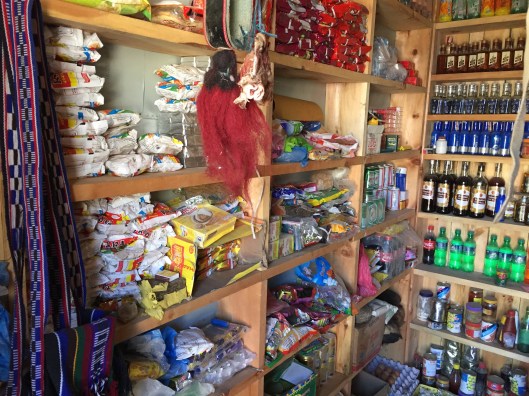
Shortly after noon someone suggested refreshment. Although lunch wasn’t long away such treats shouldn’t be missed when you’re not sure when the next may arise and adjoining the restaurant visited yesterday there was a small shop. Amid speculation as to whether biscuits, chocolate, or perchance another chilled San Miguel, were to be found we headed uphill as though we hadn’t seen a shop for weeks. The last we had seen was in Kagbeni at the start of the trek nearly 3 weeks before. Although we had made good use of the travelling tent-shop in Shimen just a week ago that seemed a long distant memory, being several passes and adventures in the past.

It was now clear from the sign above the door, proudly announcing in English, Nepali and Tibetan that this was the ‘Kanjirowa Traders & Suppliers with Restaurant’. Inside we found Dolpo retail heaven. There were drinks aplenty including bottled San Miguel and canned Lhasa beer. There was Ruslan vodka and Pepsi in cans, Frooti fruit juice, plastic bottles of Coca-Cola, Fanta and Sprite. There were bottles labeled ‘Virgin’ that I don’t think was oil. There was Khukri rum from Kathmandu. There was even Royal Stag, an Indian whisky. I mention this as it was so unexpected. There is not a road for miles and all of this must have been brought in on foot. But never mind the drinks. There were other more useful things too such as, to mention but a few, torches and batteries, lighters, crisps and other dry snacks, pony harnesses and adornment including a red-dyed yak’s tail, locally woven scarves, tins of vegetables, jars of peanut butter, trays of eggs, and clothing including trainers, flip-flops and more beside.

IMG_3964.JPG

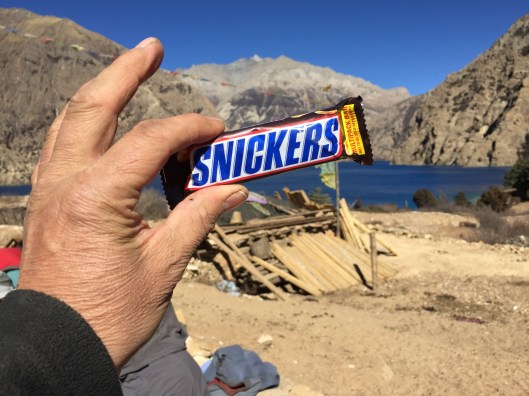
But I have left the best to last. An item of sustenance and joy that I last enjoyed many days ago and which is my staple mountain snack. The shop had just one, for an amazing 150 rupees (that’s about £1.10p). It needs no further introduction (cue drum roll…..)

IMG_3968.JPG

Yessss! Cleaned from the lake and wearing fresh clothes, warmed by the sun, in the company of great trekking buddies, refreshed by chilled beer (Lhasa on this occasion) and munching a Snickers. Does it get better than that?

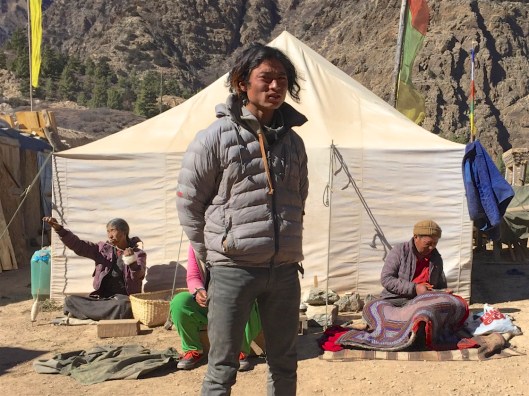
Next to the shop was a tent in front of which 3 people were working. A woman in a purple jacket and black dress was sat cross-legged on the ground spinning yarn. Next to her on stools was the a couple we first saw in the the hotel kitchen/diner yesterday. Then they were preparing food and the woman was memorable as she was wearing strident green trousers and a pink jacket. Now she and her partner, also dressed exactly as previously, were making rugs in the sunshine. The photo below shows the scene. It is not my finest as the colourful lady is obscured by our horseman but hopefully youl’ll get the gist.

IMG_3962 - Version 2.jpg

We were then shown into the tent and there were about two dozen chickens inside. The mystery of the appearance of the eggs had been solved. This part of Ringmo was a veritable hive of activity.

After a lunch of fried lamb (ours) and more wonderful Nepali bread I put my solar charger on the roof to ensure my camera had power for the next few days. Actually that was my iPhone but coverage was a rarity so it was never turned on. I then took out my contact lenses to give my eyes a break for the first time in several days and spent an hour or so re-packing my main bag so that the items needed during the last days of the trek were to the top. Through the window of our room I had a good view onto the roof next door where women were making ‘corn dollies’ although the significance of this would not become clear until later.

IMG_3988 - Version 2.jpg

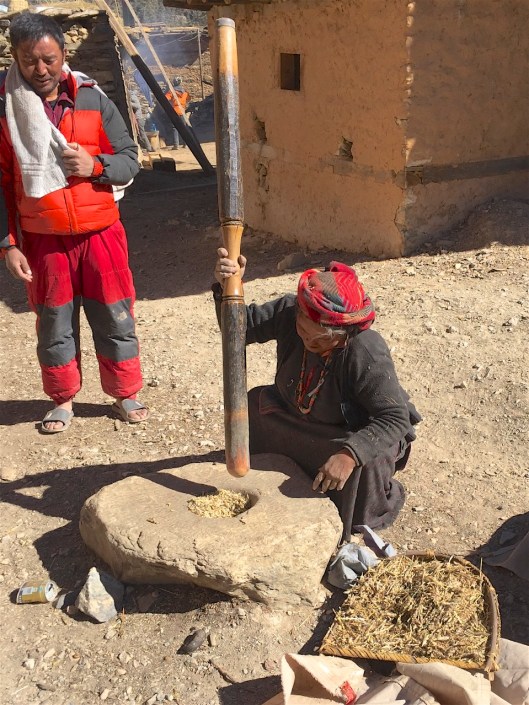
Down in the courtyard before dinner Gyalbu and I found the matronly lady who greeted us upon our arrival working. She was grinding grain with a sizeable decorated pole in a hollowed out slab of stone in the same way we might grind pepper in a pestle and mortar.

IMG_3982 - Version 2.jpg

Before dinner in the hotel we were joined by a travelling Dolpo-pa businessman. He was from Dho Tarap 20 miles or so away to the east. That town of over a 1000 people used to be the capaital of Dolpo before the region was annexed by the King of Gorkha in the 17th century. We had not visited Dho but passed within about 10 miles of it when heading north from Chharka Bhot towards Tinje just over a week previously. He was trying to establish tea houses and other services for trekkers in Dolpo so that local people could generate more income. He was concerned that while trekking was on the increase the revenue generated by the compulsory purchase of trekking permits went to the government and was not ploughed back. He went on to say, and I have no corroborative evidence but report just what he said, that in many villages where health posts, post offices or schools (for example) are built by foreign aid they frequently fall into disuse. This was because they were often not supported with Nepalese government funding to pay staff to run or maintain them.

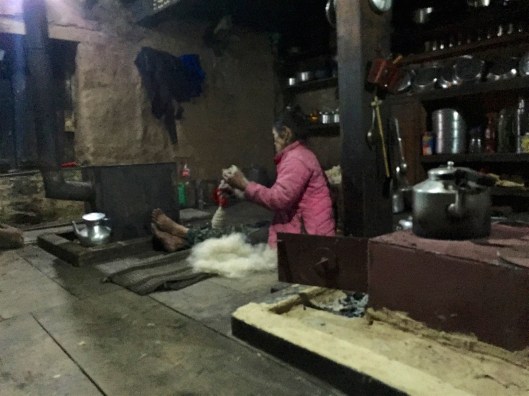
At dinner the hotel owner and his wife were joined by their daughter and son, his son’s wife and their child, and by the matronly lady I saw grinding grain earlier. These were the same people we had with us at dinner the previous day, with the addition of the child. The child caused much amusement by running around the kitched with sheep intenstines on a stick occasionally touching the stove to cook it, in the same way children elsewhere might do with dough on a green twig around a campfire. To complete the picture, and don’t read this while eating, handkerchiefs and tissues have no place here and the child’s runny nose was cleared from its face with a deft lick from Mum. Meanwhile the owner, that is the man who butchered the sheep in the morning, refined his work on the floor with the meat on a plastic grain sack. Oblivious to all this the lady of the house quietly sang songs while spinning yarn by the warmth of the stove.

After a while we were joined by the travelling businessman’s 16 year old son, Urker. He told me that he would leave Dho Tarap for school in Kathmandu the following year and he would be there for 5 years. He then showed me his swollen thumb which he had broken several days ago when he fell from a horse. I asked him if he liked football and he said that he had never played, nor watched, a game of football. Some of his friends had seen football on TV but he hadn’t. While there were some families in Dho with a television his family didn’t own one as his father disapproved. Urker said that when he left school he would become a monk in Kathmandu like his older brother. His older sister was working in Kathmandu now and he could join her but he wanted to be a monk. He was interested in my life and work and smiled broadly when I showed him photographs of my wife, children and grand-children. We had quite a chat before he was taken to his room by his his father. His passing comment was that he thought Chinese clothing was rubbish because it didn’t last. I was left to reflect and be very grateful indeed for the opportunity to meet that young man who, without formal schooling, spoke very passable English in addition to his native Nepalese and the Tibetan of his ancesters. Good luck Urker.

Following a very tasty dinner of lamb and potatoes and a more modest amount of Roxy than Friday evening it was time for bed. The women were still at work on the roof next door, now illuminated by 3 battery-powered lightbulbs. There were 4 people in a square alternately threshing barley by hand in the weak light. The rythmic threshing was quite restful which was just as well as it went on all night. These people were working 24/7 with only short breaks to try and finish the harvesting over the next 2 weeks as by then the weather would have closed in and they must leave Ringmo. Once more I was stunned by the hardship of life in this region. Even some of the residents of Ringmo, on the face of it and by Dolpo standards a relatively prosperous village, were transhumant. Despite the increasing revenue from tourism as evidenced by the new hotel, the restaurant with its remarkable shop, and the climate being more clement than further north, some people in Ringmo cannot sustain themselves during winter and will by early December join the annual exodus south.

Trek Day 16 (continued) – at Ringmo

19 Saturday Aug 2017

Posted by andyjameswriter in Dolpo trek

≈ 2 Comments

After the thrill of trekking the lake path in the company of the transhumant Dolpo-pa family from Saldang our afternoon in warm and sunny Ringmo was no less fun; just less precipitous and somewhat warmer.

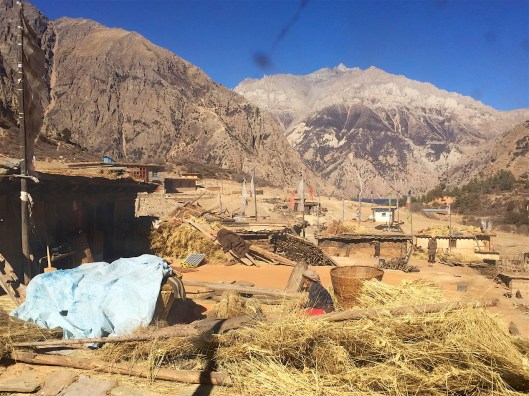
Ringmo, shown on some maps as Ringmogaon, is a traditional village with a seasonal population of about 200. Quite populous by local standards its principal businesses were yak herding and general trading but increasingly tourism is a source of welcome revenue to an otherwise still poor area.

IMG_3884 - Version 2.jpgCharacteristically dry and dusty under a sky as blue and crystal clear as the lake Ringmo nestles on the banks of the Phoksundo Khola on what is becoming one of the most popular trekking routes in Dolpo. While electricity remains provided entirely by solar power there is one telephone, presumably in the post office which must have been cunningly concealed. Such is the hope of the residents that a new hotel has been built by the headman to attract more visitors.

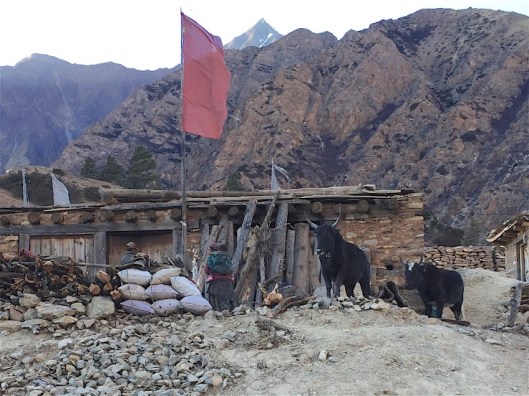
IMG_3974.JPGI understand there were enquiries made by the owner when he learned we weren’t staying there, instead electing to spend a couple of nights with another family who had added bedrooms to their existing house and called it a ‘hotel’ and which was recommended by our horseman. Leaving to one side the basis for that recommendation, while the new hotel stood on high ground with a pleasing view over the village and its surroundings, our chosen abode had more homely qualities; think rustic guesthouse. Reached down a series of alleyways between low, flat-roofed stone buildings variously housing people, yaks and grain, and often all three, dodging goats and inquisitive grubby children we were led to an open courtyard.

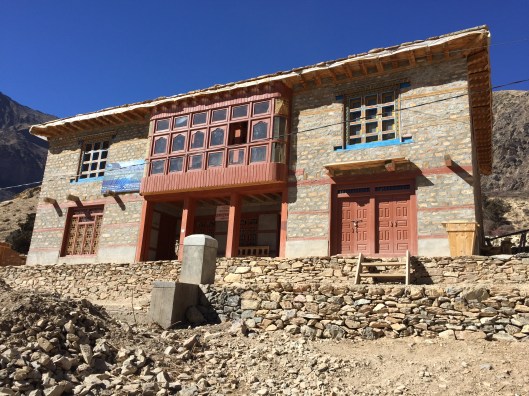
There in front of us was a delightful house. Backed by the azure-crowned mountains  and forests was a two-storey building. Its lower floor was of original construction newly fitted with shuttered wooden window frames and doors while the upper floor was all new. Sympathetically built of local stone and rough mortar and also fitted with new windows and doors, one of which was reached by a wooden corner balcony, this floor featured a reassuringly waterproofed roof. Around the courtyard various articles of clothing were drying draped over stacks of firewood, yaks were snuffling around an evil-smelling enclosure, and by the entrance was the customary long-drop toilet. Despite first appearances and any thought of staying up the hill in the new hotel having been banished, we soon warmed to the guesthouse with its cheery demeanour, colourful flags and sunny countenance and our ponies were immediately at home.

IMG_3937.jpg

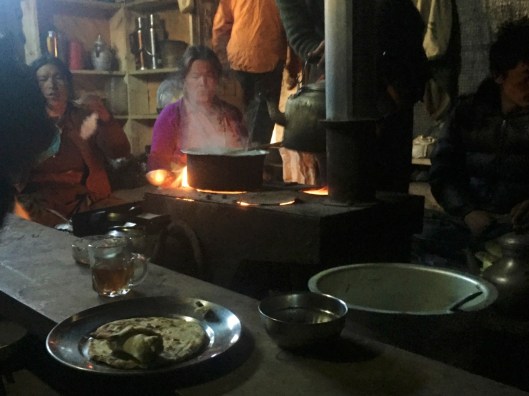
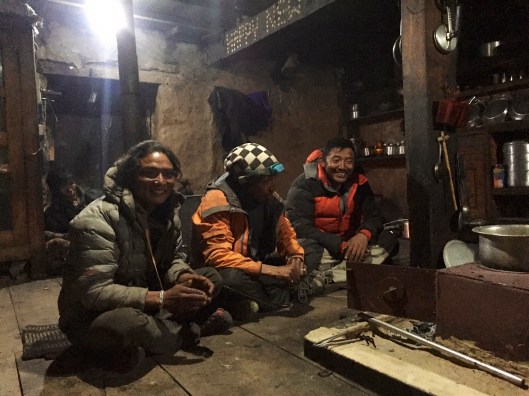
We were welcomed by a rosy-cheeked matronly lady in traditional dress who invited us to leave our gear outside for now and go to the kitchen, first on the right through the door in the corner. Inside we found a younger couple preparing food. The room was what we had come to expect in Dolpo. There was a central wood- (or dung-) burning stove (this one with a rickety stove pipe) on which were placed saucepans, frying pans and a kettle. The man sat to one side cross legged on the floor while the woman, in bright green loose trousers and a white-trimmed pink anorak, was on a low stool. Thanks to the new windows the room was not as dark as some and we could see many shelves bearing all manner of cookware, flasks, jugs, plates, bowls, cups, utensils and dry foodstuffs. In one corner was a cupboard which at first sight appeared to be filled with food. The quantity of hardware suggested this was indeed a guesthouse-cum-hotel and we were promptly seated on the floor behind the usual low benches upon which was placed some tea. We were soon joined by other members of the owners’ extended family, 3 men and 3 women in total, who proceeded to laugh and chatter with Gyalbu and Sangye. Then, joy of joys, lunch was served; an awesome omelette! We and eggs had been strangers for some time and their re-appearance was as welcome as it was unexpected.

After lunch we were shown to our rooms. I was to share with Mark in the room on the left in the photo above – the one reached by the balcony- and jolly comfortable it was too.

IMG_3994.JPG

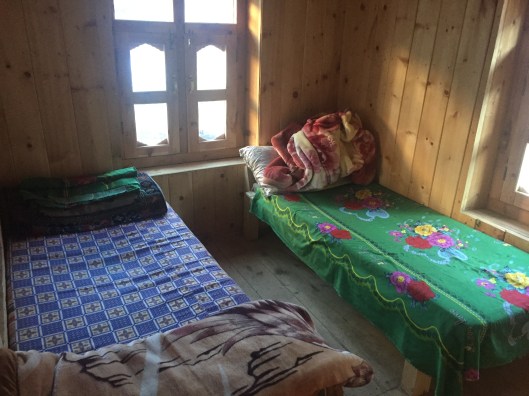
It was a dry and clean room which smelled of new wood in which were two single beds with thin but adequate mattresses, pillows and clean bedding, and enough room for our bags. Once settled we met the others downstairs and headed out to look around the village. We had heard there was a restaurant towards the lake and set off to find it. By now it was about 4:30 and the sun had gone down so big jackets were donned. Heading back towards the lake without bags and having secured our beds for the night, we were more inclined to take in our surroundings. While there were some new buildings in Ringmo, or at least newly renovated buildings, the majority were unimproved single- or two-storey traditional dwellings and we were eyed curiously by the yaks while their owners went about their business unmoved by our passing.

IMG_3901 - Version 2.jpg

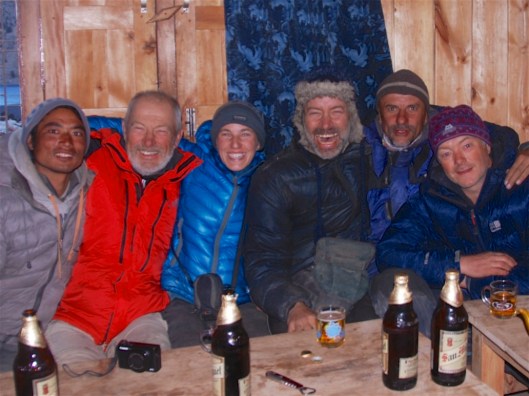
Sure enough, on higher ground at the northern edge of the village with a view over the stunning Lake Phoksundo and the Ringmo monastery to the east, we found the restaurant. It was an older building but fully renovated inside and out in new light wood. There was even a television although we couldn’t confirm that it worked as the precious electricity was being saved for the evening and we were the only visitors. It still being quite early and having agreed to eat back at our accommodation later, we were nonetheless delighted to find some beer available. And not just any beer but chilled San Miguel! As they say, one is never enough although as it turned out perhaps it should have been. Nonetheless we had a fun and relaxing time, on this occasion without Gyalbu and Sangye but having been joined by our horseman, as you can see below…

IMG_7377.jpg

It was dark when we left a couple of hours later and although we should have been better prepared we had neglected to mark our route back to the guesthouse and managed to get lost. Eventually, after a considerable time stumbling around in the dark and probably more by luck than navigational skill, we made it back in time for a dinner of fried meat (unspecified) and rice washed down with monsoon quantities of Raksi, or Roxy as we preferred to call it.

According to our hosts we ‘partied like Tibetans’ before falling into bed and sleeping soundly. In the absence of substantive evidence to the contrary and all having been unaccountably robbed of our memories during the night, we took that as a good thing. That was until we learned that amidst the revelry we had bought half a sheep for dinner the following day. Ah well, I guess it could have been worse.

Trek day 16: to Ringmo via Lake Phoksundo

15 Sunday Jan 2017

Posted by andyjameswriter in Dolpo trek

≈ 2 Comments

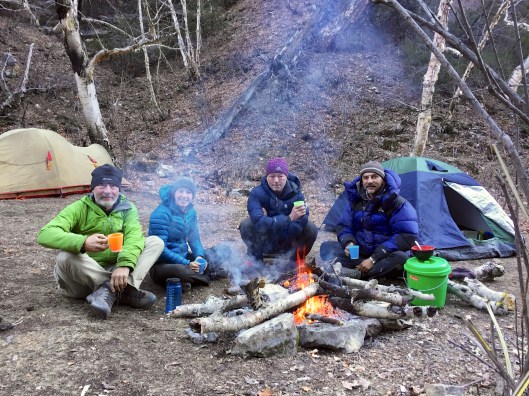
The morning of Friday 18th November dawned very cold indeed. We were fortunate that the campfire had retained some heat and could be restarted by Gyalbu and Sangye while boiling some water for tea. The tsampa porridge was no more appetising than usual but eating it around a fire accompanied by hot tea seemed to make it more palatable. Possibly our shaking cold hands made a better job of stirring the customary lumps out of the mixture. Apart from the crackling of the fire and the occasional snorting of ponies as they foraged in vain for edible grass or more leftover Smash from dinner, the campsite was silent. We had neither seen nor heard any wildlife among the sparse and bare silver birch, nor on the steep mountainside to our rear; littered with dead trees and branches that had succombed to the grip of winters past. Even the diminutive evergreen bushes that might have offered cover to a small animal appeared devoid of life and the leaf mould around us bore no footprints other than ours and those of our ponies.IMG_3644.jpgAfter breakfast we quickly packed our tents and other gear and made for the footpath south. Today we would follow the Phoksundo Khola for about 7 miles to the lake about which we had heard so much, and then take the precipitous western footpath to the village of Ringmo on its southern shore.
Sangye and the horseman with his string left camp at about 8:30 and we followed shortly after. Our track remained within the gorge for the first while. Although this river valley was wider than yesterday’s tributary and the escarpments either side were progressively softening we were initially in shadow with hats, gloves and thick jackets essential. Through the valley ahead, beyond the V-shaped silhouetted rock faces and grey boulder-strewn footpath flanked by the ice-cold river, we could see snow-covered mountains above green forests in sunshine. The silver birches to our side seemed to be begging; their gnarled upper branches reaching into the crystal clear blue sky above, as anxious as we to escape the starkness and bitter cold of the morning shadow.

After 30 minutes or so our wait for the sunshine was over and we stepped into a different world. The air was no warmer but the sun’s rays warmed us enough to remove a layer or two of clothing and enjoy our walk along the flat, broad and sandy riverbank. The mountainsides left and right were at a gentler angle enabling small forests of pine to take hold and smaller deciduous trees and bushes to flourish. Many of these were bare due to the time of year but for the first time in many days we could see evidence of life.

Our first river crossing was via a ricketty wooden bridge. Most of the footway planking had fallen off and been swept away so three quarters of the crossing was made balancing along one of the two main bridge spars; rough-hewn tree trunks. We later came to regret that this was the only bridge encountered as all subsequent crossings, of which there were many, were un-bridged.

The first of these were taken ‘boots on’ by Tim and Jovi, while Lizzie and I decided to remove ours to keep them dry and wade across. As a result Tim and Jovi were well downriver before we had crossed, boots tied across our shoulders, slowly and gingerly trying to find a route without painful sharp rocks underfoot while ignoring the growing lack of feeling in our toes. Mercifully the crossing was accomplished in less than two minutes and we gratefully dried our feet and put our boots back on; toes now very clean but still numb. Mark was with Gyalbu behind us making slower progress due to taking many photographs so Lizzie and I continued in pursuit of Tim and Jovi who were by now out of sight among trees.

Before long we had to cross the river again and went through the same boots off-boots on process. The difference this time was that our feet were still frozen from the previous crossing. Nonetheless, we stuck to our belief that in the long run our policy of retaining dry boots would pay off. This time our feet were seriously complaining and the second dunking in icy water while teetering over sharp rocks proved to be the last. It was just too slow, too cold and too painful. The rest of the crossings were accomplished at speed, with boots on, trouser legs rolled up and with much laughter, as demonstrated here by Lizzie.IMG_3662.jpg
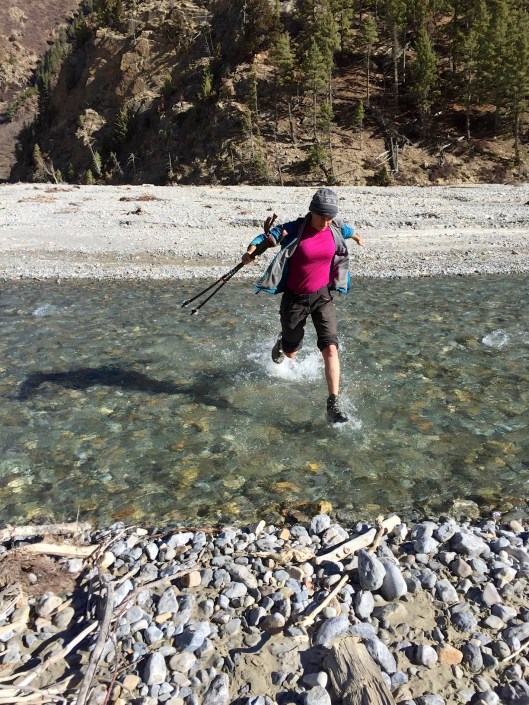
Unsurprisingly, without having to stop and recover after every chilly crossing we then made much faster progress as our feet gratefully carried us to the lake along pale sandy footpaths. Flanked with sunlit fresh small pine and other evergreen trees, low scrub and with the mountain views around we could hardly believe we were still in Dolpo – it was such a change from the previous 2 weeks and so beautiful. We could have almost believed we were in Northern Europe or Canada.

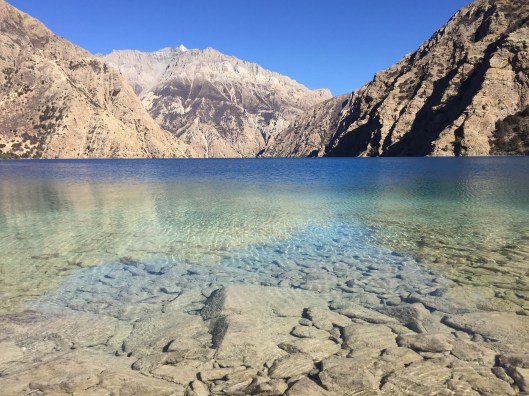
Then about 10:30 we reached Phoksundo Lake. Wow! Just wow!!

Directly ahead in the distance, beneath a sky that still refused to carry a single cloud, were stark grey mountains in silhouette; jagged-ridged and riven alternately with sharp arêtes and steep-sided valleys. Either side were pine forests on craggy mountainsides. In the foreground was grassland, now rendered parched and withered by the lack of rain and the determined grazing of countless sheep that use this route south, strewn liberally with rocks and boulders. And in the middle, oh my. In the middle was Lake Phoksundo, a striking, magnificent sapphire blue almost mesmerizing in its intensity.IMG_3683.jpg

As we approached we could see people and ponies too. The ponies were pack animals. They were not ours as our main packs were not evident and Sangye and the horseman must have already moved ahead. To one side Tim and Jovi were stopped for a break and to their front were a group of a dozen or so people. As Tim and Jovi saw us they waved and we returned their wave. The other group, we could now see they were Dolpo-pa taking a break too and it was their ponies that were grazing, must have thought we were waving to them and they waved back. I recognised one of the group as someone I had seen before – a younger woman wearing glasses. Spectacles are a rarity in Dolpo which is why I remembered her. At the edge of the group was an older lady wearing a blue scarf wrapping a blanket around a child. It was the boy who I exchanged nods with at the pass yesterday – the boy in the orange jacket. While Lizzie and I and the others were on our trek the boy was with his mother and wider family heading south. They were not on a holiday as we were but had left their home in Saldang for the winter because it could not sustain them. As a result of us deciding to avoid the increasing perils of the northern passes in winter we had become witness to the reality of life in Dolpo. I was truly stunned at the time at the realisation of what we had stumbled into. I remain very grateful to have been lucky enough to be in the right place at the right time.IMG_3686 - Version 2.jpg
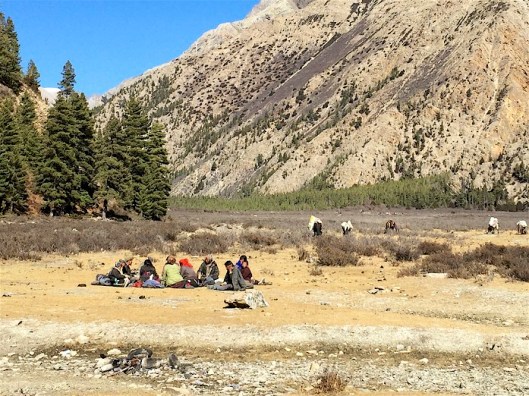
Once Lizzie and I had taken a break with Tim and Jovi, and once Mark and Gyalbu had joined us, we all moved on. The Saldang family were showing signs of moving on too and we assumed their sheep would move slowly so we should move ahead of them. This would enable us to make faster progress and not have to walk in the wake of the inevitable cloud that would surround them on the dry dusty paths ahead.

Each step we took as we ascended the pathway that snaked around the western side of the lake brought views of even greater majesty. Sometimes our view of the lake was through stands of pine trees dappled with sunlight.IMG_3712.jpg
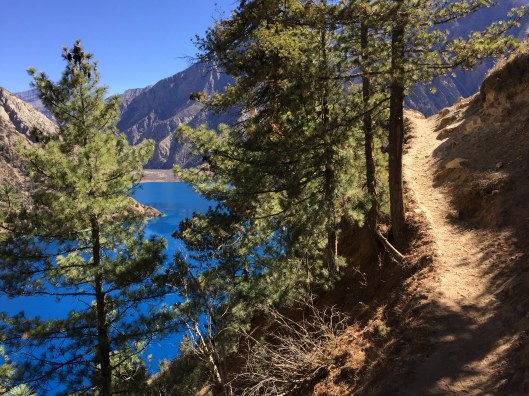
Sometimes we stopped, stunned anew with wonder in the presence of such beauty. IMG_3725.jpg
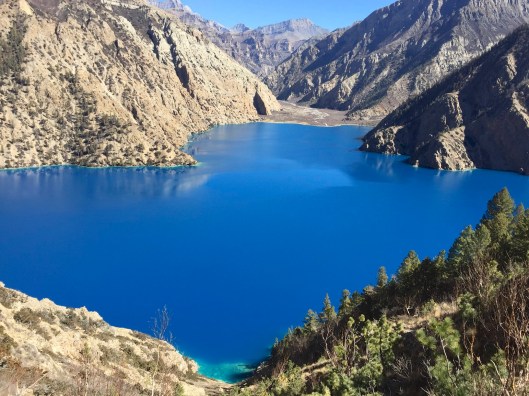
Stopping was important not just to better appreciate the view and take photos, but because the path was becoming increasingly ‘airy’ and I knew only too well the impact of not watching one’s footing at height. Indeed we were stopping so often that Mark and Gyalbu caught us up, as did the Saldang family and their animals, so we redoubled our attempts to stay ahead of them. We had a degree of success and looking back could see the Dolpo-pa taking great care along one of the paths we had just skipped along, engrossed in talk of our surroundings. In this photograph the ribbon path may be seen with some of the Saldang ponies at top-centre. Seeing this we gulped and decided to slow down.IMG_3744 - Version 2.jpg

Roughly half-way along the path we rounded a bend to the right and for the first time could see Ringmo at the southern end of the lake, surrounded on its other 3 sides by forest and mountains. Not long after the sound of the neck bells that adorned the Saldang ponies became more pressing. They were moving fast and we needed to move at their pace or let them past. We chose the latter.

We had just arrived at an incredible viewpoint that demanded time to appreciate. Lizzie grabbed her camera (again) little knowing that she was about to take one of her last 20 photos. Her camera battery was destined to expire later that day without any chance of re-charging it. Here she is making the most of the view and the battery life.IMG_3751.jpg

And here’s why. We were on a rocky promontary from which Ringmo had come into view. As it was the high point of the path it was adorned with prayer flags rippling in the stong wind and bringing into sharp contrast their surroundings. Next to us was the slippery rocky sandstone path – too steep to hurry down. To the right was a rocky mountainside dotted with trees but too steep to sustain a forest beneath which was the southern end of the lake glinting in bright sunshine. Beyond the lake was the village and its flanking forests. As we gazed in rapture the first of the Saldang pack animals appproached our position. A grey pony with a red decorative headpiece, a red-dyed yak’s tail about its mane and a collar bearing 20 or so bells this immensely strong animal, bearing 2 enormous sacks of grain, was the leader of the string and barely faltered when it saw us. IMG_3763.jpg
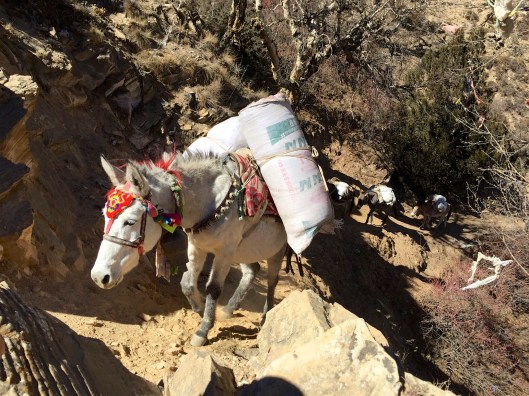
Driving resolutely past us at a distance of about 5 feet the leader was followed by other ponies and mules; unadorned but equally heavily loaded. After a dozen or so had passed people joined them. First was the Saldang horseman, or at least the person fulfilling that role on this section of their journey. All the time my camera was recording the scene but the best shot of all was taken by Lizzie as the boy in the orange jacket passed with his mother and family. They looked quickly at us with some recognition but without emotion as the path dropped away and their gaze was focused ahead.Dolpo Lizzie 169.jpg
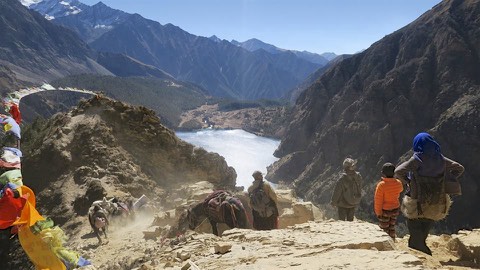
Some time later, once the remainder of the pack animals had gone a dust cloud grew in their stead as the sheep were driven past by several women herders. There were 2 older women at the front wearing traditional dress and headscarves to protect them from the dust. Thery carried their bags with tump straps on their foreheads.IMG_3798.jpg
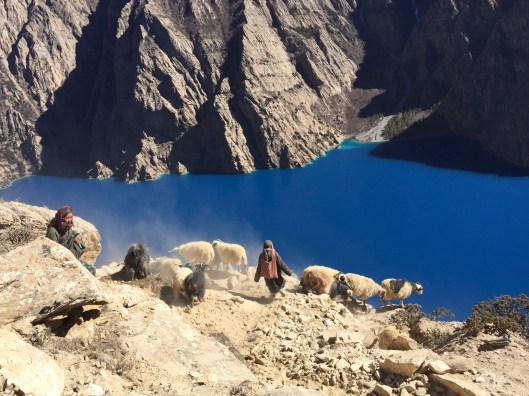
Behind the flock was another woman also wearing a headscarf. She was the young woman with glasses I recognised earlier and she wore trousers and a green jacket and carried her things on her back in a blue rucksack.

Once the family had gone Lizzie and I followed, amazed at the speed with which the Dolpo-pa descended the tricky path. To think we had started ahead of them so as not to be delayed!

The next section of the route was something I had looked forward to ever since I knew we would come this way. In the film ‘Himalaya’ the older yak caravan leader, Tinle, tries to catch a younger caravan leader rival (Karma) by taking his caravan on a short cut along this very path. In the film it was called the ‘lake path’ and other members of Tinle’s party were dramatically horrified that he was going this way. Shorter it most definitely was, but far more dangerous as the path was steep and very narrow and a slip would be fatal. While Tinle was ultimately successful his use of the lake path it cost the life of a yak and its salt when a bridge dramatically collapsed and the yak fell to its death (only in the film – not for real!). We followed Tinle’s footsteps over that very section. Here is Lizzy being (very) careful over the path that collapsed in the film, now packed with supporting boulders underneath. You’ll notice I took the photo from some distance as it wasn’t a place to lose concentration!IMG_3852.jpg
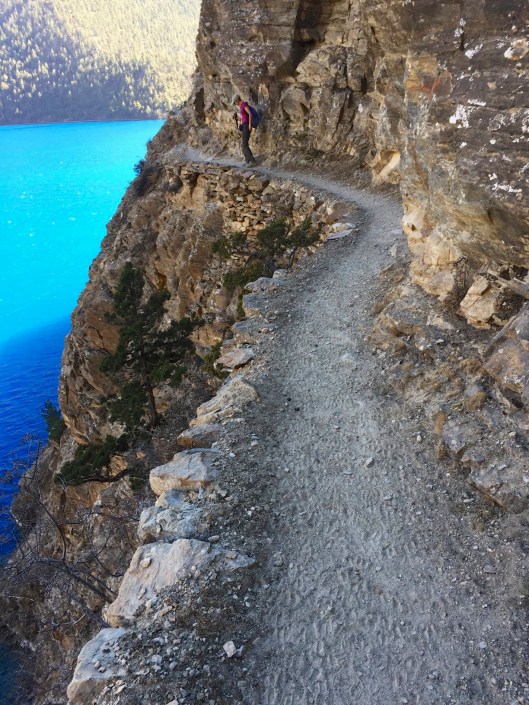
Not long after this we arrived at Ringmo where we were to have lunch then rest. It was not yet 2pm but we’d already had a very full day. Extraordinarily, by pure chance and amazing good fortune, we had followed the migrating family from Saldang and their animals over the lake path so dreaded by Tinle’s yak caravan herders in ‘Himalaya’. While the film dramatised the path brilliantly with the help of a dummy yak floating in the lake after its ‘fall’, to be frank we found it quite dramatic enough in real life. And all before lunch too!

Suddenly the frigid campsite where we had spent the night and departed in gloomy shadow just 6 hours before seemed a lifeltime ago.
← Older posts
Newer posts →

Enter your email address to subscribe to this blog and receive notifications of new posts by email.

Join 49 other subscribers
Follow Andy James on WordPress.com

Blog Archive Categories

  • Dolpo trek (45)
  • Lefkas (3)
  • Mont Blanc June 2019 (9)
  • Picos de Europa (8)
  • The Great Glen Way (5)
  • The Haute Route (10)
  • The West Highland Way (6)
  • The Writing Journal (6)
  • Walking London – the Capital Ring (4)

Blog at WordPress.com.

  • Subscribe Subscribed
    • Andy James
    • Join 49 other subscribers
    • Already have a WordPress.com account? Log in now.
    • Andy James
    • Subscribe Subscribed
    • Sign up
    • Log in
    • Report this content
    • View site in Reader
    • Manage subscriptions
    • Collapse this bar
 

Loading Comments...