• About
  • Photographs
    • In Praise of Agiofili Beach
    • Corfu’s Most Beautiful Village?
    • Making a splash in Vassiliki

Andy James

~ A Writers Journey

Andy James

Author Archives: andyjameswriter

Trek day 15 (afternoon): to a campfire and a starry starry night

02 Monday Jan 2017

Posted by andyjameswriter in Dolpo trek

≈ 3 Comments

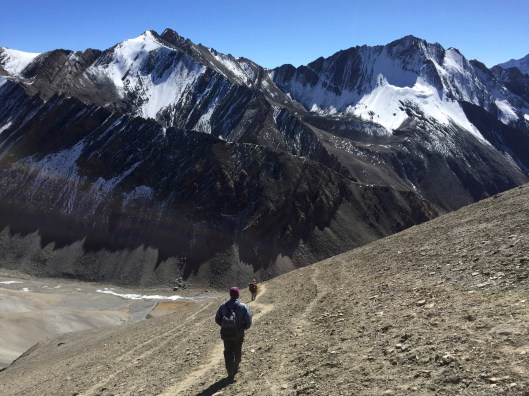
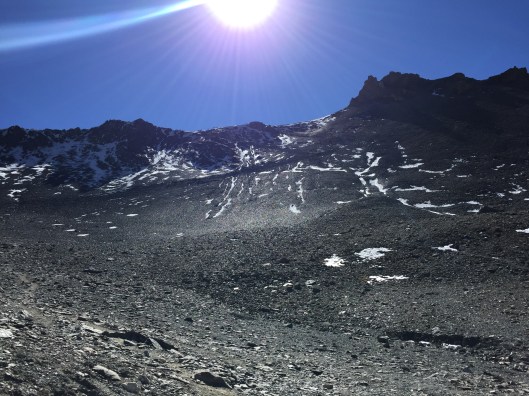
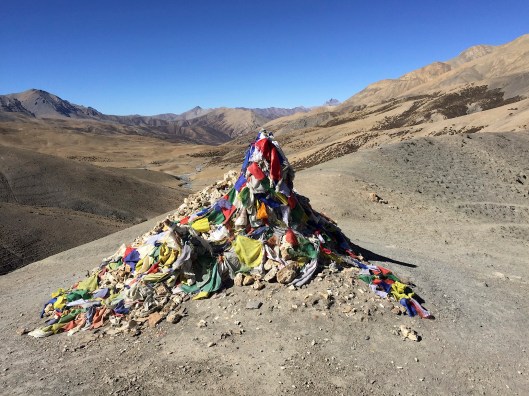
From the Nagdalo La the views were breathtaking. To the north was row after row of mountain peaks beneath a deep blue cloudless sky. Beyond the grey gritty pass the nearest peaks and ridges retained the familiar burned sand colour with occasional lighter exposed rock between bands of scree. In the middle distance the shading became lighter. With their outline and detail softened by distance they appeared rocky and too steep to support scree. Perhaps the blue sheep seen north of Saldang were still there among bushes and other vegetation but lower down than could be seen from here. Our view was of the upper ramparts and into the distance their shading tended to light grey. The most distant peaks were white with snow. To the south only the nearest peaks and ridges were in sight while those beyond, being mostly lower, were hidden from view. By now it was after midday so the sun was high, but the mountains were so steep that many of their northern flanks were still in shadow with extensive snowfields shining brightly in contrast to their otherwise stark blackness.

At around 12:15 Tim reached the pass, followed closely by Lizzie, Jovi and Gyalbu, and 5 minutes later we were joined by Mark. Despite our good acclimatisation this had been the toughest of all the passes so far with a height gain of over 1000m. The hugs and mutual congratulations we shared made it seem more like we had climbed a peak rather than a pass. For the next few minutes we ignored the elements and simply enjoyed being together surrounded by such magnificence, before Gyalbu led us down into the valley 600m below.IMG_3595.jpg

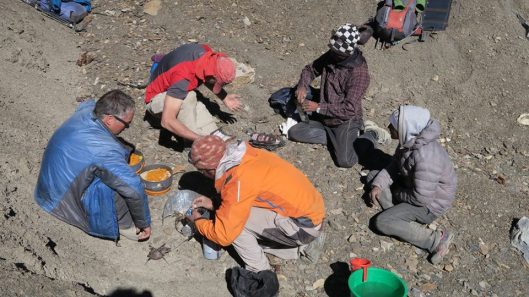
By the frozen Tuk Kyaksa Khola, Sangye had managed to extract enough water to make some tea. Tim and I, who with Gyalbu had descended quickly by scree-running most of the way, used the rest to prepare lunch of chilli con carne with kidney beans and red pepper with rice. This scene, in which Gyalbu is working with Tim to get the stoves alight while Sangye and I are opening bags of chilli con carne, was captured by Lizzie. We were all in a shallow depression to get out of the wind. Once the stoves were alight and windshields were in place a hot and tasty lunch was ready in no time.15740953_10154700310385853_8634060180487885344_n.jpg

As we would lose the sun early down in the valley we moved on immediately after lunch. We were heading south-west down the river to its junction with the Phoksundo Khola where we would camp the night. While the distance was a modest 5 miles or so, such was the height loss that the terrain changed dramatically.

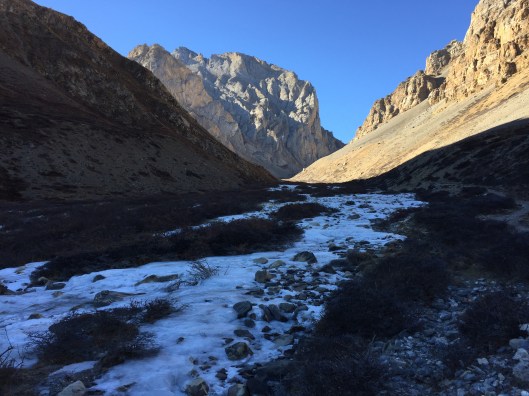
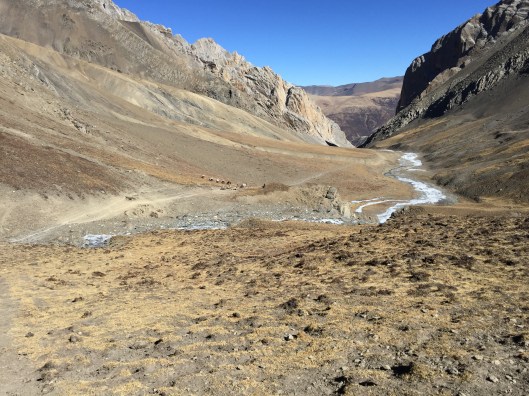
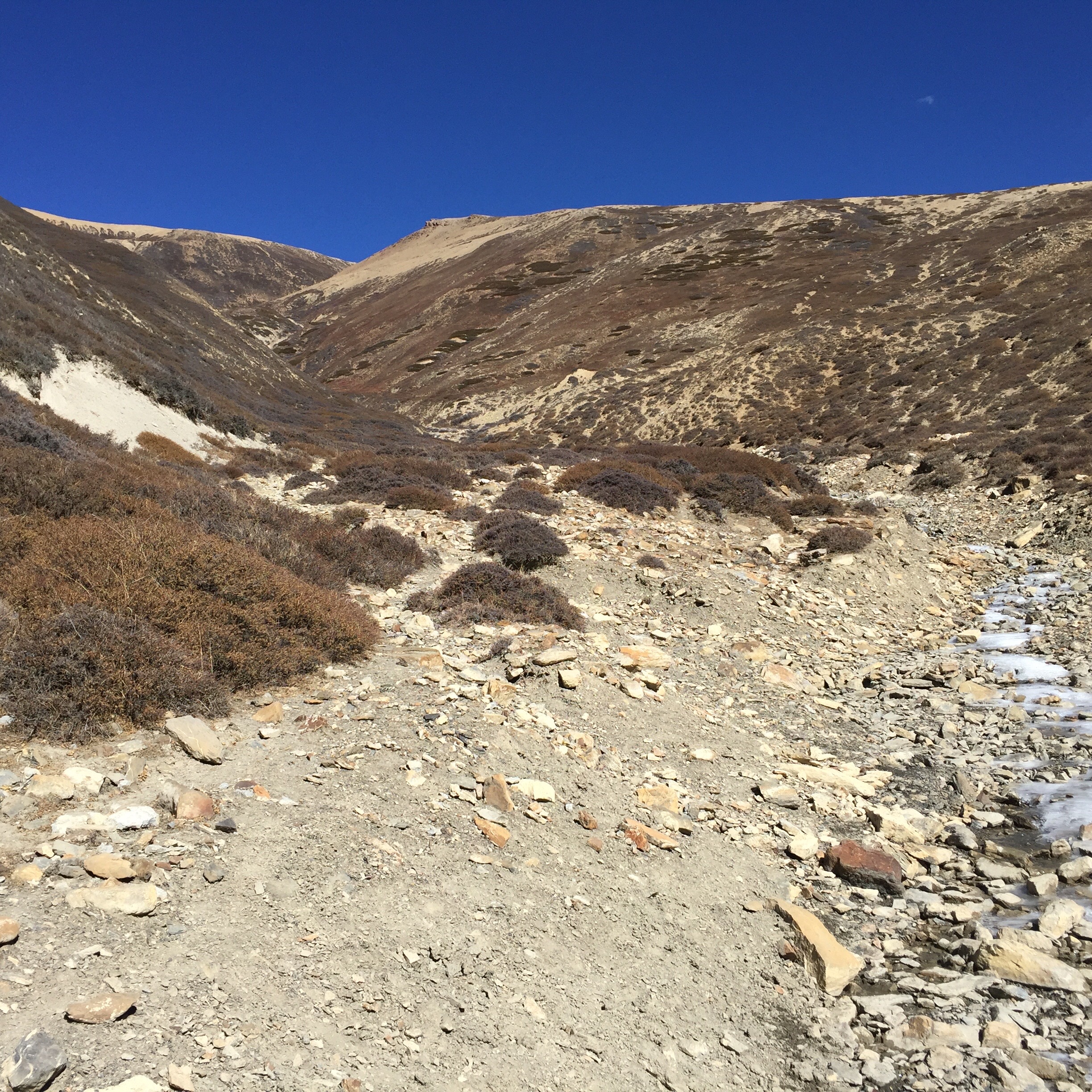
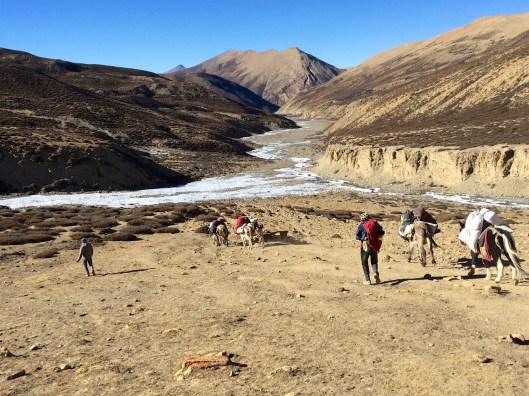
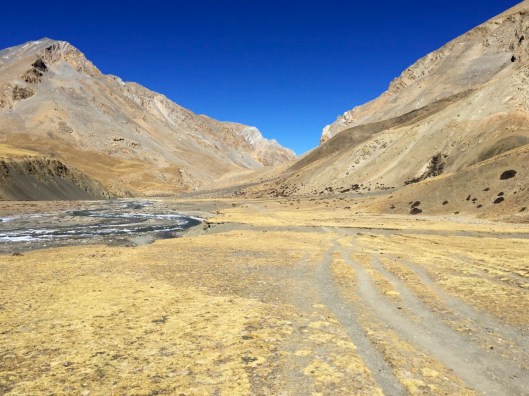
When leaving our lunch spot the valley was broad and dry strewn with small sharp rocks. There was no vegetation. The only colours were the white of the narrow ice-bound river to our left and the serrated snow-covered mountain ridge ahead, our dirt brown valley bisected by a meandering pale brown track, and the big azure sky above.

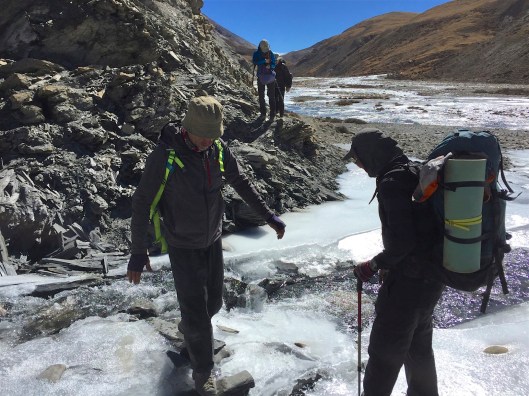
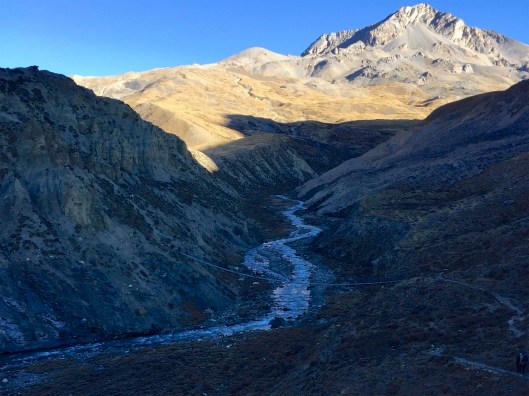
The frozen river had to be crossed several times as we descended and the angle of descent increased. The valley became progressively narrower with the escarpments left and right looming more dominant and the rocks towards their base were larger. After a while the escarpments became so steep that the valley looked more like a canyon and we were often in deep cold shadow.IMG_3604.JPG

From time to time we would emerge blinking from the shadow into brilliant sunshine and in these places new colours emerged. We saw the tan and olive green of dusty thin scrub on the south-facing scree. Increasingly we also saw low bushes devoid of leaves or other sigs of life but evidence of our progression to a different altitude more tolerant of vegetation. Frequently our path became more of a climb and I found myself glad we were descending rather than ascending. Even our ponies and mules were uncommonly slow on these sections.

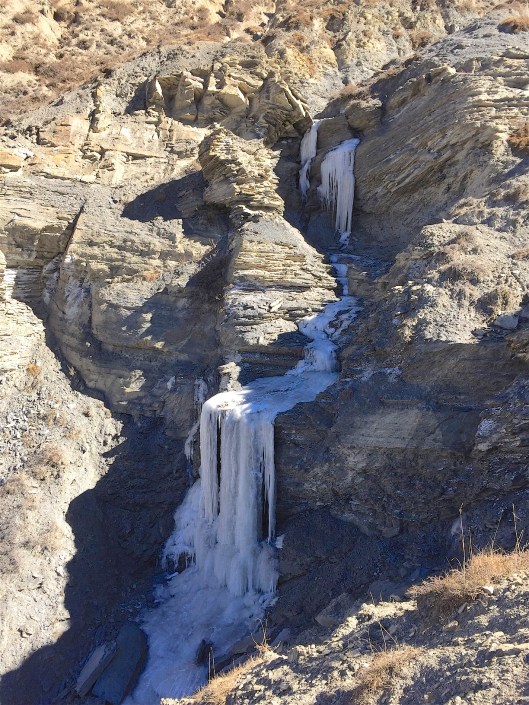
By mid-afternoon we were passing dry wild flowers and thistle, small stands of diminutive bare silver birch clinging by the tips of their roots to steep escarpment, and low evergreen bushes. Through our canyon to the valley beyond, while the Phoksundo river was still hidden well below we could make out small copses of pine on the mountainside opposite. But once back into deep shade these brief and valiant outposts of life were extinguished to be replaced by bare grey-brown rock left and right. The cold of the mountainside occasionally emphasised by its adornment with a white curtain. In summer the curtain would be a joy of dancing waterfall and spray but now, with winter advancing, it was solid, deathly white.

We felt the sun for the last time around 3:15. By then we had vertical rock to both sides and and spindly trees and bushes around. These would have flourished during summer when the depths of the canyon were breifly penetrated by the sun. Now their apparent demise was only belied by vestiges of evergreen on the hardiest. With gloves and hats adorned we moved quickly down towards the bottom of the valley which we needed to gain before it got properly dark around 6 pm.

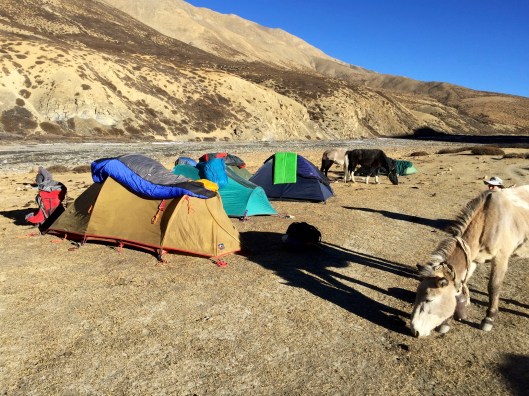
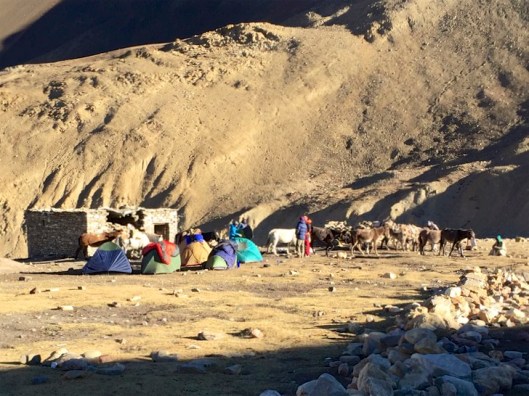
In the event we reached the Phoksundo Khola shortly after 4pm, followed by Sangye and the horseman with our bags and tents. The nags had found the going tough and the horseman, having failed to pursuade us to camp earlier (er, where exactly?), had not pushed his string as hard as usual. We quickly set about putting up the tents while the ponies were hobbled and fed, and Sangye fetched some water for tea. Though still frozen in places the Phoksundo Khola, here at just under 3800m, had some flow.

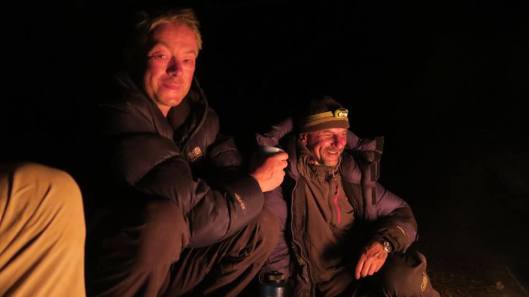
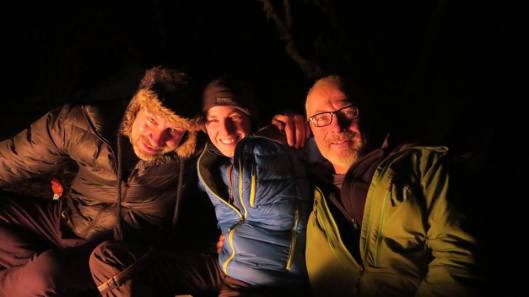
Once the tents were erected our next priority was warmth and for the first time we were surrounded by wood. There was no greenery but the stand of trees in which we camped managed to survive previous winters and come to life in better weather. There were many dead and dried small branches on the ground and we put these to good use. For the first time we had the means to make a camp fire and everyone enthusiastically joined in the wood-gathering. In no time we had a sizeable pile of firewood and a fire was lit. We dragged rocks around it and sat on them, often wreathed in smoke but revelling in the warmth, drinking tea. Dinner was prepared by torchlight by Lizzie and Jovi. It was another treat from our rapidly dwindling supply of ‘Look What We Found’ ready meals: chicken casserole – this time with Smash – and there was plenty of it. Indeed there was so much potato that the ponies enjoyed some too! A perfect meal for a cold night under the stars made memorable by the heat and light of the campfire. It didn’t stop some people being cold during the long night but at least we went to bed with warm toes and filled tummies and I wondered how the boy in the orange jacket and his family were faring.

I am grateful to Lizzie for sharing these two photographs which capture part of the scene. We were in a cocoon of light and warmth so perhaps you could envisage the wider picture. The flames were dancing beneath a little smoke and if we lifted our eyes from the draw of the red embers around us we could see shadowy tents, ponies and thin boughs of silver birch beyond which there was nothing. The wind could be heard in the upper branches but at ground-level the air was still and away from the fire, freezing cold. There was no cloud and above was the darkest, starriest sky I had ever seen. The river was gurgling a few yards away and from time to time we would hear a pony or mule snort or stamp its hoof. By way of dessert after our tasty chicken dinner Mark had shared a few chocolate bars that he had somehow kept for such an occasion. While this situation wouldn’t suit everyone, for us it was heaven and our smiles were not just for the camera. Of course we enjoyed the challenge of the trek and our encounters with the extraordinary Dolpo culture but the high points, the pinnacles of our adventure, would for me at least be measured not by challenge but by the memory of moments like this.15697891_10154700281940853_8748905839627382726_n.jpg

15781475_10154700285100853_2236389609524623854_n.jpg

Trek day 15 (morning): to the Nagdalo La

31 Saturday Dec 2016

Posted by andyjameswriter in Dolpo trek

≈ 2 Comments

This day, Thursday 17th November, saw the start of our third week of trekking and there was to be no respite. By lunchtime we would be crossing the Nagdalo La, one of the highest passes in Upper Dolpo at 5350m (17,553ft), following a height gain of over 1000m. The anticipated distance to be covered was over 20 miles with the pass being around half-way. In light of this, and an early call by the monk who needed access to the monastery shortly after sunrise, we were up and about early clearing our bags and sleeping bags from the monastery foyer where we had slept. We could still can hardly believe the monk had shown us around the inner and most holy part of the monastery the previous evening. It was exceptionally moving and yak tallow candles were lit in remembrance of loved ones and distant friends. We had then been permitted to sleep in the foyer out of the biting wind with a view over the valley to the Crystal Mountain.

Following breakfast of tea and tsampa porridge in the monk’s kitchen, by 8 am we were packing our gear, loading the ponies and looking forward to the day. After crossing the pass we would lose over 600m of height almost immediately down a scree slope and then lose another 1000m following the steeply descending Tuk Kyaksa Khola to its junction with the Phoksundo Khola where we would camp overnight at a mere 3750m (12,303ft), 600m lower and hopefully warmer than the monastery.

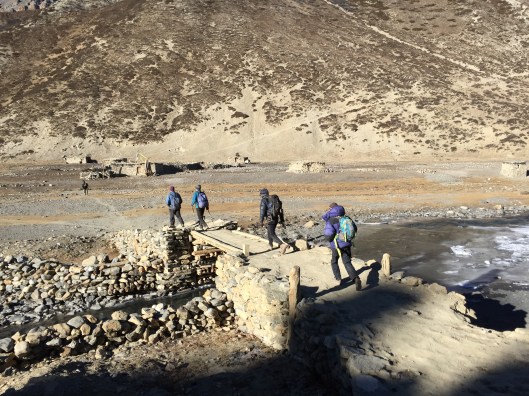
Shortly before 8:30 we took the path down into the broad, flat and stony valley confluence. During spring this would be awash with snow-melt and a crossing would demand care. Today there was barely a trickle and what water there was had been frozen solid, but we nonetheless took the traditional route west across the wooden bridge before turning south.IMG_3510.JPG

Even in the morning sunshine the air at this height was still cold as we made our way to the left of the substantial maniwall with its prayer flags hanging limp. As we walked up the Hubaiung Khola the still low sun cast deep cold shadows across the valley and our duvet jackets and warm hats stayed on.IMG_3515.JPG

After an hour or so we emerged from the steep-sided valley gorge into more open land. The mountains either side were still high with scrubby, sandy, and rocky lower slopes and precipitous upper ramparts, but they had at least opened up to allow the sun to warm us as we walked. Several times we had passed frozen tributaries on the the left and right which required care in their crossing due to the ice, but towards 10 am the valley became broad and I was able to pick up a faster pace and get a toe-warming leg-stretch. After a while I found myself alone and guessed the others had stopped for a bite to eat. They knew I carried my snacks to hand and preferred to keep going so separation was now quite common.

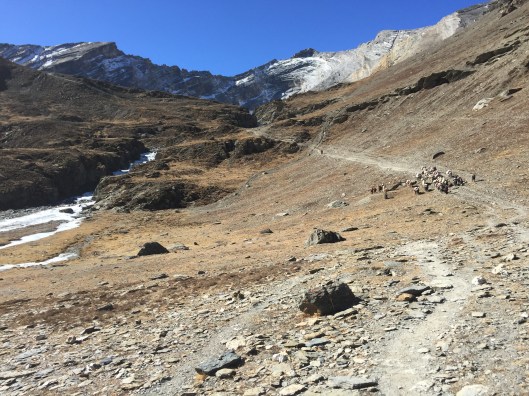
Ahead on a yellowed grassy plain between mountain and the river I could see a group of around 20 people and the same number of fully-laden horses. They appeared to be just moving off following a stop as some horses were being led on while others were still being packed. Not wanting to spook the horses I kept my distance and allowed them to complete their preparations and move on. I had seen no paths other than the one we had been following so reasoned that this group must have travelled south from either Pho, Bhijer or Saldang via Shey Gompa as that would be the only viable southerly route for them. We had not seen them go past the gompa this morning so I assumed they had camped in the valley overnight and that this was why they were still preparing to depart. I was however a little confused as, if these people were indeed from one of the more northerly villages heading for their winter homes then where were the rest of their animals? I could see no sheep or goats. Nor for that matter any yaks although that wasn’t a surprise as yaks don’t do well below 3000m. I figured if there were sheep or goats perhaps they had gone ahead with herders while families followed-on.IMG_3522.JPG

My thoughts about their purpose and destination had to wait as the map showed that the Great Himalayan Trail went south-east from here, up the escarpment to my left and then over the Nagdalo La. While I could see no path it wouldn’t be the first time that a path was hidden in shadow. I checked the GPS and that showed me to be in the right place and the more detailed mapping which overlayed the data also showed the path heading southeast about now. I was keen to see where the nomadic group were going so followed at a distance, keeping a very close view back down the valley to see where Tim and the others went once they arrived as I was cautious not to become separated if indeed there was an earlier side-track.

A few hundred metres ahead the group crossed the frozen river and made their way up a steep path to the left. The path began with 2 or 3 metres of steep climb that some of the horses struggled with and had to be unloaded. Some of the people struggled too but eventually they and the weaker horses were assisted up the step and continued their journey up the slopes towards the pass. I could go no further without losing sight of the path from Shey Gompa so I sat down at the top of a rise to wait for the others; and before long they appeared. When they reached roughly the place where I had first seen the travelling group, they stopped for a break as that would be the last before the upward toil to the pass. Although still at some distance I could see a few people and ponies and mules, but there seemed to be too many. Our trekking group should number 7 with 6 nags but I could see around 10 of each. I was sure this was the trekking group so I just waited to see where they would go next. After a while the group separated and those which I could now clearly see was a well-dressed group of trekkers with 6 ponies and mules moved in my direction rather than up a hidden track. IMG_3532.JPG

This was the good news I was hoping for; I was on the right path and could now follow the Dolpo-pa ahead.

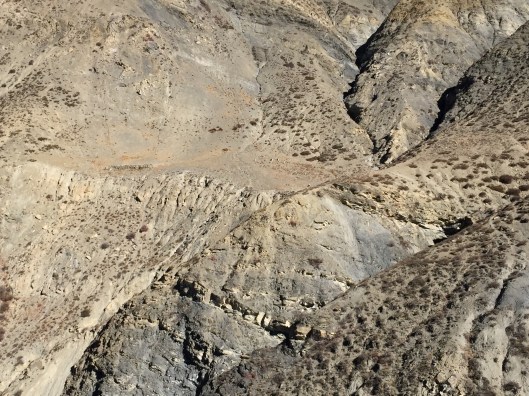
After a while the horseman and Sangye and their string caught up with me and following a short exchange of words and encouragement they moved ahead at a sprightly pace while I plodded on. It wasn’t that the route was especially steep but it was relentless and couldn’t be hurried. Once over the crest of the first ridgeline the majesty of the higher mountains was laid out in front of me. The sandy and scrubby terrain lower down had given way to something much more tough. The ramparts ahead were grey rather than sandy and with the sun directly ahead they appeared black in silhouette. Looking smooth from a distance closer inspection revealed the ground to be covered by sharp, angular rocks through which a rough path had been fashioned by the myriad feet and hooves that had passed before. Occasionally larger jagged rocks punctured the ground and the surface was rendered shiny either by patches of snow and ice or the coal-like patina of the strewn rocks all reflecting sunlight; sunlight rendered untra-bright and piercing by the clarity and rarity of the air as we climbed above 5000m.IMG_3543.JPG

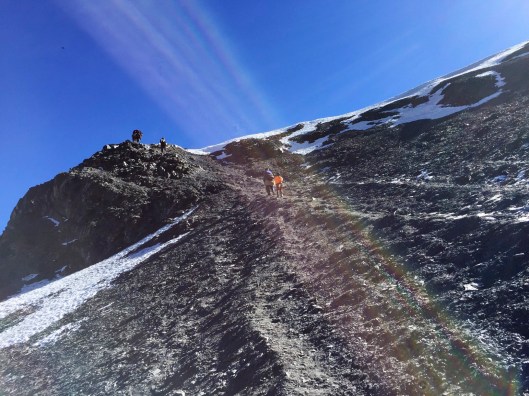
Though not evident from the photograph, I could see Sangye and the horseman with his ponies ahead toiling up the path from left to right before it zig-zagged up the final steep and icy section to the pass between the middle two knolls just to the left of the sun. I could also see some of the Dolpo-pa still pushing upwards too, while those at the front of the group had gathered in the pass itself which offered a magnificant view back down the mountainside.

I continued my climb alone, glad that nobody else would witness my laboured breathing and slow pace. It was getting towards midday when I reached the final steep section and realised exactly why those ahead of me had struggled so. The steepness of the final 100m was exacerbated by a very loose surface eased only slightly by the gritty path and patches of snow and ice. In particular there were long sections of the path which were covered in ice, and to move off the path invited a slide down the sharp and unforgiving scree. I found out the hard way and having arrested my slide, which was just painful and embarrassing rather than anything worse, stopped for another breather to regain some strength.

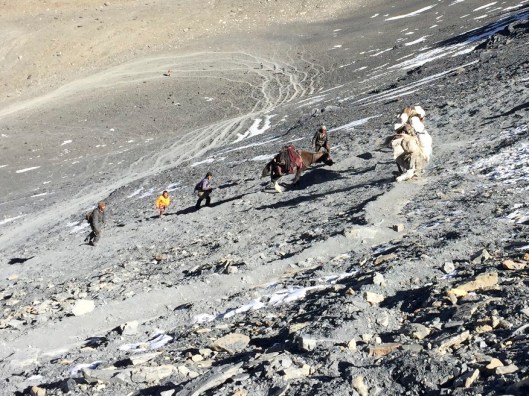
There was a group of 4 people and 4 horses below. From their clothing I could see these were Dolpo-pa rather than trekkers and realised these were the people who I had seen at the head of the valley earlier, with Tim and the others. They must have come on apace as the trekkers were much lower down the mountain. As I watched the Dolpo-pa approach I could see three adults. While they were all wearing trousers only one, the leader, appeared to be male while the other two appeared to be women. Traditional dress must be impractical outside the home environment. There was also a child of about 10. A boy in an orange jacket.

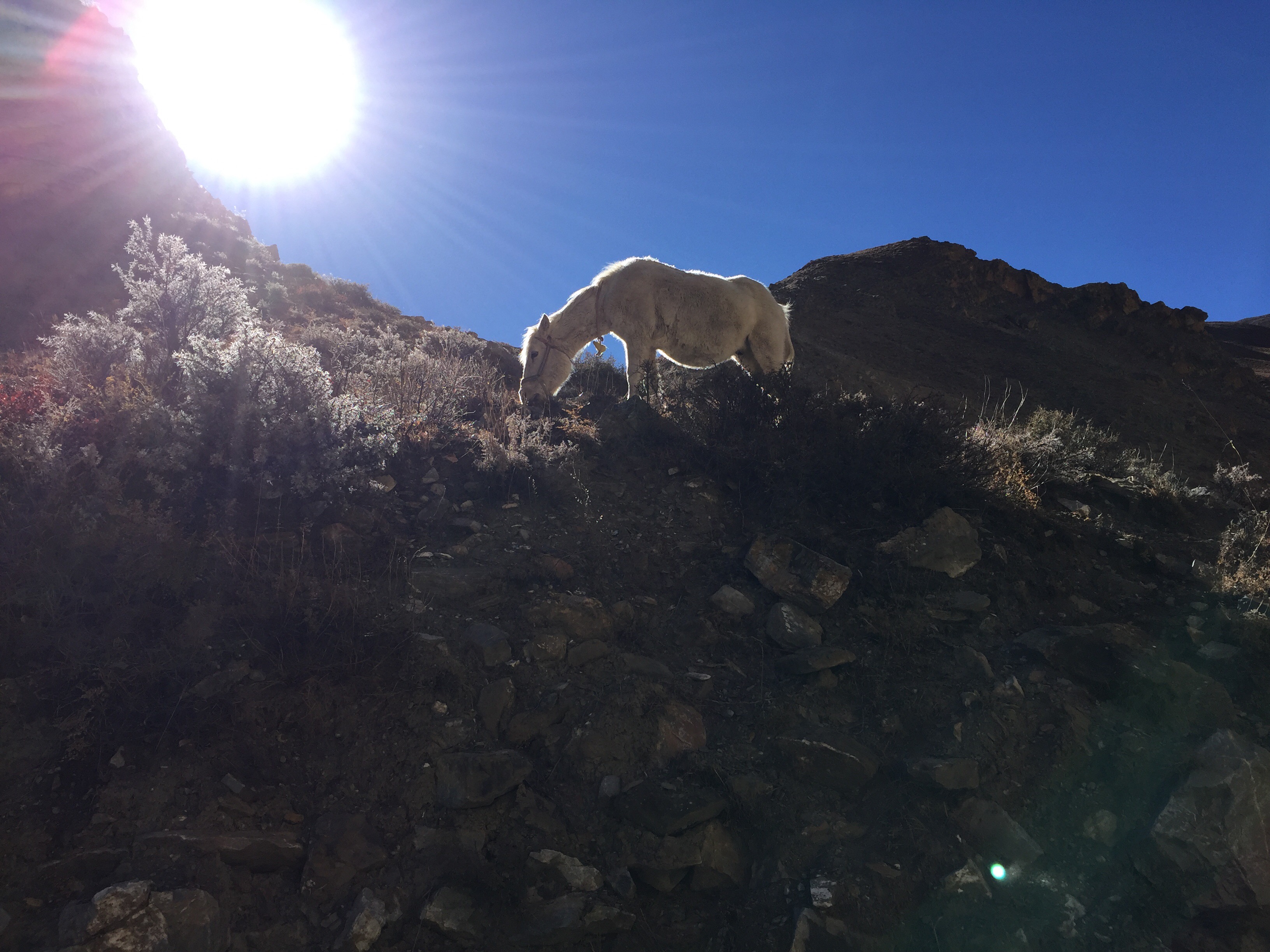
They were following the path I had slipped on a short while ago and at that very moment the lead pack-horse, a handsome heavily laden white pony with a garland of yellow, slipped and went down on its neck.IMG_3551 - Version 2.jpg

Fearing the worst all the group started towards the pony shouting and hollering, but the sturdy animal was fine. After a few feet of sliding it regained its footing and continued uphill.

My attention was diverted from this drama for a while as a party of trekkers appeared across the pass coming towards me. This was only the second party of trekkers we had seen; the first being the Australians on the second day between Pilling and Ghok. I called “hello!” to no response. Undeterred I tried “bonjour!” but struck lucky third time with “guten tag!”. They transpired to be a very tired Austrian group which had left Juphal 3 days ago and were going as far as Shey Gompa before returning. They were intrigued by the route that I described to them but our halting conversation was drawn short as their team of 10 mules were bearing down upon us at speed now they were going downhill.

Looking back up towards the pass through the dust created by the nags I could see that the boy in the orange jacket and the people I assumed to be his family had overtaken me and pressed on to the Nagdalo La in the rising wind. All bar one of the horses had crossed the pass with the leader. The final horse and one of the women were about to cross, leaving just two people to make the crossing on their way to lower and warmer climes to the south. These were the boy in the orange jacket, and his mother now wearing a blue headscarf.

Unaccountably the boy stopped and from about 20 feet away looked round at me. In the whistling wind no words were spoken. I kept plodding onwards and after a few steps I simply stopped, smiled and nodded. He nodded too – if there was a smile I didn’t see it. He just nodded and turned to follow his mother over the pass encouraged by calling and shouting from those already at the top.IMG_3556.jpg

I turned my attention down the path again as I could now see Tim, Lizzie, and Jovi, with Gyalbu and Mark not far below. I waited a few minutes to allow the distance between us to narrow, then headed for the pass, every steep step a struggle in the wind.

By the time I reached the pass several minutes later the boy was gone. There was just a chough battling to make headway in the wind, a string of wind-beaten prayer flags, the most extraordinary views all around, and me with my thoughts on what life in Dolpo was like for a 10 year old boy in a transhumant family.

Trek day 14: to Shey Gompa – on the trail of a snow leopard

24 Saturday Dec 2016

Posted by andyjameswriter in Dolpo trek

≈ 2 Comments

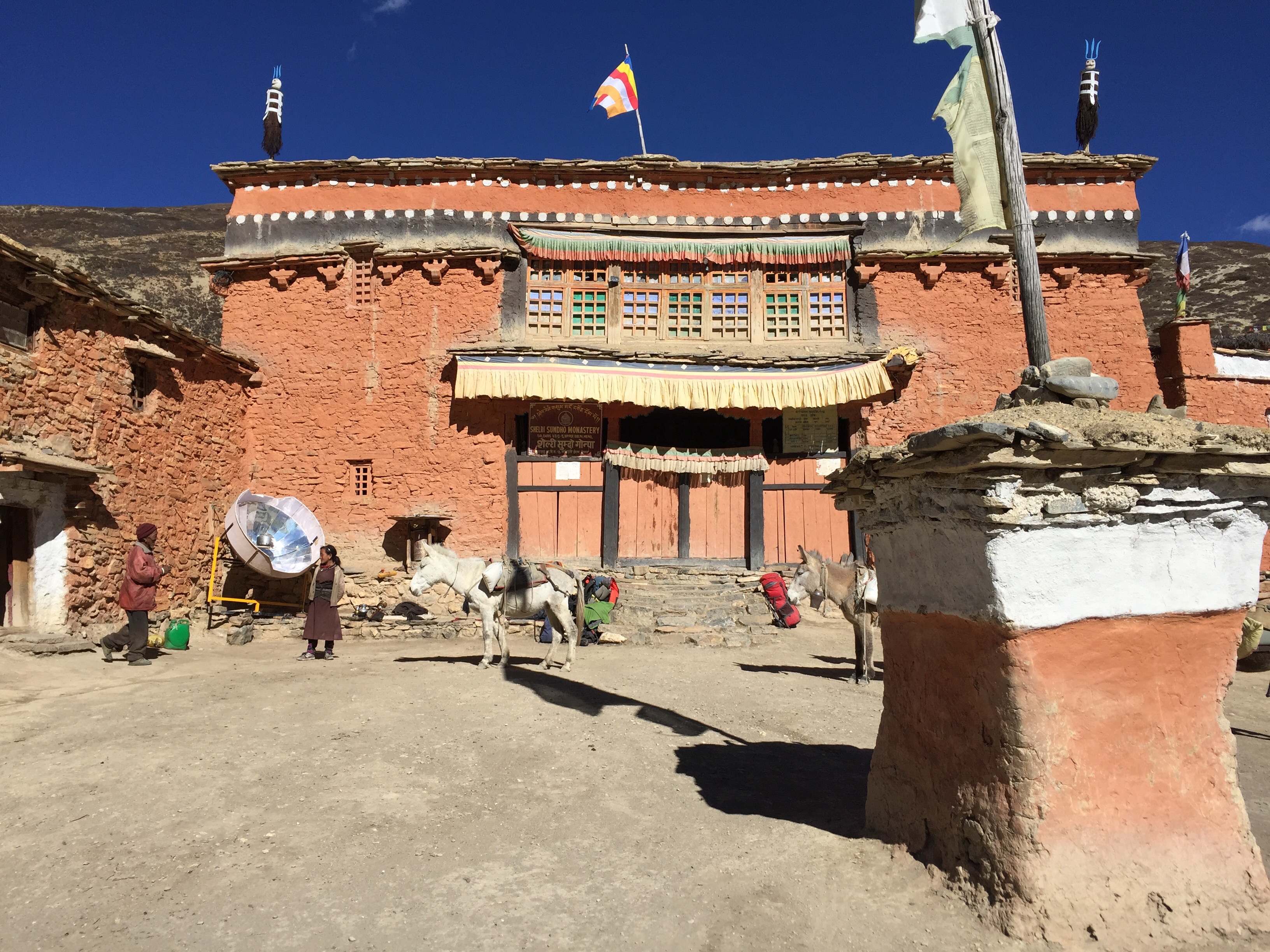
Ever sinse we decided to go south from Saldang I have looked forward to going to Shey Gompa. In truth I was disappointed that our original route didn’t include this iconic location. The heartland of pure Tibetan Buddhism is the Crystal Mountain, or Shey, embedded with crystals that sparkle in the sunshine, and the 800 year old monastery (gompa) at its base: Shey Gompa. Known locally as the Shelri Sumdho Monastery, Shey Gompa faces the Crystal Mountain at the confluence of 3 rivers at a height of over 4300m. It’s importance to the Dolpapa cannot be underestimated and I was delighted that by the end of today I would be there.

Our night’s sleep on the gompa floor was fairly good being disturbed only by the creaking of the floor as first one then another of us tried unsuccessfully to tiptoe quietly to the door with dimmed head torch. A door with squeaking hinges, secured not by a latch but a block of wood leaned against it and which defied silent movement. Each series of small but significant night noises was repeated in reverse as the relieved individual returned. Relief was not simply due to liquid reduction but from having either successfully negotiated the trip into the valley looking for a suitable spot or opted for a closer location unmolested by the mastiff. At least by having everyone’s sleep reduced to a light doze the incidence of foundation-shaking snores was reduced.

Breakfast saw a return to tsampa porridge which didn’t encourage us to tarry, but the warm sunshine in the gompa courtyard was welcome while we packed our bags and the ponies were loaded. We didn’t see Mrs gompa-keeper during our departure but the keeper and the 3 children we saw yesterday were keen to be with us and were happy to be photographed sitting outside the gompa. We left shortly after 9 am.

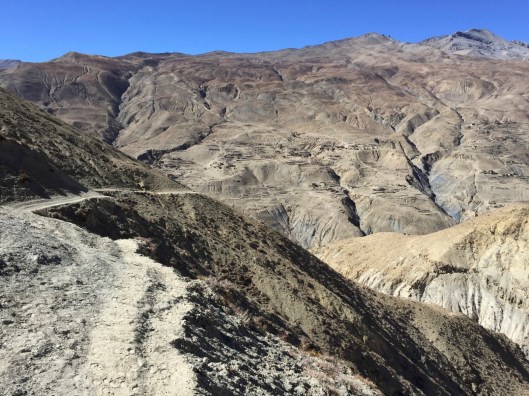
The gain in height from Namgung Gompa to the Selma La was over 700m and we began to gain that height as soon as we crossed the Namgung Khola heading south-west. In no time the gompa looked like a model over our right shoulder and then slipped from view as we crested the first dry scrub and rock-strewn ridge. While the sun was warming down at the gompa it waned as we gained height and the windchill took over. Likewise the terrain became more barren. The scrub common lower down petered out and as our path contoured between the peaks around us the river froze. I soon found myself accompanied only by Jovi as others stopped to admire the views, rehydrate, take a snack or maybe a photograph, and in due course I was alone. I preferred to use a camelback, carry my snacks in a pouch on my belt and take photographs on the move so didn’t need to stop. While I still often walked with the group, on this occasion I relished a little solitude and strode ahead trying to catch up with Sangye and the horseman with the string. They had made a quick getaway from the gompa and covered ground fast so were a long way ahead. Each time I crested a ridge I expected to see them close, but each time they eluded me.

Towards midday I neared the pass at over 5000m. I could see no-one ahead and no-one behind. By this time the wind was screaming and was colder than I could remember all trek. Winter was definitely on its way fast and I once more gave thanks  for our decision not to go north. Taking the unusual step, for me, of donning my duvet jacket and hat I quickly crossed the pass and headed down the other side. But which way? While there was a single track before the pass there were 3 leading from it on the southern side. I took a chance on the path heading into the valley half-right, not because I was convinced of it being correct but because it disappeared over a minor ridge not far ahead which I thought might offer some protection from the wind while I checked map, compass and the GPS. As it turned out the area was a grit-bowl the contents of which were being driven hard, but I had to stop to confirm the route. The view of distant peaks, many snow-covered, was magnificent but one that had to be appreciated quickly.

Luckily my guess was right so it was off with the big jacket and a rapid descent. It was still blowing a gale but it was warmer and now on my back protected by a rucksack so I set a fast pace and once again scanned the distance down the valley looking for the ponies. After around 15 minutes I saw them. They must have been galloping to have got so far ahead, or maybe I wasn’t as fit as I thought. Either way I was delighted to have them in sight and doubly pleased to see they had stopped. I couldn’t see Sangye or the horseman but the ponies were grazing. When I had drawn level with them two behatted heads appeared from behind some scrub. The guys had been laying down in a depression to get out of the wind which was still howling. We laughed and I joined them, jacket on once more. After 30 minutes or so Tim appeared, with the others joining just 5 minutes later. We all then moved down the valley together for another few hundred metres to a more sheltered spot for lunch.

After the energy sapping morning and the chill at the pass we decided to have the best lunch available. This was selected from our ‘Look What We Found’ bag. More importantly it was Tim’s favourite which had been saved for a special occasion; and this was it. We made Lancashire Hotpot with mixed rice. It was awesome. Hot, tasty and exactly what we needed.

After lunch we continued our trek down the valley which would eventually lead us to Shey Gompa. By early afternoon our dry valley had joined that of the Sephu Khola which rose under the Selma Mukchun La to the east and in warmer weather flowed west to the confluence under the Crystal Mountain and Shey Gompa. As we followed the northern side of the Sephu valley the wind abated and our surroundings became more benign. Dusty sandy tracks bordered by scrub and low hills replaced the barren grey and gritty landscape higher up, although the few dwellings we saw looked empty and the river remained frozen solid.

As Tim and I made our way along a sandy track 2 or 3 miles from Shey Gompa Tim suddenly froze and said, quietly but with strong conviction: “ssshh … quiet!” He then dropped to one knee and studied the ground. “What’s up Tim” I said quietly. He just looked daggers at me, held his right forefinger to his lips and beckoned me forward to join him. As I came close he pointed intently at the ground and whispered hoarsely “snow leopard!”.

I froze, shivers running down my spine, and saw the clear fresh print inches from the end of his finger, shown here in the centre of the photo with 4 toes pointing down.
I mouthed to Tim “where is it?”. Tim just shook his head and rising to a half crouch tracked the animal print. He soon stopped and pointed again but the spoor was unclear to me. Tim pointed to several other, to me, less distinct prints. I looked quizzically at him with furrowed brow and a shake of my head. Tim said, quietly and almost into my ear, that he wasn’t sure but it appeared as though a mother and juvenile had been on the track recently heading east, but had doubled back and left the track heading north. Probably when they saw us. We continued looking for many minutes but there was no sign, no movement. The best that we could do was take a photo of the valley which we thought the pair has used to escape. To think that we had seen the fresh prints of a snow leopard within a few miles of where Peter Matthiessen saw his. They were up there somewhere. Honest!

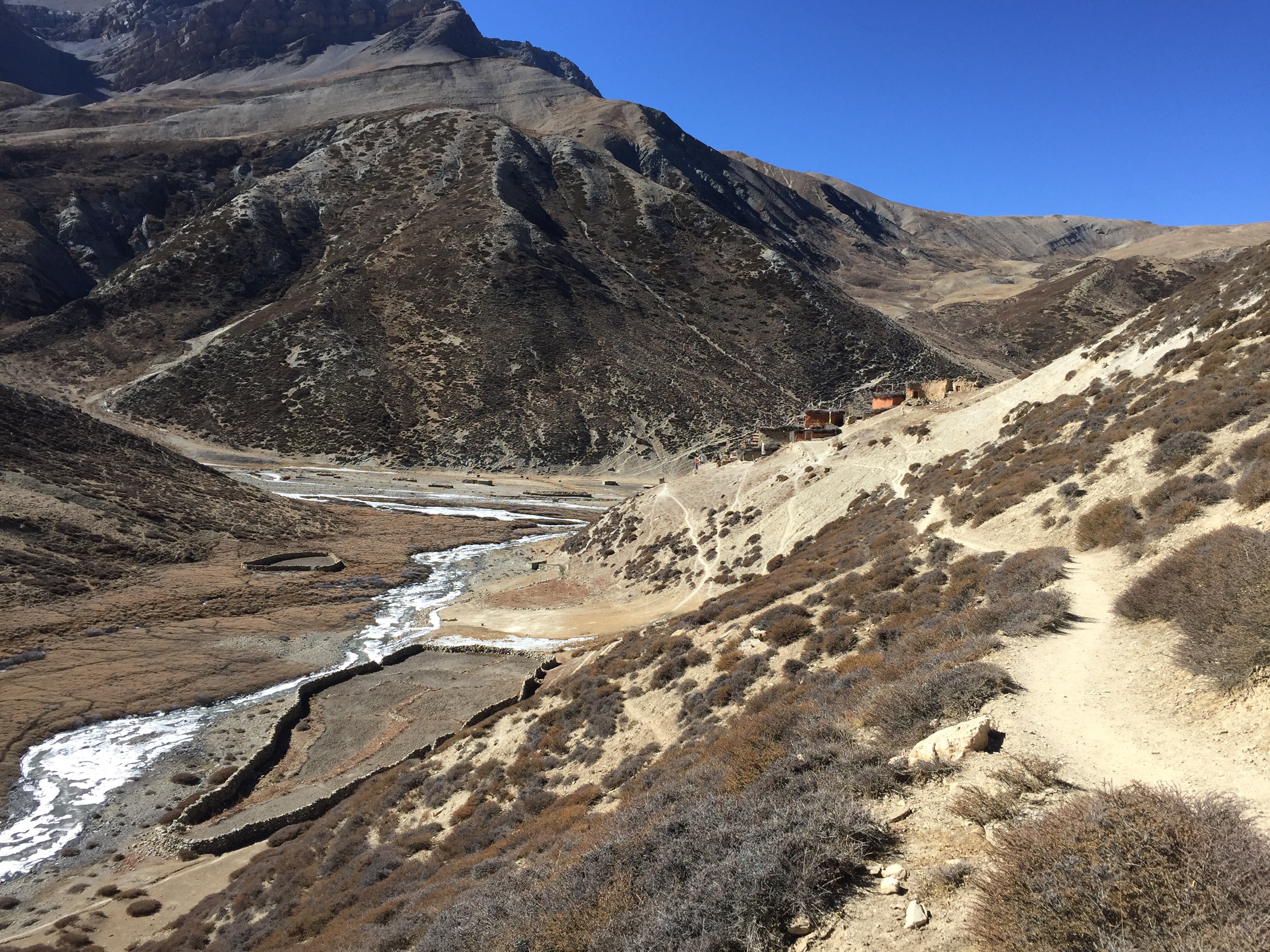
Exhilarated at our find and saddened but not surprised that we had been eluded we continued the few hundred metres to Shey Gompa. We could see it in the distance from the snow leopard prints. The red bricked building is on the slope right of centre standing proud over the dry valley and the Crystal Mountain opposite but out of shot.

As we arrived at this most holy of Buddhist gompas Tim and I held back, allowing Gyalbu to approach first. 

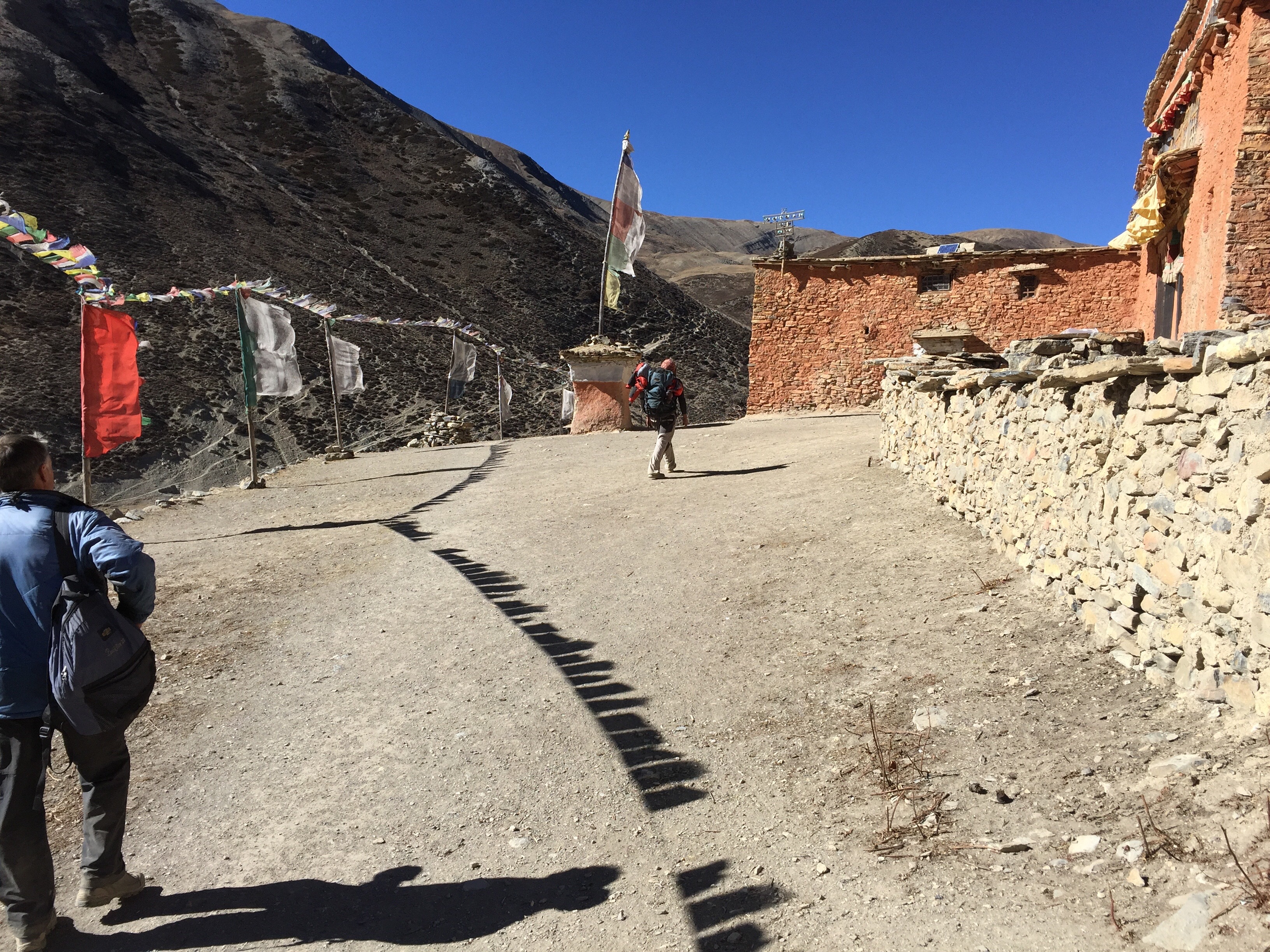
Shortly after the horseman arrived with our bags and I waited pensively, well away from the gompa. Then from a side door firstly a woman, a nun, appeared followed by a monk. These were the guardians of Shey Gompa, the Shelri Sumdho monastery, and both were in working clothes. They smiled broadly and went to Gyalbu and embraced him. He was being welcomed and so were we all.

What an extraordinary day. Magnificent views from the Sela La, getting as close to a snow leopard as I am ever likely to, then being made welcome by a monk and nun at the heart of Tibetan Buddhism in Inner Dolpo.

I make no secret of it – there were tears in my eyes.

OM MA-NI PAD-ME HUM!

Trek day 13: a short walk to Namgung

23 Friday Dec 2016

Posted by andyjameswriter in Dolpo trek

≈ Leave a comment

Freed from concerns about whether or not we would be able to complete our journey everyone had a good night’s sleep. The depth of the sleep was possibly assisted by a wee dram or two the previous evening. Capitalising on his success in selling us the bottle of sweet Spanish wine, our host the monk had miraculously unearthed a bottle of whiskey. Not just any whisky either; he had found a battered and very dusty but nonetheless intact bottle of Johnny Walker Black Label. After several minutes of close negotiation with Jovi the bottle was ours and following a dinner of roti with a very tasty yak and potato stew we proceeded to pour a glass for everyone. That was we 5 trekkers, Gyalbu, Sangye, the horseman and the 3 or 4 villagers who had popped in on some pretext or other to get a better look at we visitors. Oh, and the monk’s son. The monk himself and his wife declined a drink which limited the round to about half the bottle. Of course there was a second round and by then the mood in the shadowy room, warmed by the central stove, was distinctly jovial.

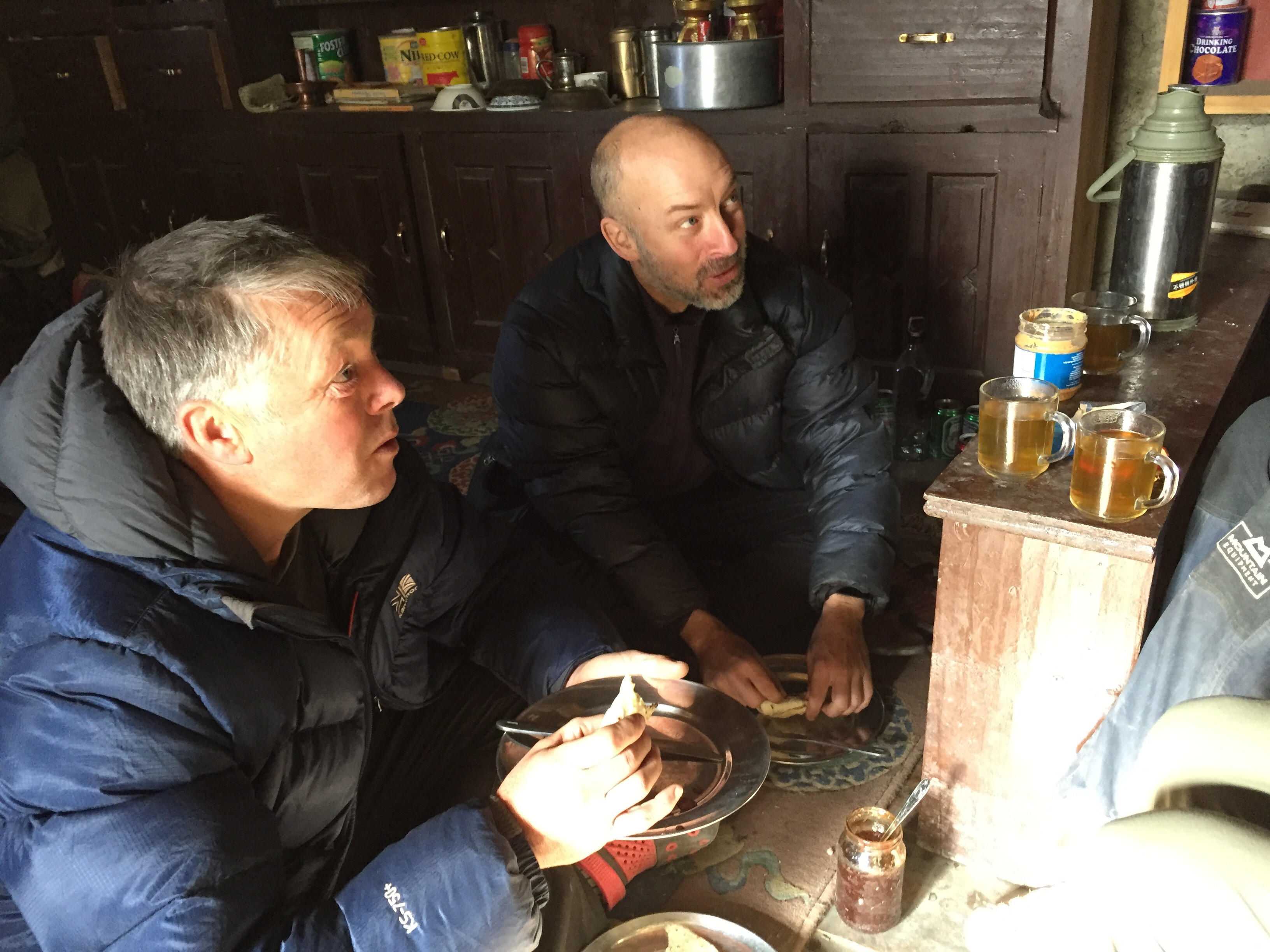
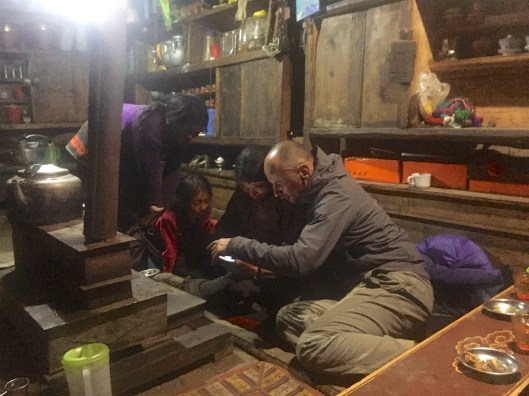
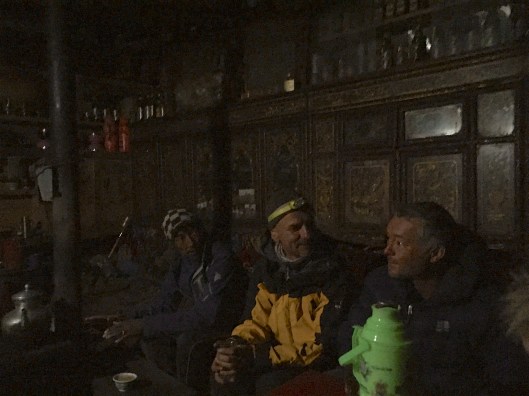
Breakfast was a repeat of the previous day with the monk’s wife making enough roti for 2 each. There was plenty of jam for those who wanted it but the peanut butter purchased from the headman’s wife yesterday proved to be very popular too. The scene is captured in this photo in which Tim and Mark are tucking into their breakfast on the floor chatting to Jovi and Lizzie unseen to the right of the bench-table. The jam is on the floor while an almost empty jar of peanut butter is on the makeshift table among glass cups of tea and the thermos flask; universally used in lieu of a teapot in Dolpo.

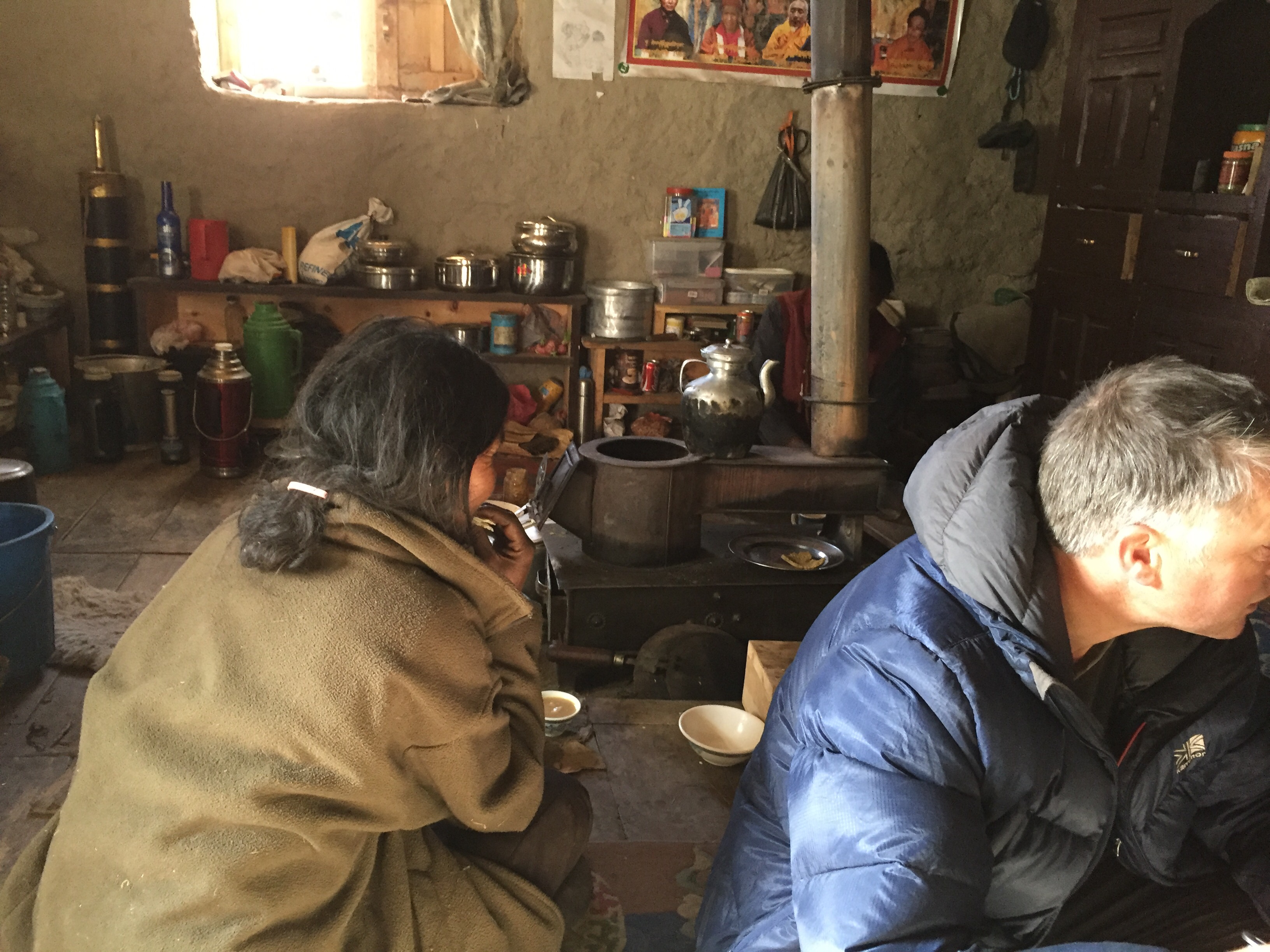
From their slightly raised position Jovi and Lizzie had a good view to the other side of the room, now empty of other people save for the monk’s son who was having his breakfast too. He was having roti with tsampa porridge which can be seen on the floor in front of him and in which a piece of cheese is floating. The monk’s wife is obscured by the stove chimney pipe. Behind her on the bare wall next to the window are the customary Buddhist photographs, and in this house they were not accompanied by Wonder Woman. A typical array of cookware and stores are on, in and around the shelves. The cookware in this house was notable for being clean and shiny and to their right we saw plastic sealed containers; something not seen before and indicating the relative wealth of the family. To the left of the photo is a selection of flasks and next to the red jug which I had used yesterday to pour water over myself during my ‘shower’ there is an empty bottle of Nepalese ‘Ruslan’ vodka. When it last contained vodka I don’t know as this is an older style of bottle to the current Ruslan, but it was now used to measure Raksi into the kettle on the stove. Apparently Ruslan, produced in the Himalayan Distillery at Birgunj to the south of Kathmandu, many miles from the Himalayas close to the border with India, has around 90% of the market share for vodka in Nepal. But not in the monk’s house where Raksi or tea is preferred. Next to the Ruslan bottle is a churn for making butter tea.

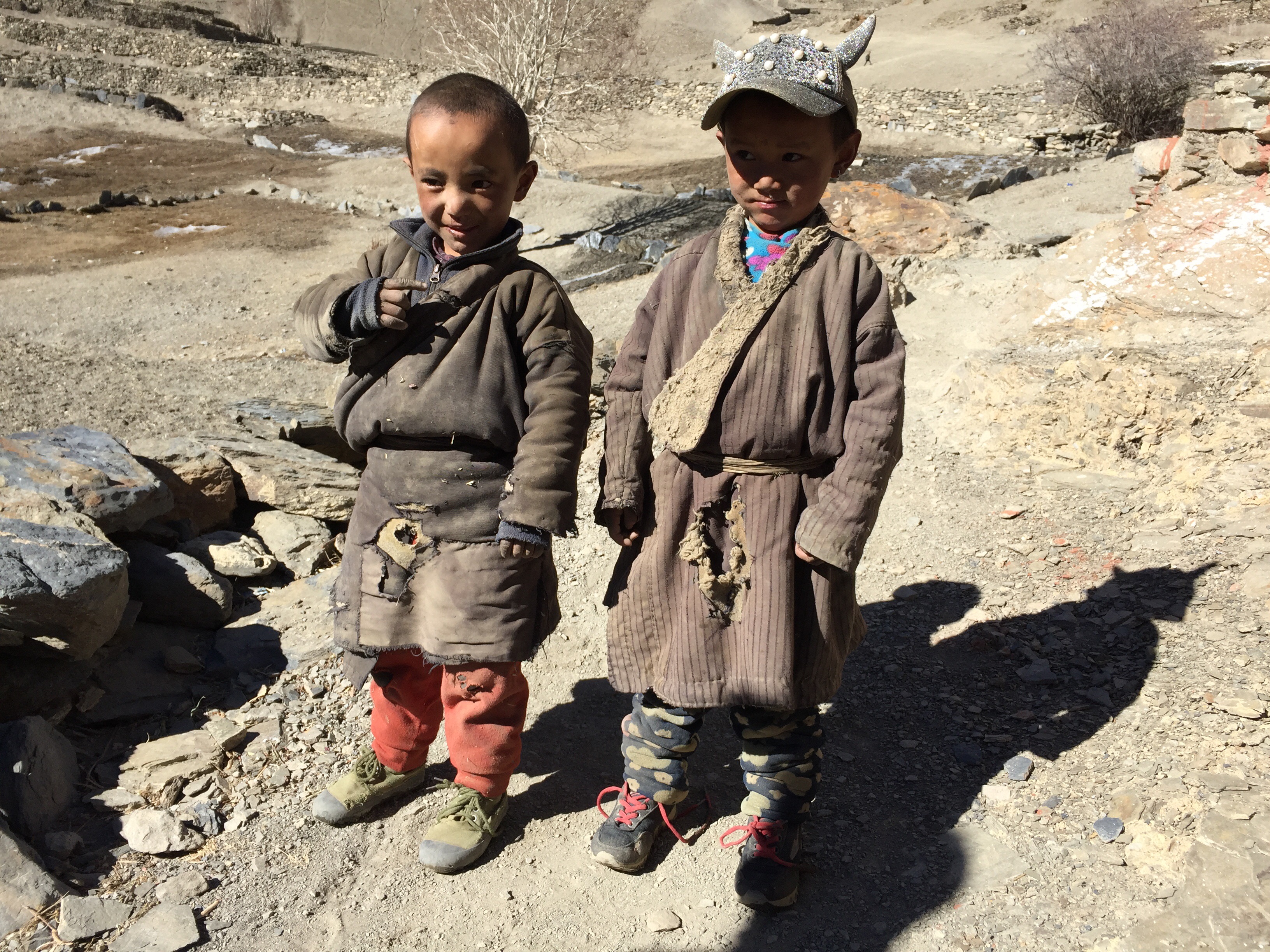
As we were in no hurry the sun was high before we departed. While Namgung is a short walk, to make for the next village, Shey Gompa, in a single day would be too much as that would include traversing the Sela La, a pass of 5095m (16,715ft). There were two ways of getting to Namgung. One initially headed north from the village before broadly heading south-west over the mountains for a few miles. The alternative followed the Nagano Khola south to its tributary, the Namgung Khola, and then followed that upstream to the village. We were advised before leaving Saldang that the mountain route was best so we headed north. This took the same route through the village as had been taken yesterday when we went to the headman’s house. Having passed the monastery Gyalbu asked an incoming traveller to confirm we were on the best route. There followed some discussion as there was some uncertainty over the best way to go. While Tim and Gyalbu sought clarity two young boys who were with the traveller detached themselves from the conversation and came over to where the rest of us were waiting, seemingly intrigued by our attire. They could have been drawing a comparison between their clothes and ours. While our gear was quite grubby it was typically brightly coloured and in good repair. They by contrast were wearing very worn and ripped tunics. They did at least have laces in their shoes although they and their trousers, one of which had holes in the knees, had seen better days. Despite this they seemed in good spirits and smiled broadly at us. Most engaging was the hat that one of the little fellows was wearing; a silver-grey baseball cap sprouting horns in the style of a Viking helmet. 

Once the discussion on the route was completed we all went back down the hill past the monastery. The traveller and the boys continued their journey while we retraced our steps having now been advised the river route was better than going over the mountain. We followed the river for around 2 miles until we passed the small village of Kirathan nestled between steep terracing and the even steeper mountainside on the other side of the river. There were a few people in sight and one or two animals but Kirathan, like Saldang, looked as empty as its dry and dusty fields looked forlorn. I for one was now glad we were heading south, back into a world of people and vitality. The wilderness of the borderlands had been fascinating to see and challenging to traverse, but Dolpo had shown itself to be more than a series of barren high passes and our trek was more than an exercise in high-altitude survival.

Shortly past Kirathan we reached the Namgung Khola and turned to the south-west up the wide steep-sided valley that would eventually lead us to Namgung 5 or 6 miles away. We had to take care as this was not a recognised trekking route and the path was not shown on our map. The mountain track had been but this one wasn’t and there were several minor river junctions that would need to be navigated.

As had been the case with the Nagano Khola valley, the Namgung Khola valley was broad with signs of it handling a torrent in the springtime as the winter snow melts, but now the flow was much reduced. It was at least flowing and the degree of icing was less than we had seen further north. There was more vegetation too. The low sparse scrub was still evident but there were now larger woody bushes not seen before. Although these didn’t extend far up the valley sides which rapidly became steep and rocky, they and the occasional leafy plant in shady spots provided meagre grazing for our lead pony during a mid-morning break.

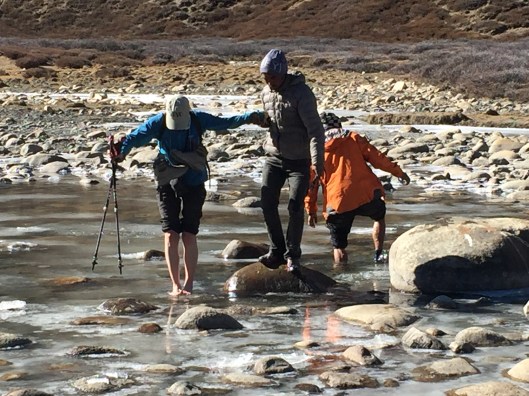
As the valley gained height so the vegetation reduced and before long the river’s flow reduced still more as we found ourselves in a canyon rather than a valley. Ahead we could see 2 people who had stopped for a break and shortly we caught up with them. We recognised the younger man as the monk’s son with whom we had taken breakfast earlier. He and his uncle, who we hadn’t met before, were woodcutters heading further up the canyon to where small trees were known to grow to gather fuel. We had noticed that the family stove was not fed with the dried dung common elsewhere but couldn’t understand where the wood came from. Now we knew. We exchanged a few words with them, typically Namaste and Tashi delay leaving more meaningful conversation to Tim and Gyalbu, then walked up the canyon together with the monk’s son leading. Before long the river reappeared, and in sufficient volume to warrant some care being taken in its crossing as there was no bridge. Why would there be? This wasn’t a recognised path although its use as such was clear by the narrow dusty track that we were following. Our new friends came to our assistance as they knew where to cross and fashioned a stepping stone causeway over the deepest part of the icy river. This spared another wet boots/dry feet or no boots/icy feet dilemma from which we had been saved when the rivers were frozen.

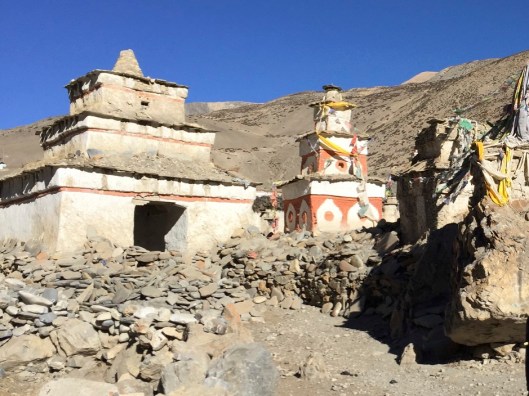
Shortly after the crossing we could see caves in the steep escarpment to our right, in front of which some appeared to have rough walling. Tim told us it wasn’t unusual for Buddhist monks to spend years, at least 3 but often much longer, as hermits in deep solitary contemplation. As there had been monasteries in this valley for centuries it was highly likely that the cave we could see had been, or indeed was, occupied by a Buddhist hermit. The walls would have provided a measure of security and warmth during the winter. Perhaps some food might have been grown in small unseen gardens but more likely there would have been some food provided from the monastery and left at a pre-arranged location for the hermit to collect without compromising their privation. The religious significance of this area was marked by chortens in the vicinity of the cave.

Shortly after we came to a river junction. Our route lay with the main river which turned west, while the woodcutters were taking a small tributary to the south so it was time to bid them farewell. But not before we shared our lunch with them and their photographs were taken, in this case with Gyalbu on the left.

As we continued up the Namgung Khola there were several more times that we needed to cross it, sometimes with the help of rocks cast into the water as stepping stones when the river was too deep to ford and too wide to jump. These crossings were accomplished without any dunking and after a while the river thinned to a trickle and we found ourselves once more in an area of more bushes and even small trees despite the now arid terrain.

In due course, as had happened before, the vegetation gave way to the more usual sandy and stony valley floor and we could see the ruins of a monastery built into the rocks to our right on the south-facing side of the canyon. Ahead we could see more chortens indicating that Namgung Gompa was not far ahead. Fifteen minutes later the river made another reappearance as the valley narrowed and the flow was even sufficient to support a small water mill which would have been used earlier in the year to mill grain from the millet, buckwheat or barley grown on the terracing around Namgung village.

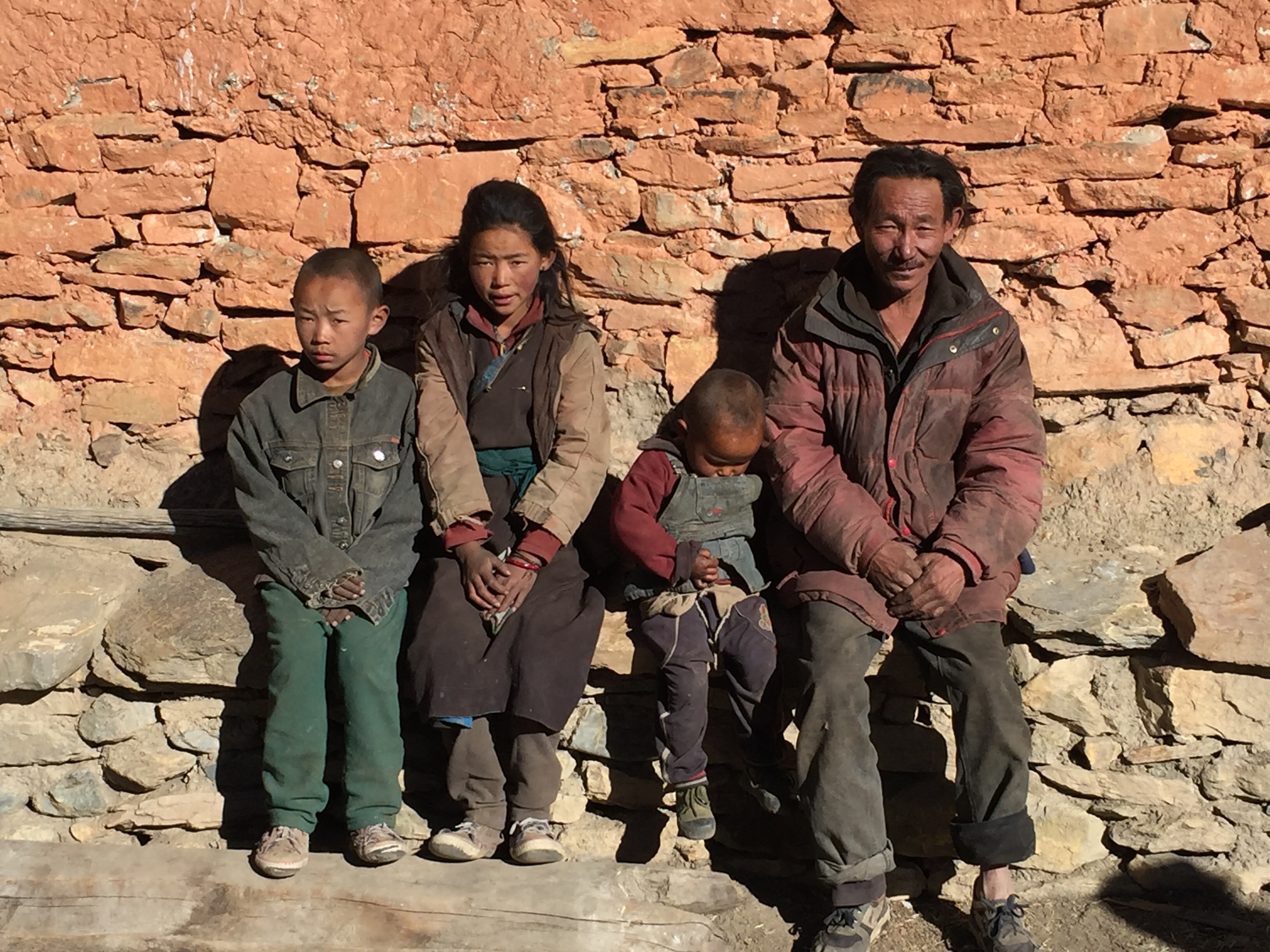
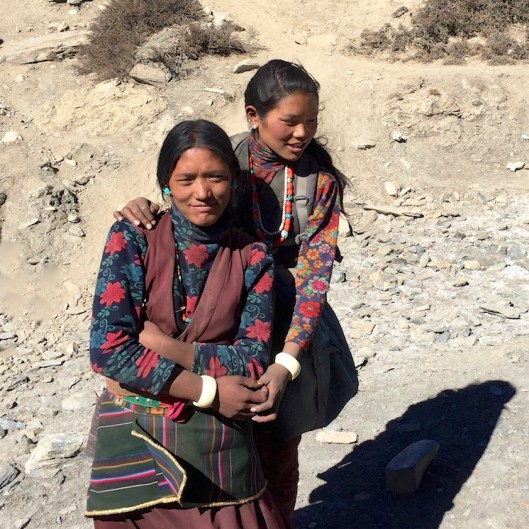
Before we reached the gompa (monastery) we were greeted by some children; 2 boys and their older sister. They chatted with Gyalbu and led us to their father, the gompa-keeper. While Tim discussed food and accommodation with him, a man in his early 60’s, we enjoyed the last of the sun before it dipped below the mountain ridge. The gompa-keeper’s daughter, probably in her early teens and so too young to be dressed traditionally, particularly liked having her picture taken and even posed for us. She told us she had lots of brothers and sisters and the boys we had seen were her brothers.

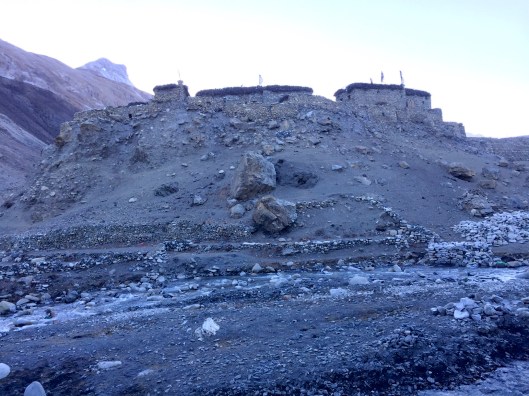
Namgung is a small village; just a hamlet really, the centrepiece of which is the handsome red-brick gompa. Plain fronted save for 4 windows its main entrance was to the right. To the front of the gompa are terraced fields which in summer would be cloaked in green crops but now were dry and dusty, with access from the gompa courtyard guarded by a mastiff. What the dog was guarding, attached as its was to a very long chain, we weren’t sure. As it looked completely uninterested in us a couple of our number forgot the warning and ventured too close at which time the dog erupted in a cacophony of enough snarling and barking to make the intruders recoil and retreat very quickly. It didn’t appear too serious and no injuries were inflicted but a wide berth was maintained in future. Either side of the gompa were traditional stone dwellings with small windows, firewood on their roofs crowned with prayer flags. That on the left transpired to be where the gompa-keeper lived with his family. In front of the terraced fields close to the river were a few other small houses and behind the gompa were a series of significant chortens backed by a cleft in the mountain side through which a frozen waterfall could be seen. On the other side of the cleft were a few delapidated dwellings. Further down the valley was the old, now ruined, gompa at the foot of the escarpment above the scrubby scree.

Tim returned from his discussions with the gompa-keeper with a broad grin. The gompa was unused at the moment as all the monks were away; where he didn’t say. He would be very pleased to feed us in his kitchen, the one he (actually his wife) would normally use to prepare food for the monks, and we were welcome to sleep where the monks would if they were here; on the floor of the gompa itself! We were delighted. No need for tents in the courtyard! There was no toilet, longdrop or otherwise. The advice was to do as the monks do; climb over the wall of the top terrace into the cleft in the mountainside and find a sheltered spot.

The gompa-keeper then helped move our gear through the ornate doorway and inside. The room was colourful and ornately decorated with intricate and stylish embroidery around the walls, with drapes of gold, blue and red. The beams and supporting woodwork were richly painted in primary colours and there were rows of drawers containing religious texts above shelves of books, chalices, candlesticks and statues of Buddha. It appeared the monks had been away for some time as the room was also used for storing grain and other less spiritual artefacts. In this region even religious property has to serve more than one purpose and were it not for that we would have been sleeping outside. As it was I slept just where Tim is standing in the photo below.

Once we had laid out our sleeping bags we went into the gompa kitchen where Gyalbu and Sangye were making tea. We accessed this through a doorway to the left of the gompa and then down a ladder into a dark room. It was furnished as we had become familiar but this room was clearly poorer. There were few rugs, the walls were bare and there was little shelving as pots, pans and flasks were piled on the floor. Oddly there were a few nails in the wall from which hung a cheese grater, a ladle and a julienne peeler. This being a monastery there was no Raksi but, surprisingly, the gompa-keeper produced some chang.

Chang, sometimes written as chhaang, is a Nepalese and Tibetan beer-like drink homebrewed from barley or millet. It is usually drunk at room temperature in summer, but is often served hot when the weather is colder. We had it cold.

We spoke to the gompa-keeper and his wife over a dinner of Nepali bread and a thin soup containing pieces of gristly meat. We learned that the man was indeed in his early 60’s, 62 actually, while his wife was 48. They had 9 children, 5 of whom had left home. I suspect the Namgung cuisine and nightlife wasn’t to their liking. We on the other hand were grateful for the family’s hospitality in this poor hamlet nestled in the heart of Inner Dolpo. We seemed much further from the open and apparently prosperous (by Dolpo standards) Saldang than one short trek. These people were not transhumint herders. The gompa has to be looked after all year and our arrival with the means to pay for food and lodgings will have eased their struggle to make ends meet. We were seeing a different face of life in the Dolpo. A face that despite the hardship still smiled.

Trek day 12: The epiphany of Saldang

20 Tuesday Dec 2016

Posted by andyjameswriter in Dolpo trek

≈ 3 Comments

Despite the weighty matter to contemplate following yesterday’s bombshell, and the freezing temperature, the night passed quickly and comfortably. Being outside in the courtyard had the advantage of not being awoken at dawn by the return of the family we were staying with. At just after 7 am Gyalbu brought me some tea and by then the sun was already warming the tent. Ah, the joys of a rest day!

Breakfast was an unexpected change from tsampa porridge, with or without meat and cheese, as our host’s wife made roti. The name ‘roti’ is derived from the Sanskrit word for bread: rotikã. The roti is one of the most popular Nepalese foods. It is considered light and healthy and is normally served for lunch or dinner as it goes with just about everything including meat, vegetables and lentils. It is a flat bread. Not the buckwheat variety we were accustomed to but made from a wheat flour known as atta, with butter, salt, sugar, milk and water. Once kneaded and separated into small balls, the dough is flattened with a rolling stick into small circles and cooked on a flat iron pan called a tawa. Once it is cooked and a number of small air pockets have appeared so the bread starts to puff, it is taken from the pan and served hot. In addition to savoury, roti also goes well with sweet foods so we were doubly in luck as the family had some jam. What a treat! A roti spread with a little butter (yak butter naturally but good all the same) then smothered in jam, followed by another, washed down by normal black tea with a little sugar. The day was starting well indeed. We would need to discuss the way forward, but not until later as there were a few more enquiries to be made first.

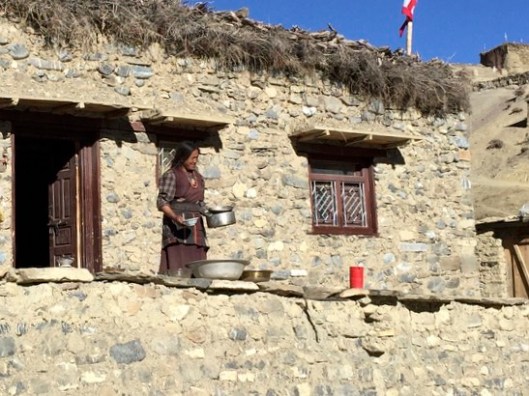
After breakfast I headed out for a walk. Although this was a rest day I wasn’t actually tired and my camera, i.e. my iPhone, had been playing up yesterday and I hadn’t been able to capture all the pictures I had wanted. It was now fixed and that was all the excuse I needed to get back into the mountains for a couple of hours, retracing our steps from yesterday. The ever thoughtful Gyalbu offered to come with me but that was declined as his skills would be better employed trying to find a way for us to continue on our origninal route. Apart from which I was looking forward to some space to myself, to think about our dilemma. As I was leaving at just after 9 am the lady of the house was doing the washing up.IMG_3190 - Version 2.jpg
After giving Tim my route and return time I crossed the river and went back up the treacherous path descended yesterday. My whereabouts would have been seen clearly by the others as I zig-zagged up the mountainside then disappeared along the cliff to the left and into the valley. The sky was blue, the sun was hot and I was in my element.IMG_3189 - Version 2.jpg
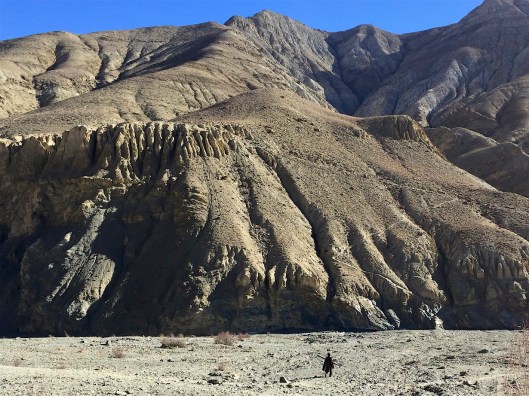
The blue sheep (bharal) were still there on the other side of the valley, although fewer in number, and I stopped for a while hoping to catch a glimpse of a snow leopard. But there was no sign – hardly surprising given naturalists spend weeks in a hide without more than a glimse. The sheep continued their leisurely grazing without disturbance, so after a few minutes I moved on. Past the frozen waterfall I went at a good pace even though the route was uphill all the way. After an hour and a half the Khoma La was just ahead and I was tempted to go to the pass but I had assured Tim I would be back by 11:30. Doing the sensible thing for a change I turned round and headed back to Saldang, downhill at speed through the dust. I reached the village just in time having not seen any people, or any animals other than the distant blue sheep. Once again the mountains were empty.

Once back at the house there was time for some washing. While my t-shirt, socks and underclothes had been rinsed and either dried in the sun or put back on wet a couple of times, my trousers had been worn from the start. I, as had others, felt it pointless to put on clean trousers as dust and dirt was everywhere and anything clean would be filthy again in no time. There were limits however and today was the day my lightweight trekking trousers got washed and my spare trousers had an airing. The spares, a pair of Haglofs mountaineering trousers, were much thicker than my trekking trousers as they were brought not only as spare trekking strides but to cope with colder weather. Thankfully the trekking trousers dried very quickly in the sun and were back on before the end of the day.

After the trousers were washed it was my turn. There was no bathroom of course but there was a toilet measuring around 1 yard by 2, with a closing door and a brick missing in the wall to let in some light when the door was closed. At one end of the toilet was a large green plastic bucket. It was about 2.5 times the size of a normal bucket and contained water for ‘flushing’ the toilet. The toilet itself was a ‘stand-up’ but there was at least a plastic insert leading to a soakaway, rather than a longdrop. Once the facility had been used, water was taken from the large bucket with a jug and used to sluice the toilet clean. The point of all this discription is that I could stand in the large bucket and pour water over myself using the jug and thereby have a bit of shower. Despite the missing brick in the wall there wasn’t much light so the door was left a little ajar and everything went fine for a while. The issue was that the floor of the toilet room wasn’t level and half way through my ‘shower’ the bucket in which I was standing overbalanced. I faced having my head or shoulder dashed against a wall while my feet were still stuck in the bucket so managed to very quickly get one leg out. Unfortunately the only place for my foot go was into the toilet. So there I was, now with one clean foot, the rest of me soapy, and the other foot in desparate need of another wash! At least I had saved the whole bucket going over and losing the rest of the water so the ‘shower’ could continue, with more care being exercised. Once dried and dressed, and after having re-filled the bucket, I actually felt clean for the first time in over a week.

By then it was lunchtime, after which we needed to decide the future of the trek. This had been on everyone’s mind all morning but it had not been mentioned.

We gathered on the steps of the house in sunshine while Tim re-capped the issues raised yesterday. Tim then said that he had found another potential route by which we could get to Jumla. He called it the jungle route as it avoided the most mountainous region and the multiple high passes between Pho and Tiyar and we could see it on the map. The term ‘jungle’ was just an expression. The route was still high and followed river valleys some of the way but included at least 2 high passes. We wouldn’t go below 3000m until we reached Tiyar. The benefit was that, being a little lower than the Great Himalayan Trail route, the rivers shouldn’t be so frozen and it might be feasible for us to do without ponies if we carried our own big packs. However the people he had spoken to in Saldang were unsure whether it was usable. One had said the path had fallen into disuse and following the earthquake climbing equipment might be needed to get through. Another said it might not be that bad but he wasn’t aware of anyone using it since the monsoon earlier in the year. We concluded that it might be viable but we needed to get closer to find out. Perhaps the people in Bhijer, the next village, would know. Or perhaps we would need to go to the village beyond Bhijer, to Pho itself where the path started, to get some reliable information with which to make a decision.

Anticipating this, Tim earlier had another discussion with our horseman to see if he would go to Pho. He had agreed to go to Bhijer, as there was a route south to Juphal from Bhijer, but he would go no further north, including to Pho. This meant that if there was reliable information in Bhijer we could make a decsion there tomorrow and not prematurely today. If we could find ponies or mules in Bhijer with a horseman willing to go north then the original route remained possible. If the local advice was that the ‘jungle’ route was passable then that alternative could be adopted. Ideally we would find a horseman with a string willing to support us but if not then we could still attempt to get through unsupported.

A third new matter was raised then. During his discussions this morning Tim had learned that there was now a road from Jumla to Rara, just west of Gamgadhi. The impact of this was that the final 40 miles of our trek would be beside a road, where a ‘road’ in these parts just means a flatten strip of terrain covered in grit and deep in dust. We all recoiled as we remembered very well what it was like on our acclimatisation walk from Kagbeni to Jharkot and back. Constantly being showered by dust a grit by passing motorcycles and toiling buses belching oily exhaust fumes. Three days of that would be miserable. Maybe we could hire a car? Maybe, but that wasn’t what we came to Nepal for.

After about an hour of discussion, and in truth a degree of arguing, we were agreed that trying to go north without support would be foolhardy and that had been ruled out. However there was no concensus on the best alternative. We were split between those who still wanted to try the ‘jungle’ lower-level route from Pho to Gamgadhi via Tiyar, those who felt that taking the escape route south to Juphal either from here at Saldang or from Bhjer might be less risky, and those who would be happy with either route. In light of this we decided to put off further discussion for a while and go for a walk around the village.

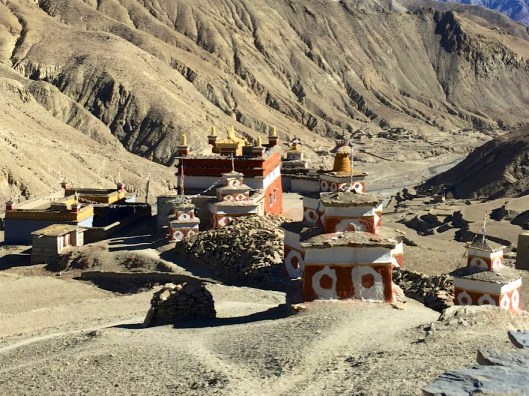
Further up the mountainside to the upper part of the village we found a monastery. The buildings were in good repair, and included the monastery itself and living quarters for the monks in ochre and white with gold-painted roof and chimneys. There were also several large chortens, both 2- and 3-tier, also in ochre and white decked with prayer flags. But there was nobody home.IMG_3237 - Version 2.jpg
Somewhat incongruously, a little further up the hill was the Tashi Samling Guest House. At the bottom of the sign in white lettering on a red background it advertised: “We facilitate lodging, fooding (sic) with typical Dolpo dishes in a homely environment”. The sign was flanked by animal skulls. We knocked enthusiastically on the door but without answer. It was closed and empty.IMG_3243.jpg

At the top of the village we found a large house that was occupied. We were invited in, entering the courtyard through a door on which had been roughly painted in multiple colours “WELCOME TO MY HOUSE”. It turned out to be the headman’s house, which explained its size and relative opulence. We were shown upstairs and through the light and well stocked kitchen, past the family prayer room, into a side room where we were seated on rug-covered benches either side of a table. At one end of the room was a shelf unit bearing goods for sale, including jars of BournVita, drinking chocolate, honey, jam and (joy of joys) peanut butter. There was also a selection of drinks, inevitably including Lhasa beer and Coca-Cola, and a selection of household goods and sundries. Chuckling at the little camouflaged fishing chair we promptly bought 2 jars of peanut butter and some jam, but elected to try this family’s Raksi rather than drink Chinese beer.

While we were enjoying the very good Raksi we heard “morning” from the kitchen. Then a little boy appeared, clothes still as grubby as the few other children we had seen these past days but otherwise looking uncommonly clean. He had twinkling eyes and a cheeky smile and when we smiled back he repeated “morning”. We collapsed in laughter, and all chorused back “morning” (even though it was mid afternoon). The little fellow was delighted and chirped a third time “morning”. Then his mother said something from the kitchen and he scampered off. We didn’t see him again but “morning” wasn’t forgotten.

Then the lady appeared again with a metal bowl half-filled with potatoes which had been boiled in their skins in salted water. We were invited to try some. They were absolutely delicious. She put the bowl down on the table and it was clear they were for us to buy if we wanted them, which we did. They were all devoured.

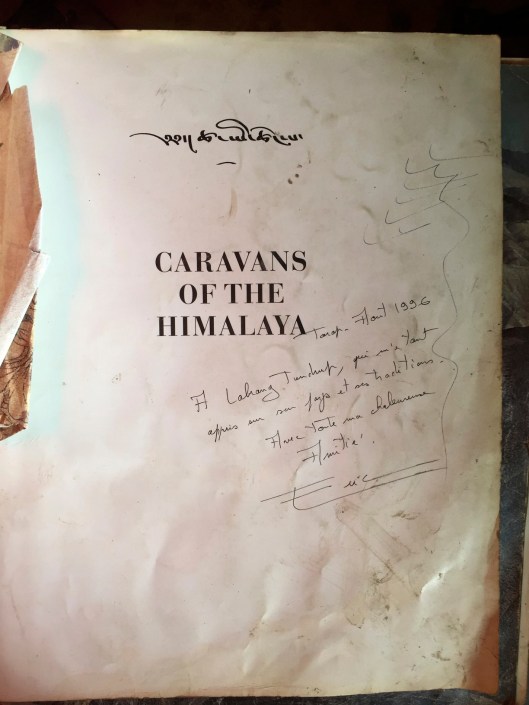
Then the headman himself appeared and introduced himself, in Nepali of course but Tim responded for us while we limited ourselves to Namaste and Tashi delay! He then went into the prayer room and returned with a large book that had been well thumbed. To our astonishment it was a signed copy of the Frenchman Eric Valli’s  ‘Caravans of the Himalaya’. The evening before I left London for Kathmandu I had watched, with Clare, Eric Valli’s beautiful film ‘Himalaya’. The film sleeve says “at an altitude of five thousand metres in the remote mountain province of Dolpo, Himalaya is the story of an ancient tribe who lead a caravan of yaks across the mountains, carrying salt from the high plateau down to the plains”. The book that the headman had showed us was the book produced 20 years ago to support the film.IMG_3259 - Version 2.jpg
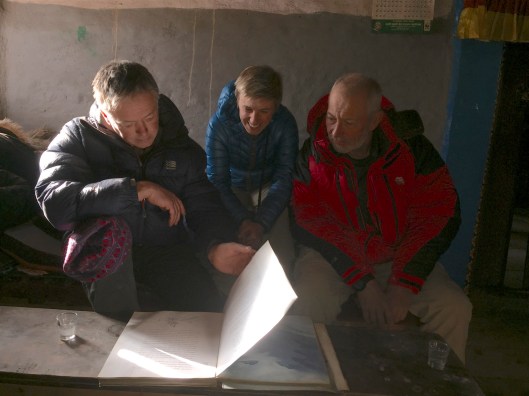
The headman then turned the pages to a photograph obviously much admired and thumbed. It was of him! In the film! This man had a leading role in the film and had been given a copy of the book signed and dated August 1996 by Eric Valli himself, with a message of thanks to Labrang Tundrup. The village chief or headman, our host, was Labrang Tundrup, who played the character Labrang in the film. We talked for a while. He said the salt caravans were very rare now but his people still moved in the traditional way, in fact some had gone south only recently. We were stunned and captivated. IMG_3260.jpg
Labrang Tundrup was then called away. He transpired to be a doctor and he was needed to treat a woman who was now in the kitchen. He listened to her for a while then had her kneel on the floor. He reached into the fire and drew out an iron rod that was red-hot at one end. He held the other in a rag. Labrang Tundrup then spoke quietly to her and touched the rod to her head four times, once on her temple and once on the back of her head, then once more each side just above her ears. Each time there was a slight smouldering and a little smoke, but on no occasion did she react. When it was over she sat quietly for a few seconds then smiled brightly, looked very quickly in our direction, then she was gone. Apparently cured.

We had just had the most amazing experience and seen things very few had. We felt utterly privileged and simply looked at each other, speechless. After a while we talked again, reliving what we had just learned and seen.

By and by the talk returned to our intentions for the rest of the trek and an aspect that hadn’t really been explored. The discussion thus far has focused on the original plan and its new variants. We had spoken at length about the problems and risks of going north and the difficulties of the new route west. We hadn’t really explored the benefit of going south as it was simply an ‘escape route’. Now Tim gently introduced that option.

Although shorter it would be a tough route as there were still high passes to negotiate, however the villages that we passed were likely still to be occupied as they were lower. We would pass the Crystal Mountain, the spitual heart of Inner Dolpo, and the nearby 11th century Shey Gompa (monastery) near which Peter Matthiessen had seen a snow leopard. Then further south we would trek around Phoksundo, the stunningly beautiful freshwater lake which features in the film ‘Himalaya’. All the way we might have the opportunity to meet more people; an opportunity we would not have if we went north or east.

Set again this opportunity was the uncertainty and risk, some people we had asked used the work danger, associated with north or west. We were simply too late in the year. Winter was setting-in, the people were leaving and the water was becoming trapped in ice. We would have to rely on our own food and fuel without likely resupply. There were no ponies for hire in Saldang and the same was likely in Bhijer and Pho. If we tried without support and had to turn back towards the end we would be in significant difficuly without food or fuel and in some danger. We had rescue cover, GPS and a satellite phone but that wasn’t the point. Then there was the final 40 miles by, or on, the dusty road to Jumla. We had been lucky so far. We had good support, fine weather and no injuries or illness. Let’s not push that luck too far. If we were determined to finish the original route we should do it when the probability of success was higher, earlier in the year. Another year.

We decided there and then, in the room where we had been enchanted by the doctor and Headman of Saldang, Labrang Tendrup, welcomed and fed by his wife, and delighted by his grandson “Morning”, to prioritise cultural experience over ‘a foolhardy walk into the jaws of death’. We laughed heartily, shook hands and hugged, and sealed the agreement with Raksi.

We were going south!
 

Trek day 11: to Saldang and an evening bombshell

17 Saturday Dec 2016

Posted by andyjameswriter in Dolpo trek

≈ Leave a comment

Sunday 13th November began as the previous day had, at dawn with the return of the family in whose room we had slept. While we rolled and packed our sleeping bags, water bottles and other items used overnight, the children pretended to mooch around the room but were actually watching us intently and with great curiosity. Meanwhile the adults, still curious about us but less obviously so than the kids, busied themselves with getting heat into the stove, cutting meat, preparing breakfast and making Nepalese butter tea.

Butter tea is a traditional drink made from tea leaves, yak butter, water and salt. Preparation begins with boiling the tea leaves in water until the liquid is dark brown when the infusion is strained into a wooden butter churn to which salt and a large lump of yak butter is added. We saw these devices at every house we visited but we weren’t always expected to drink this Nepalese brew. The churn vessel is a wooden cylinder about 4 inches in diameter and 18 inches or so long which is sealed at one end. It is constructed using a similar process by which a cooper makes watertight barrels bound with metal hoops. The equivalent to the cooper’s hoops around a Nepalese churn are ornately decorated metal sheaths about an inch wide. Ensuring the churn remains upright the tea-maker then with both hands on the handle pushes and pulls a wooden plunger up and down inside the churn, ensuring that the liquid is ‘churned’ without spilling from the top of the cylinder. Once the tea has been churned to the proper consistency it is poured into a teapot or other container which is placed on the stove to keep it warm. Drinking butter tea is a regular part of Tibetan life, and the life of people who live the Tibetan way in Nepal, such as the Dolpa-pa. Sometimes tsampa is added to give the drink a thicker consistency. Since butter is the main ingredient, butter tea provides plenty of caloric energy, is particularly suited to high altitudes and is a staple drink of Sherpas. Its slightly rancid flavour is an aquired taste for those more familiar with Chinese or Indian tea which typically does not contain butter. Traditionally the tea cup is kept filled to the brim after each sip. The only way for those for whom yak butter tea is not a favourite but who wish not to offend their host is to take one or two small sips but otherwise leave the cup untouched until the last moment before draining the bowl and making a hasty departure. With many thanks, steepling of fingers and a hearty ‘Namaste!’ of course! This photograph of churns is courtesy of John Hill, on Wikipedia.Butter_tea_churns,_Sera,_Tibet.JPG
After a breakfast of a thin meat and cheese soup thickened with tsampa and a few sips of yak butter tea I excused myself to one of the formica-topped tables that was placed by the window for the children to use. Having a good light was important as I was about to put in new contact lenses. My left eye had stopped smarting overnight following my resorting to specs the previous day and I was anxious to put some new lenses in today. The children were not paying too much attention until they saw me balancing a tiny lens on my right forefinger, hold open my left eyelid with my left hand and then put the lens onto my eyeball. At that point you could have heard a pin drop as the whole family, adults and children, silently gathered in a line just to my right, jaws dropped watching this crazy person shoving his finger in his eye while looking into a small mirror on their table. At the second attempt the lens was settled on my left eye and I studiously, but slightly nervously, repeated the process with the right eye. I was enormously relieved that the second lens went in first time and I didn’t have to rinse it after dropping it on the grubby table as I had with the first eye. Putting my glasses in my daysack and tidying away the mirror and lens holder I looked at the family, blinked theatrically, and smiled. Then we all laughed together and the moment was over. It hadn’t ocurred to me until then that our hosts had never before seen a contact lens.

We departed just after 8 am and after crossing Panjyang Khola by a wooden bridge headed steadily uphill towards the Shimen La. This was the first pass to be crossed today although at a modest 4260m (13,976ft) we had only 400 metres (1300ft) to climb. Once over the pass we lost half of the height gained as we descended into the Koran Khola valley, crossed the river and skirted the village of Khoma. It was then uphill again, 600 metres (around 2000 ft) to our second pass of the day, the 4460m (14,632ft) Khoma La.

The going over both of these passes was the same as on the previous day; dusty, stoney, sandy tracks over rugged terrain with occasional low scrub but no other vegetation. Furthermore we saw no wildlife, no cattle and no people. Apart from a few souls in Khoma the mountains were as empty of humans as they were of other forms of life and it felt very strange. We were used to not seeing many people but only rarely had we seen none at all. This continued for the rest of the day; surprising given that today’s route took us, for a change, not on the Great Himalayan Trail but on a supposedly more frequented main trekking route.

Our lunch was yak buttered flatbread and fried potatoes that had been made for us by our hosts in Shimen. What a treat: Nepalese chip butties! These were devoured in the sunshine shortly after crossing the Khoma La.

At lunchtime we were hoping to be able to refill our water bottles but the rivers were completely frozen. Our disappointment was eased by sight of a spectacular frozen waterfall.IMG_3209.jpg

Our path to Saldang followed the valley all the way and only towards the end of the day did it contain flowing water. By then we were too low to take a chance on it being clean and decided to wait until we could get fresh water in Saldang.

Our first sight of Saldang was truly spectacular, appearing as it did spread over several levels and a considerable distance, on the north-east-facing mountainside across the Nagaon Khola. Saldang was the biggest village seen to date and we understood it to have a population in the order of 2000. Above and below the village the land was extensively terraced but at this time of year it was barren, dry and dusty.IMG_3224.jpg

As we approached the village, while some people and ponies could be seen the village appeared lightly occupied. The only colours in the village other than dust-brown thin soil came from the setting sun which illuminated and back-lit the red, green, blue, yellow and white prayer flags flying above most houses, and an ochre-walled monastery towards the northern side of the village.

Then a cry went up; from Gyalbu who had seen a flock of the elusive blue sheep on the other side of the river valley we were following. We counted 20 blue sheep, or bharal as they are also known, on an incredibly steep escarpment. I did take some photographs but the animals were so far away and so well camouflaged they are almost impossible to see. Look upper-centre below the small dry river bed.IMG_3206.jpg

Could you see them? The so-called blue sheep which are neither sheep, nor blue? In ‘The Snow Leopard’ Peter Matthiessen describes them like the Rocky Mountain sheep, short-legged, strong, broad-backed, quick and neat-footed and having gold demonic eyes and the males of the species being a handsome slaty blue. Well that may be so, but they were too far away for us to see their stature or the colour of their eyes. Indeed we believe that the beasts we saw were female as they looked dull, which is how Peter described the female pelage. As for their ‘sheep’ title, apparently (according to Tim, Gyalbu and Wikipedia) they are actually goats. Matthiessen’s principal interest in these animals was due to them being the favoured prey of the snow leopard and where one is found the other is likely not far away. If we found the bharal hard to see the snow leopard would be a hundred-fold harder to spot. After a few minutes straining our eyes to no avail we moved on.

As we approached Saldang down a precipitous track made treacherous by deep dust concealing little rocks with the size and charateristics of ball-bearings we could see the wide river below spanned by a wooden bridge. There was still a lot of ice on the river banks but at least there was some flowing water. 100m over the other side we approached the first occupied house and were welcomed by a woman in traditional dress and a monk who transpired to be the woman’s husband. Their house was neat and well tended. Their main room was in the same format seen previously with a central stove and hearth surrounded by rugs and wall units bearing household artefacts. However as this house was well above ground there were windows to give light in addition to the solar power-driven bulb. In addition, this house had a wide courtyard for our horses and tents, and 2 other rooms. Thinking to get ahead of the game and put my tent up in daylight I erected mine immediately. By the time others considered doing the same Tim told us we had been offered, and had accepted, rooms to sleep in.

We were served a delicious dinner of ‘normal’ tea and yak nibbles (small pieces of fried dried yak meat) followed by buckwheat bread and yak curry. After dinner we tried the Raksi and were disappointed having been spoiled by the excellent quality of the Raksi served last night in Shimen. It was then that we spotted some Lhasa beer for sale and a bottle of wine; a sweet Spanish red wine of indeterminate grape variety. Jovi expertly negotiated a fair price with the monk who appeared delighted to have found a buyer for the wine which, judging by its thick layer of dust, had been unsold for some time. It actually turned out to be better than we feared and contributed to a fun evening during which each of we trekkers in turn played music from our respective iPhones, iPods, etc though a mini speaker that Mark had packed for just such an occasion. The monk and his wife and their son, an amiable strapping chap in his 20’s sat with us during the evening and appeared to be enjoying our odd selections of music as much as we did. They did however decline the wine – clearly they knew its history!

Eventually our hosts departed to their room and we were given the main room and one of the others for sleeping. Tim and Mark shared one while Jovi and Lizzie shared the other. I could have slept in either but as my tent and gear were already ready I elected to go into the tent where I could read with a light on and afterwards snore without rebuke.

Before we retired it was agreed that the following day would be a rest day. We had travelled in the order of 120 miles so far and needed a break, not least to do some washing. Less happily Tim advised us that he had some worrying news the implications of which we would need to consider carefully the following day. There were 3 main issues which we needed to sleep on.

The first and most concerning was that our horseman had been approached earlier that evening about supporting us to Jumla. He insisted that he was told we were going to Juphal where he lived. Whatever the truth of the matter our route to Jumla was due west from Saldang to Bhijer and then north-west. He was most unhappy and flatly refused to change his route. He said that going north at this time of year was madness and apart from that his horses would be unable to cross ice when laden as had been the case getting to Ghok. There would soon be snow in the high passes and he wanted no part of our misadventure. We had joked earlier in the trek about embarking on ‘a foolhardy walk into the jaws of death’ but it seems that this is exactly what the horseman was concerned about. He was taking his horses south-west from Saldang to Juphal via Shey Gompa, with or without us.

The second issue was that Tim had tried to secure alternative pack animals and a handler in Saldang, but there were none to be had. The main trekking season was over and the village was emptying as the villagers headed for their winter dwellings. The penny suddenly dropped. We had already found Pilling completely empty and its people in Ghok. While Chharka Bhot was buzzing Tinje was largely empty, as was Shimen. Now we knew why. The Dolpa-pa were transhumant and on the move! Transhumance is the seasonal movement of people with their livestock between fixed summer and winter locations and we were so late in these parts that we were caught up in it. The extraordinary annual human migration that is part of the way of life in Dolpo and to which we were, until now, oblivious, was underway.

The third matter was the increasingly frozen rivers, as evidenced by the frozen waterfall we passed today. As we went further north and gained height the rivers would be increasingly frozen there too, meaning we would struggle to find liquid water and would have to melt ice in order to drink and cook. As there are hardly any dwellings that far north we would also be reliant upon our own food and tents for sleeping. There would be no lodgings between Pho and Tiyar, a distance of over 40 miles over tough terrain, and a low likelihood of finding any until Gamgadhi 10 miles further on due to the small villages probably being empty.

I was gutted. Unless we could find an alternative way of getting to Gamgadhi then we would have no choice but to take the escape route south. As I contemplated what this alternative might bring in terms of benefit and what our alternatives might be I checked the temperature outside my tent. It was only 8 pm and the temperature had already dropped to -6 Centigrade. It would drop further overnight, probably to around -10 C or less.

Tomorrow there would be some tough decisions to be made.


Trek day 10: to Shimen.

10 Saturday Dec 2016

Posted by andyjameswriter in Dolpo trek

≈ 2 Comments

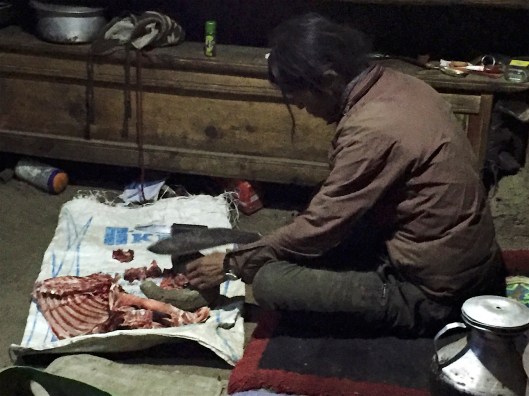
On the morning of 12th November were were up and about early. The journey to Shimen wasn’t especially far, about 11 or 12 miles. Nor was it especially difficult as we would be following the Panjyan Khola valley north-west with an aggregate height loss of around 300m. We were up early because we were all sleeping in the family room and Nepalese familes rise with the dawn, and so did we. By 7 am breakfast was being prepared and we were treated to porridge with meat and cheese again. On this occasion the father prepared the meat for cooking. He was cross-legged on a rug by the stove, with the meat on an empty nylon sack on the floor in front of him, hacking it into small pieces with bone and gristle included, using a kukri. A kukri (or khukuri) is a Nepalese knife with an inwardly curving blade similar to a machete, used as both a tool and a weapon. For over 2000 years the kukri has been, and in this household still is, the basic utility knife of the Nepalese. Perhaps along with the Bowie, stiletto and scimitar, the kukri is one of the most famous knives in the world having been immortalised by the formidable Gurkha soldiers.IMG_3083.jpg

After breakfast we took our time departing. My left eye had been getting increasingly sore and by this morning I thought I had a piece of grit under my contact lens. While I didn’t want to have to revert to wearing my glasses for the day, I could barely see through the streaming eye so I took the opportunity of a slow start to remove my lenses and find my specs in the main bag. Great care was taken walking that day as the last time I walked in glasses was in Corsica last year with an unfortunate result. With the lenses out there was a noticable reduction in discomfort and reverting to glasses proved to be the right decision.

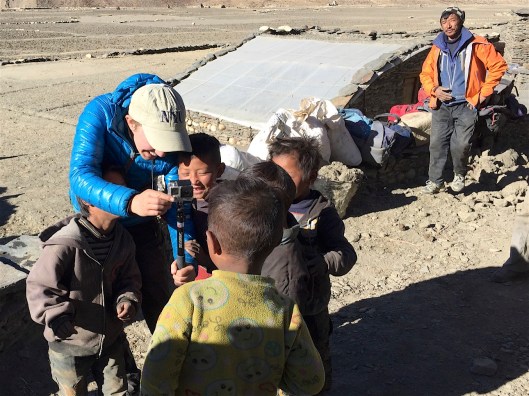
As we left some local children were outside apparently eager to get another glimpse of the strange visitors to their village. Lizzie amused them with her Go-Pro, letting the kids see what she was filming. However apart from these youngsters we saw very few people and we were reminded again that the village, which 25 years ago had a population of over 1000, was significantly empty both of the people and their livestock.IMG_3087.jpg

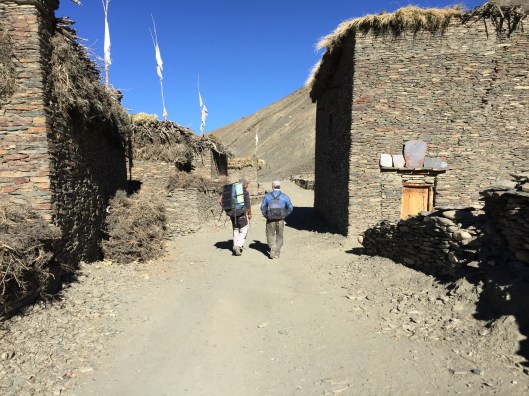
As we left the village at 9 am along empty dusty and stony tracks confined by solidly built stone houses topped with firewood and white prayer flags, we saw one building with a swastika embedded in the wall. In the Western world the swastika is synonymous with fascism but it goes back thousands of years and has been used as a symbol of good fortune in almost every culture in the world. In the ancient Indian language of Sanskrit, swastika means ‘well-being’. It was adopted by Hindus and Buddhists and was used in that context in Tinje. Our map showed there to be a health post and checkpoint in Tinje but we saw neither and weren’t checked, nor engaged by anyone as we left.IMG_3090.JPG

Outside the village, where low walls and barren dusty fields covered a considerable area, the only things on the dry dirt were a few children playing with tyres as if they were hoops from a bygone era. While endearing at one level the appearance of tyres, probably from a moped or light motorcycle as they were too big to have been cycle tyres, were another indication that times were changing in this part of Dolpo with the coming of the road on which we now walked.

A few miles down the valley our route reverted from a broad, typically 12 feet wide, flat dusty and stony track, which I believe was the Marim to Dho road. It became the type of track we were more familiar with; still dry, dusty and stony but the width of a yak or two and undulating with the surrounding terrain rather than cut through it. Quite where the road went at that point I’m not sure. Perhaps I wasn’t paying attention as it veered to the right and headed for the Marim La and Tibet (China) beyond. Perhaps the contractors ran out of money and the road hasn’t been completed; but then how did the motorcycle being repaired in Tinje get there?

As we progressed along this section of our trek we saw more small settlements and religious sites than we had before.

First around the settlement of Phalwa we saw a collection of chortens that outnumbered the dwellings. While this collection included chortens of the ‘3-tier’ variety seen before there were others more grand. In the foreground was a maniwall. Mani stones are stone plates, rocks or pebbles that are inscribed with the six-syllable Buddhist mantra OM MA-NI PAD-ME HUM. These are not uncommon in areas of Nepal under the influence of Tibetan Buddhism, such as Dolpo. Maniwalls are entire walls comprising mani stones.IMG_3097.JPG

Further evidence of the impact of the road confronted us shortly as in the area of the chortens we saw a house being renovated with new windowframes made from cleanly dressed light wood. A sizeable stack of wood ready to be used for other purposes was next to the front door. This was not local wood as there arent any trees and nor is there a woodyard nearby. Indeed there may not be one in the whole of Dolpo, so this can only have been brought a considerable distance and it was unlikely to have been carried by yak.

Mid-morning we passed a family heading south; father with 2 mastiffs on leads and a packhorse and 3 yaks ahead and mother behind leading a white pony carrying their two children. We greeted tham and they us, and continued our journeys in opposite directions.IMG_3126 - Version 2.jpg

Towards lunchtime on an unusually straight section of track we saw a red-roofed building some distance ahead. This turned out to be Namyal, on a river bend where we found a small settlement, a monastery and chortens reached over a rustic wooden bridge bedecked with prayer flags. There was a good supply of clean water from a spring higher up the escarpment that backed Namyal so we took a Wei Wei noodle lunch in the courtyard in the company of 2 men who had just carried-in a supply of grain and other essentials. The settlement was empty and the goods were apparently for the resident monk who was also out at the time. In conversation with the older of the men it transpired that he was from Shimen where we were headed for the night. To our delight he offered us the use of a house in Shimen which he knew to be empty and his kindness was accepted enthusiastically. He said that he wouldn’t be in Shimen this evening but he described where it was and said to mention his name and everythjing would be fine. Shortly after our peace and reflection was shattered by a metallic green motorcycle heading down the track from left to right on the other side of the river; the track on which not 30 minutes previously we had exchanged greetings with the family with the children on horseback. To add to the engine noise, indeed seemingly to drown it out, the rider had a boogie-box stapped to the handlebars screeching out some form of music. It sounded like drum and bass which in other circumstances might be enjoyable, but not today, not here. The only other motor vehicle we had seen was being repaired in Tinje. Was this a vision of the future for Doplo? The probability of that saddened us and we moved out towards Shimen.

Our afternoon passed trekking steadily towards Shimen on familiar dusty, stony tracks beside a typically bubbling and rushing river that was increasingly frozen at its edges. The only difference to previous tracks was that this one now had a tyre print. Just one but it felt like the thin edge of the wedge. At least the track’s smoothness enabled good time to be made on foot and by 13:30 our gaze was being drawn along a line of chortens to Shimen in the distance. We reached it 30 minutes later.

We immediately headed for the house mentioned to us at lunch. As at previous villages it had the appearance of being empty but while the terraced fields and animal compounds were dry and barren there was smoke coming from the chimneys of some dwellings. We commented that ‘our’ house looked handsome in the afternoon sunshine; a tall stone dwelling appearing to be in good repair with a thick roof of juniper firewood and several white prayer flags fluttering in the light breeze. As we approached the house a young man and a woman we took to be his wife came to meet us. We explained our purpose and his face fell. This was the headman’s house and nobody had told the young man that there would be guests, and they weren’t prepared. Furthermore it wasn’t for the man we had spoken to at lunch to offer his masters house, of which they were housekeeprs, for use by trekkers!

He did at least offer to find somewhere else for us to stay, and did so shortly after so the afternoon wasn’t a disaster, just a surprise. Tim and Gyalbu went in search of alternative accommodation with the young Nepalese man and while they were gone a young boy emerged from the house and spent some time simply staring at us. I guess we did look a little unusual in our trekking gear and daypacks, with poles and colourful jackets and cameras.IMG_3165 - Version 2.jpg

After a while Tim and Gyalbu returned and, as good as his word, the headman’s housekeeper had found a family happy to accommodate and feed us. Having deposited our bags we took advantage of the early arrival and afternoon sunshine to explore the village which while narrow due to its proximity to the river was spread quite a long way along its bank. Next to the village school, a new building with single-story classrooms on 3 sides of a playground, we saw a white tent by the river. Looking a little out of place it warranted investigation. To our delight it proved to be a cafe/shop set out in the same manner of more established Nepalese rooms; a central stove surrounded by rugs and narrow benches or a piece of 4″ by 4″ acting as tables, with goods and chattels, in this case stock for sale, around the outside. It was being run by a young lad of aroud 14 while his mother was out collecting firewood. Being perennially hungry and thirsty we all went in, sat down, and ordered Lhasa beers and coke, and various cakes and nibbles. Tim even ordered a huge Chinese pot noodle before finding and buying the entire stock of what turned out to be our favourite snack – Chinese dried cherries. The young shopkeeper was in his element and even proved to be a tough negotiator when faced with Jovi’s careful approach to parting with money. He was the trek treasurer after all and looked after our kitty well.IMG_3170.jpg

After a while the mother of the young shopkeeper returned and the jovial mood of consumption continued. Despite his previous reticence Jovi threw caution to the wind and first bought 2 rugs to supplement the thin air mattresses that he and Lizzie were increasingly finding not to be up to the level of insulation we now needed as the night temperatures plummeted. Then much to everyone’s humour, not least the shopkeeper who couldn’t believe what he was seeing, Jovi bought a green, yak fur-trimmed, coat. It was at least 5 sizes too big but he bought it after having had it modelled by the lady who owned the shop. During this time a group of village children came in and were delighted when they were all given a share of the sweets we had bought, although some had to be shown how to unwrap them. Only after he had bought the coat did Jovi find a huge rip under the left armpit – but that didn’t matter and he proudly wore it for the rest of the day. Changba Lendhup, Jovi’s Nepalese nickname meaning ‘the crazy one who drinks Chang’ really lived up to his name!

Once it got dark the shop had to close and we found our way back across the fields to our accommodation. We had passed a really fun couple of hours in the shop and probably assured the young shopkeeper’s education for the next year or two!

That evening we enjoyed a small bowl of dried meat, sukurte, followed by the customary meat soup and flatbread, with a Raksi or two to follow. The room was in the same format we were used to but was better lit by solar energy than some and had one or two unexpected embellishments. The wall units were adorned with pictures of His Holiness the 14th Dalai Lama, inconguously adjacent to a Nepalese woman dressed as Wonder Woman, while in one corner was a modern stack music system connected to a 12v battery charged by solar power. On the floor in addition to the rugs were 3 plastic stools in pink and green and there were 2 formica-topped tables. We guests still sat on the rugs, as did the mother and father. The modern furniture was for the 3 children!

We all slept in that room over night while the family went elsewhere, returning early the following day. Jovi even slept in his new coat, on his new rug, and in the morning declared himself much warmer. It was just as well that he, and Lizzie, were pleased with his purchases as they were a considerable additional burden for our mules to carry!

Trek day 9: to Tinje, just 7 miles from Tibet (China)

05 Monday Dec 2016

Posted by andyjameswriter in Dolpo trek

≈ Leave a comment

At over 20 miles, today’s trek to Tinje was to be one of our longer days. Following the Panjyan Khola north we would see the valley widen and would gradually lose height to a mere 4110m (13,484ft) – still one of the highest permanent settlements in Nepal after Gorak Shep at 5100m (16,728ft), near Everest base camp.

The highest permanent settlement in the world is believed to be at La Rinconada, a mining community in Peru at 5100m (16,728ft). Other countries with communities living at 14,000ft or higher in addition to Nepal include China, India, Chile and Argentina. The highest town in the USA is Alma in Colorado at 3560m (11,680ft) although the residents of nearby Leadville also claim that title as it depends on the definition of ‘town’. Less contentiously, the highest town in the UK is apparently Flash, a community near Buxton within the Staffordshire moorlands, at a lowly 463m (1,519ft).

We set off at around 8 am in the morning sunshine with the terrain being very much the same as yesterday. We were in a flat, scrubby and sometimes bouldery valley bottom with a freezing but not now entirely frozen meandering river. Either side golden sandy hills rose steeply to grey mountaimns in the distance. The going was reasonably easy on deep dusty and stony tracks.The big difference was that the track meandered too and for the first time un-bridged river crossings were needed. Where possible stepping stiones were used but these weren’t always available.

Our first crossing was at about 9:30 and we elected to remove our boots and socks rather than risk walking the rest of the day in wet footwear. With trousers rolled up and with socks in our boots tied around our necks we set off accross the Panjyan Khola. While not very deep the river was still quite wide and without boots the river bed was slippery and painful to walk on, and so progress was slow. However the most striking aspect was the temperature. If the river had been frozen solid as previous rivers had been the crossing would have been straightforward, but bare feet moving slowly and carefully through calf-deep ice-cold water get painful very quickly. Very quickly indeed! Once on the other side our feeling-free icy feet were dried as quickly as possible before socks and boots were put back on. The picture below shows Lizzie with boots suspended around her neck being assisted across by our horseman from his vantage point on a mid-stream rock with his boots still on, while Sangye returns to collect Jovi. It was not that she or Jovi needed help as such, but the impact of a slip or fall in those conditions with a long way yet to go would have have made for, at best, a very uncomfortable few hours, so most of us accepted a steadying hand. While the horseman kept his boots on and put up with wet feet thereafter the approach taken by Gyalbu and Sangye was to keep just their socks on. This did nothing to keep their feet warm but did reduce the pain walking on sharp rocks and provided a little grip on slippery ones.IMG_2982.jpg

Thirty minutes after the crossing our feet were again warm and at about that time we saw a train of 6 mules approaching with two handlers; a mother and her son. The lead mule was an unladen grey, and its head, neck and haunches were decorated with a red and yellow head-plate and long red hair-like raffia. Later we met two young men with their 4 mules laden with grain, and shortly after a man and woman with a mastiff and a string of 4 grey mules. As none of the mules in either string were decorated we were left none the wiser as to the reason why the first grey had been. But it did look rather splendid.IMG_2988 - Version 3.jpg

Towards lunchtime and about 11:30 we encountered a herder with nearly 30 yaks and some laden mules so we moved to one side to let them pass. Shortly after another herd of yaks came by, followed by a herd of 50 or so sheep. It was getting quite busy and Chharka Bhot was going to be even more full in a couple of days.

From time to time we saw herders’ encampments on both sides of the river, but otherwise the day passed with us making good progress down the valley. After lunch, at around 2 pm we reached a junction where the Sulun Khola joined the Panjyan Khola from the south-west. While admiring the ancient and huge triple-layer chorten on the tongue of land between the two rivers, and the ruined village of Chhamdang to the north, we noticed something odd about the far bank. It included a straight line. As nature, at least nature in this part of the world, rarely does anything in a straight line, the road had caught our eye. Yes, a road! Ok an unmetalled but engineered track, but this was the first time we had seen a road in Doplo and I understood there to be no roads of any type in this district – but there it was. It ran along the west bank of the Panjyan Khola from the north as far as this river junction then continued along the west bank of the Sulun Khola. There was no traffic on it but it was there. You can see it on the photo below above the river valley on the far bank.IMG_3036 - Version 2.jpg

Subsequent on-line reasearch has shown that in 2012, the World Highways website reported that the Nepalese Government was pushing ahead with its road network improvement programme. The government had managed to upgrade roads in 72 of the country’s 75 districts despite the geographic challenges presented by its mountainous terrain and frequent steep slopes. The three districts without improvement included Dolpo and later reports said that district was a priority for improvement. I further found that in March 2012 a Bidding Document for Procurement of Works was issued by the Nepalese Ministry of Physical Planning and Works seeking bids for the contract to construct a road from Marim (on the border with Tibet) via Tinje and Dho Tarap to Dunai, the district capital. I assume that this was unsuccessful as 2 years later, in June 2014, a second bid document invited ‘sealed bids from eligible bidders’ for the excavation of a road from Marim via Tinje to Dho Tarap only. Two years on, it was that un-metalled road that we saw on the bank of the Panjyan Khole heading south-west to Dho. With the inevitable development that the commissioning of this road will bring it would seem that we are some of the last people to experience an unspoiled Dolpo.

By 3 pm we could see Tinje in the distance, some 2 miles ahead to the north down the now dead straight Panjyan valley. It would be darker by the time we got there as the westerly shadow was already encroaching and with it would come the cold.IMG_3041.jpg

We entered the village at 3:45 with sinking hearts. We could find no ‘hotel’ or shop, not even closed ones. The village appeared empty and lifeless, and grey in the shadow. In style it looked similar to Chharka Bhot in that the houses of which there were several dozen were all surrounded by animal compounds, but they were all stone without a white fascia and none of the window casements appeared to be painted. This gave the settlement an austere countenance that not even the prayer flags could dispel.  We did manage to find one person, a woman who seemed to be hiding in the shadow of a stone farm building, and we asked her if there was anywhere in the village that might feed or lodge us. Her response was a simple (in Nepali) ‘I dont know’ then she disappeared.IMG_3056.jpg

We continued into the centre of the village and found 2 young men repairing a motorcycle; the first vehicle we had seen in Dolpo and an indicator that the Marim to Dho road was already having an impact. In response to our enquiry as to food and lodgings one of these fellows took us to the house of one of his friends. That family was welcoming and friendly but although they offered to feed us they could not accommodate us. That wasn’t a problem as our horseman had by now joined us and our tents were to hand. However we wanted to experience a ‘homesleep’ if possible. The mechanic then took us to another of his friends and this time we were in luck. This family would feed us, and we would be welcome to sleep in the main room where they normally slept, while they slept elsewhere. This felt to us like a huge imposition and we initially demurred in favour of a tent, but the father of the house insisted and we eventually, and gratefully, accepted his hospitality.

The family comprised father, mother and three children. A relative was statying with them too. Their main room was similar in style to those seen previously, except this time it was illuminated by two small wattage solar power-driven bulbs so my photographs taken without flash are a lot lighter and the scene is easier to see.

This photograph shows the father sitting at the stove by the hearth. The stove is the same as we had seen before with a fuel hatch at one end and a simple stove pipe at the other but this time was smaller with only room for 2 pots. In this room the stove pipe really did go through the ceiling so the room was much less smoky. Around the stove are the customary rugs and around the walls are narrow storage units with pots and pans, cups and glasses, thermos flasks and other basic kitchen and household items. On the far side of the room the man’s older daughter, in her late teens and dressed traditionally and with a purple cardigan and with her long black hair plaited to her waist, is selecting cups in which to serve us tea. Her mother is not in the picture but is pouring Raksi to warm us. The family relative, another woman, is seated on the floor wearing a black jacket over her robe and apron. The younger children were not in the room at this time.IMG_3060.jpg

We trekkers were sitting behind the decorated bench/table bottom-right of the picture above and this part of the room is shown below, this time using a flash so the scene is lighter than it was in reality. You can see that by then we had each been served, and eaten, fried meat sukurte in little metal bowls and from the lack of leftovers you can see that it was very good. We had also had a small glass of Raksi which was poured from the green-lidded plastic jug bottom-left. Next to the relative in her black jacket the son joined us and had sat down next to Jovi, who was showing him photographs of his wife and children on his iPhone. The lad was enthralled.IMG_3068.jpg

Later the younger daughter arrived and Jovi again showed his family photographs.This time her father and older sister wanted to see too.IMG_3077.jpg

Meanwhile the mother, as usual, had been doing the hard work of preparing our dinner, a delicious yak meat stew with potatoes and rice. After dinner the conversation around the hearth was all about us and our journey. The family had never hosted visitors before but were apparently enjoying doing so, and of course making a little money. They told us that after this experience they would be opening a ‘hotel’ and would put a sign up outside their house to encourage more visitors. After just one more Raksi, and after the mother had shown us to their toilet, still a stand-up but this time with an inlaid plastic bowl rather than an air-drop, the family left us. We unrolled our sleeping bags onto the floor and, all of us together for the first time, went to sleep around the still-warm stove.

From an unpromising start Tinje had proven to be very hospitable, and the family with whom we stayed were perfect hosts. I couldn’t help speculating how their lives would change once the new road was commissioned but was so glad to have been here before it was.

Trek day 8: an easy stroll to Kharka and a day to remember

04 Sunday Dec 2016

Posted by andyjameswriter in Dolpo trek

≈ 3 Comments

After a sound sleep at Chharka Bhot’s Yak Hotel, Thursday’s breakfast was a pleasant surprise: it wasn’t just tsampa porridge. Today the porridge included some yak meat and cheese. Leaving aside the slightly odd combination of meat and cheese mixed with a gloopy tea it was very enjoyable. The meat was quite tough and needed a good chew but was very tasty. The cheese was hard by normal standards but was either in thin slices or small cubes and was good to eat. Most of all it was a welcome addition to tsampa porridge alone.

After breakfast we headed north-west out of the village. As we were already on the outskirts the river bank was only a few steps away. The old village across the Chyanjun Khola looked less like a fortress in the bright morning sunshine. The colourful prayer flags rippling in the breeze and dozens of choughs wheeling overhead gave the picture more life than it had in yesterday’s late afternoon chilly gloom but was nonetheless imposing.

Passing an animal compound in which a yak was being buchered, and then seeing a woman beside the river washing its entrails, we crossed the bridge towards a series of chortens, or stupas before stopping to fill our water bottles; not forgetting to add sterilisation tablets on this occasion. While we hadn’t made a detailed investigation we hadn’t found the health post or post office that our trekking map indicated to be within the village, but they could have been in the older part which we didn’t enter.

The chortens were on rising ground outside the village and were of the 3-tier rectangular variety bedecked with prayer flags and topped with a small mound. They were white and ochre in colour, some predominantly white with ochre embellishments while others were the reverse. Those which were white-based featured narrow walkways through their lower level. All were built with a square or rectangular base of about 8 ft high topped by tiles, upon which was built a similar-looking second-level of around two-thirds the size also topped with tiles. A third-level was added following the same size reduction ratio and whose tiles were capped with a mound which may have contained religious relics. Most were surrounded by delapidated and collapsing stones walls.Their state of repair suggested they were very old, although perhaps they were just faring badly in the incessant wind-driven dust and alternation between hot days and cold nights. This coupled with there being a new gompa (monastery) further down the hill made us assume these chortens were no longer in use. We still passed them on the left just in case.IMG_2912 - Version 2.jpg

By 8:45 we had left the village, its yaks, gompa and chortens behind us and were making for Kharka, i.e. ‘resting place’, a camp around 15 miles away in the Panjyan valley. Between us and our target was 700 metres of climb and another huge pass; the 5030m (16,503ft) Mola La.

Despite the relentless height gain the way was benign; being predominantly sandstone of a pleasing hue ranging from butter-cream to light caramel. Dotted only with light low scrub and warmed by the sun the paths were deep in dust. Any incline, up or down, was likely to be treacherous due to small pebbles in the dust which behaved like ball bearings underfoot for the unwary or careless trekker.

In contrast to our experience yesterday and the day before, now that we were to the west of Chharka Bhot we met many Nepalese heading to the village. Given there are no roads here the only way of getting supplies into the village is on foot; human, yak or pony. Clearly the supply route is from the west, probably from Dunai via Dho Tarap, rather than from Mustang in the east even though Kagbeni and Jomsom are only a few days away. An in this photo taken around 9:15, often women carried heavily laden woven baskets or sacks on their backs supported by a tump-line across their foreheads. IMG_2929 - Version 3.jpg

Porterage wasn’t the only occupation outside Chharka Bhot. While we had seen no animals to the east, on this side stragglers were still being rounded up some distance from the village. At just after 11 am, some 6 miles into our journey, we could see a tent and rough stone enclosure in the distance from which a herd of 6 yaks were being driven. As we continued the animals were herded in our direction making for the same path. After a while we could make out two figures calling and whistling to their charges and 20 minutes later our paths crossed. It was a mother and her daughter taking the last of their family’s yaks to their winter compound at Chharka Bhot. They were dressed traditionally with coral and turquoise jewellery and matching white bangles and stopped and talked a while with Gyalbu, seemingly quite taken by his humour.IMG_2946 - Version 2.jpg

Once we had prised Gyalbu from his appreciative audience we continued our climb to the Mola La which was reached at about 1 pm following a brief stop for a Wei Wei noodle lunch. The weather had continued fine all the way and for the first time we were able to enjoy the views from over 5000 metres without a strong chilly wind. Indeed the prayer flags adorning the cairn were not even ruffled as we looked north-west down the Panjyan valley. Our night stop was just 7 miles ahead, down in the valley on the left bank of the river.IMG_2956.jpg

During the early afternoon we continued to meet Nepalese heading into Chharka Bhot. Often these were families with men walking beside pack animals with women and children on horseback moving into the village. We were approaching a total distance to date of around 50 miles and the Australians met between Ghok and Pilling remained the only other trekkers encountered sinse we left Jomsom. So far as we could tell, our group were the only people of any nationality, local or foreigners, who were travelling from east to west in this area.

Once over the pass I moved ahead to catch up with Sangye and the horseman with his string. The afternoon sun was hot without a chilling wind and the golden sunlight bathing the open Panjyan valley was inviting. Such was our downhill pace that by just after 3 pm we were close to the end of the day’s walk and the horseman (on the left below) was looking for the best place to stop.IMG_2964 - Version 2.jpg

In the event we set up our tents just over the frozen river. The place on the map called Kharka was just a marker. There was no building and no evidence of anyone else ever having been there. We had it to ourselves. Tents were set up, sleeping bags were aired and the pony and mules grazed on what little vegetation remained.IMG_2966.jpg

Late afternoon amid lengthening shadows Jovi and I produced dinner. It was another winner from our ‘Look What We Found’ range, Tim’s favourite: lamb hotpot with mixed rice. Gyalbu and Sangye managed to find some water for tea and a small flask of Raksi to warm us. By 5.15 the sun was down and it instantly became very cold. We were in our sleeping bags earlier than ever; at just 6 pm. It was going to be a long night.

Then something extraordinary happened given that there had been no phone signal for days and we were presently miles from anywhere even remotely likely to have a transmitter: Jovi called from his tent that he had recieved a text message! What?? Call it surreal. Call it unbelievable. Call it whatever you like, but it happened. Now, many people alive at the time say thay remember where they were when they learned of JFKs murder and similarly where they were when they learned of New York’s twin towers being hit. I remember the latter as I was at the corner of Vine Street and India Street in London just passing the Rajasthan 2 Indian restaurant where some workmen were listening to the news on their radio. In turn I will always remember where I was when I learned that Donald Trump was elected US President, for that was the content of Jovi’s text.

How that Trump message got to Jovi we shall never know. But when I heard the news I was in a tent in the middle of nowhere next to a frozen river in the dark with a pony’s bell ringing balefully just outside my tent. I know I will never forget that.


Trek day 7: to Chharka Bhot and the Yak Hotel

03 Saturday Dec 2016

Posted by andyjameswriter in Dolpo trek

≈ 2 Comments

The morning of Wednesday 9th November (day 7 of the trek) dawned bright. By 8 am the sun had already cleared the Timalibahl Danda ridge to our south-east and was flooding our previously grey and desolate campsite and the rolling hills nearby with golden sunshine. The Thasan Khola had frozen overninght but Sangye was still able to find some water for tea with enough left for our breakfast staple of tsampa porridge.

To our amazement, blinking in the brightness of the early rays, we saw many more ponies and mules than had been sharing our space the previous evening. True to his word the horseman released by the Australian team at Jomsom had raced back to join us with the now-unladen remainder of his team. While this was planned but we didn’t expect him to get back so quickly, nor to travel overnight. Immediately after breakfast the previous (deputy) horseman departed with 7 nags while his boss remained to support us going forward; ostensibly to Juphal.

The photo below shows the happy scene that morning with the team having a stand-up breakfast while our sleeping bags air in the sunshine. The delapidated shelter in which we ate dinner and in which Gyalbu and Sangye slept is on the left. The frozen river is just out of sight in the dip beyond.IMG_2750 - Version 2.jpg

At 9:30 we set off to Chharka Bhot in the face of a chill north wind and with the sun yet to share much warmth. In her book ‘Great Himalaya Trail: 1,700 Kilometres Across the Roof of the World’, the German adventurer Gerda Pauler described the walk from Nalungsumda Kharka to Chharka Bhot as a ‘Sunday promenade’. She referred to ‘the first shepherds having arrived at the green pastures where they would spend the summer months in the maze of valleys, wandering around with their yaks and horses to find the best grass’. She went on to describe ‘an idyllic area with numerour brooks, creeks and streams coming down from the side valleys, the trickling, gurgling and babbling sounds of which were music to her ears’. Apparently elation gripped her and she wanted to dance down the valley.

Several month later the shepherds and their flocks had gone and taken the grass with them. The numerous water courses were now mostly frozen or being so and the trickling, gurgling and babbling sounds, where they still existed, were muted by the wind whistling in our ears. Don’t misunderstand me, our surroundings were still beautiful in th emorning sunshine especially in comparison with Mustang, but the picture of rural idyll conjured by Gerda was two seasons earlier. It was then an austere land from which most living creatures had departed and we followed suit.IMG_2772.jpg

Unlike the deep, angular Kyalunpa Khola gorge we had followed to Ghok and beyond, the Thasan valley was less hemmed in by intimidating rock. The sandy-coloured bluffs either side of the boulder-strewn valley rose at a less steep angle allowing more sunshine to invigorate the land. I could well understand how, during spring, Gerda Pauler had been enthralled.

During the first few miles of our journey today the going was tough and often entailed hopping from boulder to boulder rather than striding down a sandy path. This was largely due to being able to walk in the bottom of the valley as the river had receded. I daresay in the springtime when the river is swollen with meltwater and the paths further up the hillsides are preferred, then the going would be easier. Eventually the valley opened up and, with the occasional reversion to negotiating paths around little gorges, we were able to walk on sandy tracks as they meandered through areas of sparse yellow vegetation. Occasionally in the valley bottom there were small patches of scrub, but the land above the snaking river was predominantly dry, loose sand and scree on jagged escarpment. The scene was topped off by an intense blue cloudless sky.IMG_2775.jpg

Just before 1 pm we stopped for lunch at the confluence of the Thasan Khola and the Chharkha Tulsi Khola. This was later than usual but we’d had a leisurely start and were already over two-thirds of the way to Chharka Bhot; now just 6 miles or so away. While the Wei Wei noodles were being prapared I took the opportunity to rinse my t-shirt and splash some icy water over myself by way of a freshen up. It would stretch the imagination to call it a wash, but it was better than nothing. By this time of day even though we were still at well over 4000m the sun was warm and I enjoyed 20 minutes or so in the sunshine while waiting for the t-shirt to dry a little. By the time the noodles were served I’d had my vitamin D solar recharge and the damp t-shirt was donned.

Following lunch we resumed our journey down the river which was now called the Chharka Khola. After a while the wide open valley again became constricted and our way was more treacherous and steep as rocky chasms were passed. The nature of the terrain alternated between open and rocky for a few miles until we crossed the Philang Khola which joined from the north-east. Shortly after we crossed the Chharka Khola to its south-west bank on a very long suspension bridge. The photo below looks back to the bridge after we had crossed. The change in vegetation beween the the area of the bridge and the less vertiginous ‘pasture’ we were on previously is clear. Less clear are our nags. Two of them are approaching the middle of the bridge from the left, three are just to the left of the bridge and one, clearer due to the white bags it is carrying, is still making its way down the path to the left of the bridge.IMG_2823 - Version 2.jpg

After another crossing of the river, this time via a much less interesting but very practical blue-painted box girder construction, we approached Chharka Bhot. In his wonderful book ‘The Snow Leopard’ Peter Matthiessen noted that for centuries the Hindus came to Nepal up along the river valleys from the great plain of the Ganges, while Tibetans crossed the mountain passes from the north. He explained that the Tibetan-speaking Buddhist tribes, which included the Sherpas, were called ‘Bhotes’ meaning southern-Tibetans and that B’od and Bhot meant Tibet. Chharka could be derived from Kharka which means ‘resting place’. (You may recall the place we stopped for lunch on the first morning out of Kagbeni was called Yak Kharka – a yak resting place). Thus the name Chharka Bhot may mean ‘the resting place of the Tibetan Buddhists’.

Chharka Bhot sits at the confluence of the Chyanjun and Chharka Kholas at a height of just over 4,300m (over 14,000ft); higher than any settlement in Europe. There didn’t seem to be much arable land in evidence with no hint of the extensive terracing seen at the previous villages visited in Mustang; Pilling and Ghok. Moreover, one part of the viillage, presumably the original part on the western bank of the Chyanjun Khola, looked like a fortress set upon ramparts. Maybe the Tibetan-speaking buddhists weren’t welcome here.IMG_2880.jpg

The settlement on the eastern side of the Chyanjum Khola was more open although the animal compounds that surrounded the dwellings appeared to form a protective wall around the village. There was however an obvious entry point and route through the village and unlike the initial suspicion felt at Ghok, the people of Chharka Bhot welcomed us. There were many men, women and children in the street and within their compounds people were busy about their business. Those we met appeared happy and a little curious and we exchanged many ‘Namaste’s’ and ‘Tashi delays’ with steepled hands and a slight bow. The children greeted their strange visitors too, although dissapointingly their greeting was often followed by  a cheeky ‘give me a pen!’ at which we laughed and moved on as we hadn’t gone bearing gifts. The men typically wore grubby work-a-day clothes while the women were dressed traditionally: the long dark sleeveless robe with colour-striped apron and belt we had seen previously, worn with a long-sleeved top or cardigan either under or over the robe. Unexpectedly, many of the compounds were filled with yaks: indeed Chharka Bhot was full of yaks and we figured this might explain why for the second day we had seen no animals during our walk. With the onset of winter the beasts had been herded from pastureland into winter quarters, and a proportion were being butchered to feed the villagers for the next few months. It transpired that 40 yaks had been butchered that day and more were for the chop tomorrow.

I have been referring to ‘yaks’ as a general term. In fact not all of the large horned animals we have seen have been yaks at all. Only the male of the species is called a yak. The female, which some will be able to visually differentiate from the male but I struggle from a respectful distance, is called the ‘bri’. To confuse the recognition process still further a yak-cattle hybrid is called a ‘dzo’. For now I’ll just refer to ‘yaks’ and hope to be excused any unintentional gender insensitivity.

A surprising aspect of Chharka Bhot was the large number of two-story dwellings, or three-story if you include cellars. I understood multi-story houses were the preserve of the local headman and other civic nobility. Typically stone-built but often with a white(ish) facia, both the single and double-story houses still featured square brown or orange-painted window casements. Most casements were decorated with patterns and colours along their upper lintel. Sometimes there were narrow bars across the windows and sometimes exterior blinds could be seen. Every roof was stacked in firewood and featured flagpoles bearing prayer flags while some had stone chimneys. The overall impression was of a neat village in which the residents had pride and had gone to greater lengthds than we had seen previously to make it presentable. Even most of the external compound wall included encased wooden doors and walls with decorative capstones, even if the only decoration was a different colour of stone.

We were searching for the yak hotel which had been recommended. No sleeping bag in a tent for us tonight – we were going to a hotel! We found the Himalayan Hotel camping and shoping centre (sic) which offered service for Nepali breakfast, lunch and dinner. It even had a mobile phone number on the sign, somewhat incongruously given there was no signal here. We kept search up and down the single street and found the Chharka Shopping Centre but it was closed and the Charka Caravan Hotel next door likewise. We kept walk in to the end of the village and found ourselves confronted by the fortress. turning round and heading back into the new village we saw the sign. It only faced west, clealy indicating they weren’t expecting customers from the east. It proudly proclaimed itself as the Daulagiri Yak Hotel and Shoping centre. At least the other hotels had proper signs. Maybe this was actually a hotel for yaks? Putting reservations to one side as it was nearly 5 pm and the light was failing fast, we entered the enclosed grubby courtyard beyond which was the entrance in a white distempered wall topped in firewood.IMG_2881 - Version 2.jpg

Nailed invitingly over and to the right of the wooden doorway was a yak’s head with its horns wrapped in a red ribbon, so maybe it wasn’t a yak but a bri. Beneath the head was an advert for the hotel. The writing was Nepali but the photographs were self explanatory and offered Signature whiskey, Khukri rum, food, either meat and greens with rice or meat and potatoes with buckwheat bread, and a variety of hot and cold crinks including coffe, cafe latte, Pepsi &-Up and fruit juices. Most tempting was GROBUT beer in cans or bottles. GROBUT? We had to laugh. The photograph had been printed back to front and nobody noticed. It was, of course, Tuborg lager!

IMG_2884.jpgIMG_2883.jpg


Throwing caution to the wind, and bearing in mind it was getting dark, this ‘hotel’ was recommended (but by whom nobody could remember), our ponies were already in the compound with us and the bags were being unloaded by the anorak-clad horseman (suggesting this was his recommendation) and especially noting all the other hotels were closed, we allowed ourselves to be shown to our rooms.IMG_2886.jpg

Through a gate into another animal compound strewn with hay and dung and up a ladder we went. The ladder was of the ‘hewn from a single log’ variety and gave access to the upper level where we found two newly built stone shelters, each with 2 rooms. In each was some printed drapery by way of decoration and some wooden platforms covered in rugs (but no mattress). The floor was covered in dirt and dust but then so were we so that wasn’t a problem. Mark and I were to share one room while Tim and Jovi were to share another. Lizzie was to have one on her own but closer inspection showed no sleeping platform or bed, no rugs and no lock on the door. After a discussion or two with our host which achieved no improvement she decided the easiest thing would be for her to share in one of the other rooms. As Mark and my room was bigger than Tim and Jovi’s and already had a third sleeping platform and a rug Lizzie shared with us.

Mark then proceeded to the ‘toilet’ over the other side of the lower compound and came back amused that it was a long drop straight down to the river bank and was relieved that he hadn’t missed his footing and taken the long drop himself! Subsequent visits were very cautiously executed both before and after entering the ‘toilet’. By then the compound was occupied by several horses and a careless night-time journey could easily have spooked one and earned a kicking. Mercifully I survived that night with a pee bottle – no easy feat sharing a room with two others but immeasurably preferable to upsetting the horses or risking ‘the drop’.

Dinner that evening was in the main room of the dwelling which doubled as the hotel dining room. By now it was clear this wasn’t a hotel at all in the Western sense, rather a family offering bed, breakfast and evening meal to travellers – and that was just perfect. It meant we would eat with the family as we had in Ghok. It also meant that as we weren’t so intrusive I could take a couple of photographs. I still couldn’t use flash which reduced the quality somewhat, but never mind. You will hopefully recognise the style of the room and its fittings as being very similar to what we saw in Ghok. As in Ghok it was lit by a single low-wattage lightbulb powered by a solar panel. This first picture shows our horseman sitting at the stove on a block of wood having taken on responsibility for getting the fire going. You can see in front of him the trivet through which he fed wood and dung. On top and to the side of the stove are pots and pans. The kettle on the stove contained Raksi being warmed. Beyond the stove are the shelves of flasks, kitchen cutlery and various jars and cups. The stove pipe can just be seen to the right. To the bottom right you can see a red-topped table which didn’t feature in ghok, but there are still no chairs.IMG_2906 - Version 2.jpg

This next picture shows Sangye, Jovi and Tim sitting on a low bench to the right of the stove pipe with a thermos flask of tea against a backdrop of a narrow wall storage unit. The decoration on the frontage is intricate and well beyond anything seen previously suggesting the owner of the hotel to be of significant means by local standards. It is still very dark and the photograph has been enhanced to show this detail. I wasn’t fully aware of the decorative wall unit until I enhanced the photo, such was the smoke and murk in the room when it was taken.IMG_2903 - Version 2.jpg

Dinner this evening was a starter of sukurte (dried meat) followed by a main of Tibetan bread and a meat soup, inevitably complete with bones and gristle. Raksi was also served several times which confirmed my determination not to brave the air-drop toilet. We didn’t try the GROBUT, or the cafe latte which apparently was an indicator of what might be availabe rather than what was available. The evening was a lot of fun not least as the room filled up after a while with several local people who had ‘popped in’ for a Raksi and to see the Yak Hotel’s unusual guests. The awkwardness of Ghok had gone. Other than Tim and the Sherpas we still couldn’t understand much of what was being said but it was obviously good natured and inquisitive and with a room full of people actually felt cozy.

By 7:30 pm the evening was over and we headed for our beds, or more correctly our sleeping bags on the rug-covered sleeping platforms. These made a really welcome change from a tent and the lack of a mattress wasn’t a problem. Despite appearances it was rather jolly and Mark, Lizzie and I entertained ourselves in the pitch black listening to some of Mark’s collection of Sandi Toksvig’s ‘The News Quiz’. After a couple of episodes, it having been a long day and with bed-tea due at 5 am, I fell asleep. Apart from the judicious and very discrete use of my pee bottle at about 3 am I had a fairly good night’s sleep. I was pleased in the morning when Lizzie reported no significant snoring noise pollution, but then Mark countered with a hilarious adjunct. Apparently, later in the evening after I had fallen asleep but while he and Lizzie were still chuckling at ‘The News Quiz’, Mark had turned up the volume so Lizzie could hear better. Within a few minutes he said I, from the platform next to him, was sleepily tapping him on the shoulder saying “Clare darling, Clare darling, its very loud….” at which point I turned over and returned to sleep while he and Lizzie were left in stitches!

Day 7 had proven to be a good day as the following night we would be back in tents.


← Older posts
Newer posts →

Enter your email address to subscribe to this blog and receive notifications of new posts by email.

Join 49 other subscribers
Follow Andy James on WordPress.com

Blog Archive Categories

  • Dolpo trek (45)
  • Lefkas (3)
  • Mont Blanc June 2019 (9)
  • Picos de Europa (8)
  • The Great Glen Way (5)
  • The Haute Route (10)
  • The West Highland Way (6)
  • The Writing Journal (6)
  • Walking London – the Capital Ring (4)

Blog at WordPress.com.

  • Subscribe Subscribed
    • Andy James
    • Join 49 other subscribers
    • Already have a WordPress.com account? Log in now.
    • Andy James
    • Subscribe Subscribed
    • Sign up
    • Log in
    • Report this content
    • View site in Reader
    • Manage subscriptions
    • Collapse this bar
 

Loading Comments...