Today, Saturday 19th November, was a rest day.
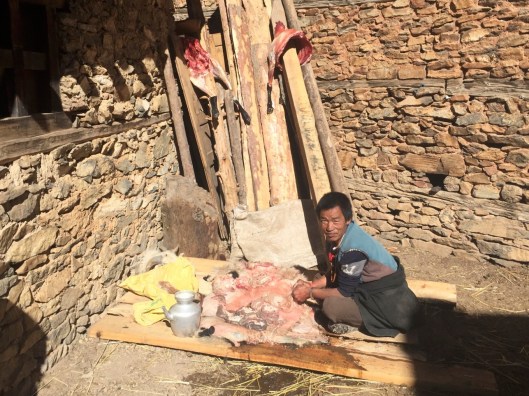
It began quietly enough with delicious egg banjos being served with tea. The banjos were omelettes rather than fried eggs between 2 slices of Nepali bread and they were going down very well. Until, that is, there was a bit a commotion outside. Further investigation revealed it was a sheep making a fuss in the courtyard; and not just any sheep but our sheep. Sure enough the sheep of which we had bought half the previous evening had just been swiftly despatched, skinned, butchered and halved. Each half was now drying on the end of a plank of wood in the corner of the enclosure where yesterday the yaks had been snuffling. Meanwhile the butcher, the owner of our guesthouse-cum-hotel, was cleaning the entrails and the fleece on a wooden platform close by where he could attempt to keep the flies off of the meat.
After breakfast and our introduction to the realities of butchery in Dolpo, in mid-morning while Mark went in search of photographs Tim, Jovi, Lizzie and I went to the lake for a wash. Passing to our left the site of our post-San Miguel disorientation yesterday evening we once more faced the limpid Lake Phoksundo.
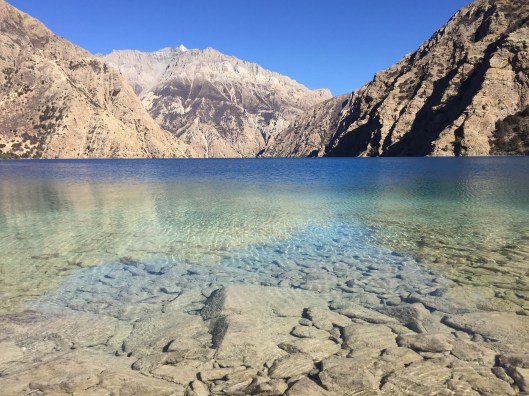
Unseen in the photo above there was a Bön temple on a promontary to the right. The Bön religion pre-dates buddhism and is believed to have arisen in the 11th century. While Tibetan people and those of Tibetan ancestry such as the Dolpopa are predominantly Buddhist it is estimated that around 10%, known as Bonpo, follow Bön. These include the people of Ringmo.
At our side of the lake, a sensible distance from the outflow river – the Phoksundo Khola, we enjoyed the water’s freshness. Variously washing ourselves and our exceptionally grubby clothes we established discreet distances along the bank. My underpants were sensible black and had a similar cut to normal swimming trunks so I stripped to them and to the amusement of the others waded into the lake. To their astonishment I then submerged and, trying to make light of the effect the cold was having (the water having recently arrived from the icy mountain streams on either side) bobbed around for a while. This was my first all-over wash since the ‘stand-in-a-bucket’ event that resulted in my foot going into the long-drop toilet in Saldang and a less than relaxing wash. Sure, the lake was freezing cold but I felt clean for the first time in ages and was soon back on the bank drying off, supressing a shiver or two. With clean pants donned I lay like a large pink lizard on a large flat rock while my washing dried. After 30 minutes or so we were joined by Gyalbu and Sangye and chatted in the sunshine.
Shortly after noon someone suggested refreshment. Although lunch wasn’t long away such treats shouldn’t be missed when you’re not sure when the next may arise and adjoining the restaurant visited yesterday there was a small shop. Amid speculation as to whether biscuits, chocolate, or perchance another chilled San Miguel, were to be found we headed uphill as though we hadn’t seen a shop for weeks. The last we had seen was in Kagbeni at the start of the trek nearly 3 weeks before. Although we had made good use of the travelling tent-shop in Shimen just a week ago that seemed a long distant memory, being several passes and adventures in the past.
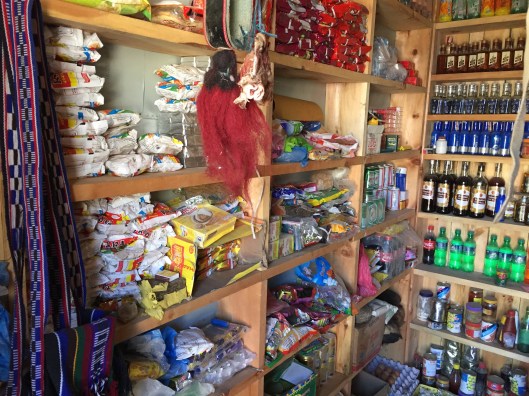
It was now clear from the sign above the door, proudly announcing in English, Nepali and Tibetan that this was the ‘Kanjirowa Traders & Suppliers with Restaurant’. Inside we found Dolpo retail heaven. There were drinks aplenty including bottled San Miguel and canned Lhasa beer. There was Ruslan vodka and Pepsi in cans, Frooti fruit juice, plastic bottles of Coca-Cola, Fanta and Sprite. There were bottles labeled ‘Virgin’ that I don’t think was oil. There was Khukri rum from Kathmandu. There was even Royal Stag, an Indian whisky. I mention this as it was so unexpected. There is not a road for miles and all of this must have been brought in on foot. But never mind the drinks. There were other more useful things too such as, to mention but a few, torches and batteries, lighters, crisps and other dry snacks, pony harnesses and adornment including a red-dyed yak’s tail, locally woven scarves, tins of vegetables, jars of peanut butter, trays of eggs, and clothing including trainers, flip-flops and more beside.
But I have left the best to last. An item of sustenance and joy that I last enjoyed many days ago and which is my staple mountain snack. The shop had just one, for an amazing 150 rupees (that’s about £1.10p). It needs no further introduction (cue drum roll…..)
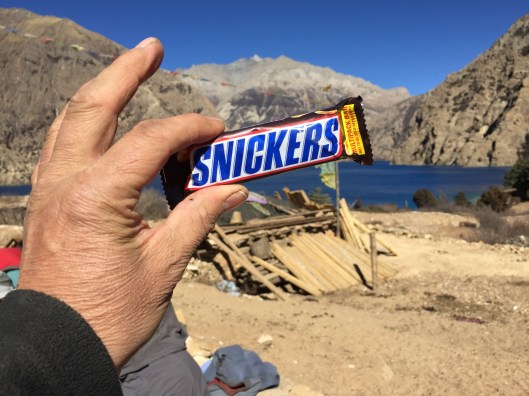
Yessss! Cleaned from the lake and wearing fresh clothes, warmed by the sun, in the company of great trekking buddies, refreshed by chilled beer (Lhasa on this occasion) and munching a Snickers. Does it get better than that?
Next to the shop was a tent in front of which 3 people were working. A woman in a purple jacket and black dress was sat cross-legged on the ground spinning yarn. Next to her on stools was the a couple we first saw in the the hotel kitchen/diner yesterday. Then they were preparing food and the woman was memorable as she was wearing strident green trousers and a pink jacket. Now she and her partner, also dressed exactly as previously, were making rugs in the sunshine. The photo below shows the scene. It is not my finest as the colourful lady is obscured by our horseman but hopefully youl’ll get the gist.
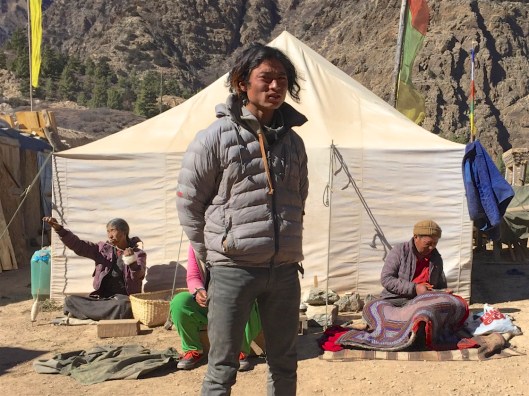
We were then shown into the tent and there were about two dozen chickens inside. The mystery of the appearance of the eggs had been solved. This part of Ringmo was a veritable hive of activity.
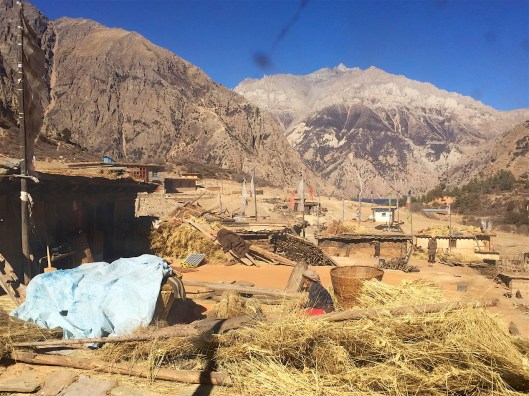
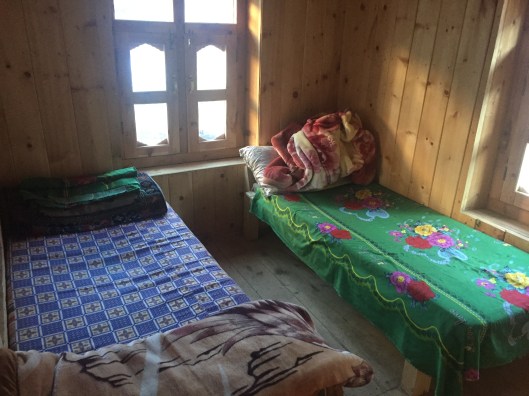
After a lunch of fried lamb (ours) and more wonderful Nepali bread I put my solar charger on the roof to ensure my camera had power for the next few days. Actually that was my iPhone but coverage was a rarity so it was never turned on. I then took out my contact lenses to give my eyes a break for the first time in several days and spent an hour or so re-packing my main bag so that the items needed during the last days of the trek were to the top. Through the window of our room I had a good view onto the roof next door where women were making ‘corn dollies’ although the significance of this would not become clear until later.
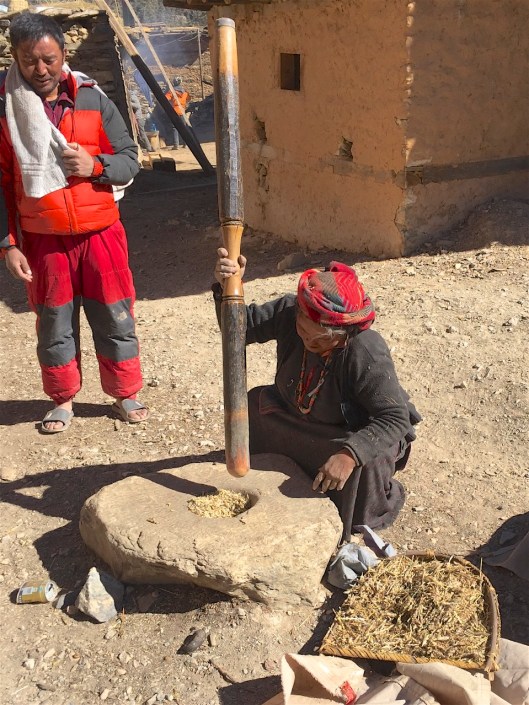
Down in the courtyard before dinner Gyalbu and I found the matronly lady who greeted us upon our arrival working. She was grinding grain with a sizeable decorated pole in a hollowed out slab of stone in the same way we might grind pepper in a pestle and mortar.
Before dinner in the hotel we were joined by a travelling Dolpo-pa businessman. He was from Dho Tarap 20 miles or so away to the east. That town of over a 1000 people used to be the capaital of Dolpo before the region was annexed by the King of Gorkha in the 17th century. We had not visited Dho but passed within about 10 miles of it when heading north from Chharka Bhot towards Tinje just over a week previously. He was trying to establish tea houses and other services for trekkers in Dolpo so that local people could generate more income. He was concerned that while trekking was on the increase the revenue generated by the compulsory purchase of trekking permits went to the government and was not ploughed back. He went on to say, and I have no corroborative evidence but report just what he said, that in many villages where health posts, post offices or schools (for example) are built by foreign aid they frequently fall into disuse. This was because they were often not supported with Nepalese government funding to pay staff to run or maintain them.
At dinner the hotel owner and his wife were joined by their daughter and son, his son’s wife and their child, and by the matronly lady I saw grinding grain earlier. These were the same people we had with us at dinner the previous day, with the addition of the child. The child caused much amusement by running around the kitched with sheep intenstines on a stick occasionally touching the stove to cook it, in the same way children elsewhere might do with dough on a green twig around a campfire. To complete the picture, and don’t read this while eating, handkerchiefs and tissues have no place here and the child’s runny nose was cleared from its face with a deft lick from Mum. Meanwhile the owner, that is the man who butchered the sheep in the morning, refined his work on the floor with the meat on a plastic grain sack. Oblivious to all this the lady of the house quietly sang songs while spinning yarn by the warmth of the stove.
After a while we were joined by the travelling businessman’s 16 year old son, Urker. He told me that he would leave Dho Tarap for school in Kathmandu the following year and he would be there for 5 years. He then showed me his swollen thumb which he had broken several days ago when he fell from a horse. I asked him if he liked football and he said that he had never played, nor watched, a game of football. Some of his friends had seen football on TV but he hadn’t. While there were some families in Dho with a television his family didn’t own one as his father disapproved. Urker said that when he left school he would become a monk in Kathmandu like his older brother. His older sister was working in Kathmandu now and he could join her but he wanted to be a monk. He was interested in my life and work and smiled broadly when I showed him photographs of my wife, children and grand-children. We had quite a chat before he was taken to his room by his his father. His passing comment was that he thought Chinese clothing was rubbish because it didn’t last. I was left to reflect and be very grateful indeed for the opportunity to meet that young man who, without formal schooling, spoke very passable English in addition to his native Nepalese and the Tibetan of his ancesters. Good luck Urker.
Following a very tasty dinner of lamb and potatoes and a more modest amount of Roxy than Friday evening it was time for bed. The women were still at work on the roof next door, now illuminated by 3 battery-powered lightbulbs. There were 4 people in a square alternately threshing barley by hand in the weak light. The rythmic threshing was quite restful which was just as well as it went on all night. These people were working 24/7 with only short breaks to try and finish the harvesting over the next 2 weeks as by then the weather would have closed in and they must leave Ringmo. Once more I was stunned by the hardship of life in this region. Even some of the residents of Ringmo, on the face of it and by Dolpo standards a relatively prosperous village, were transhumant. Despite the increasing revenue from tourism as evidenced by the new hotel, the restaurant with its remarkable shop, and the climate being more clement than further north, some people in Ringmo cannot sustain themselves during winter and will by early December join the annual exodus south.
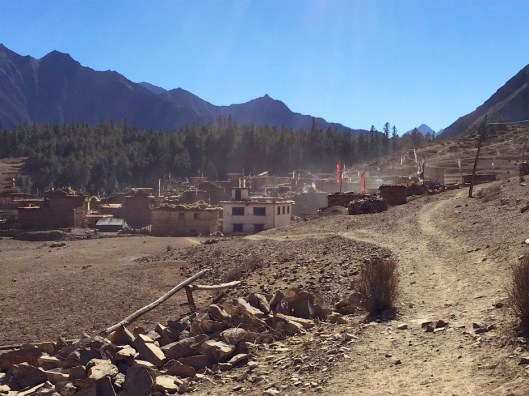 Characteristically dry and dusty under a sky as blue and crystal clear as the lake Ringmo nestles on the banks of the Phoksundo Khola on what is becoming one of the most popular trekking routes in Dolpo. While electricity remains provided entirely by solar power there is one telephone, presumably in the post office which must have been cunningly concealed. Such is the hope of the residents that a new hotel has been built by the headman to attract more visitors.
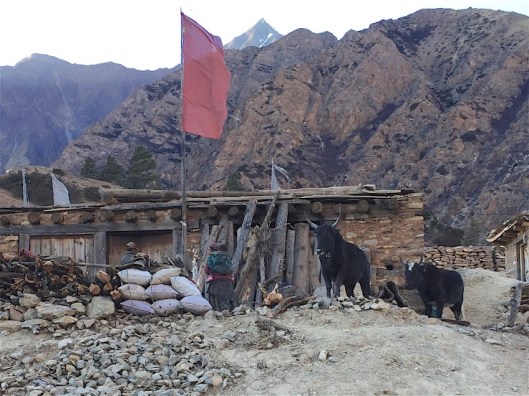
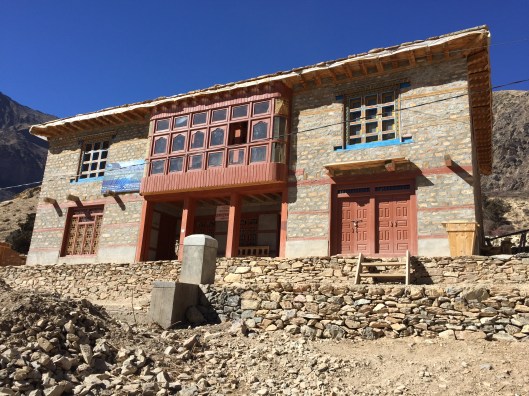 I understand there were enquiries made by the owner when he learned we weren’t staying there, instead electing to spend a couple of nights with another family who had added bedrooms to their existing house and called it a ‘hotel’ and which was recommended by our horseman. Leaving to one side the basis for that recommendation, while the new hotel stood on high ground with a pleasing view over the village and its surroundings, our chosen abode had more homely qualities; think rustic guesthouse. Reached down a series of alleyways between low, flat-roofed stone buildings variously housing people, yaks and grain, and often all three, dodging goats and inquisitive grubby children we were led to an open courtyard.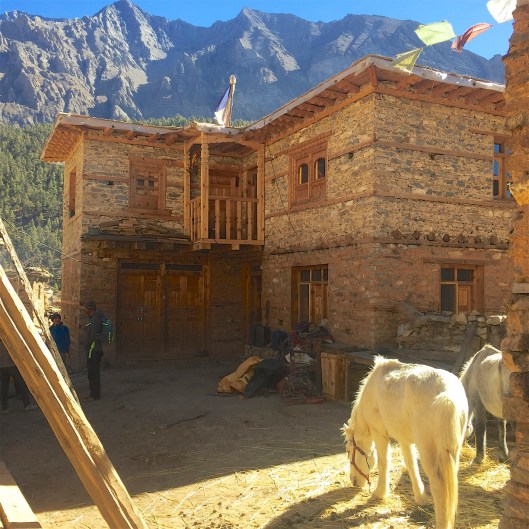
 Andy James